

structures (in the order of few km) displaying submesoscale variability (in the order
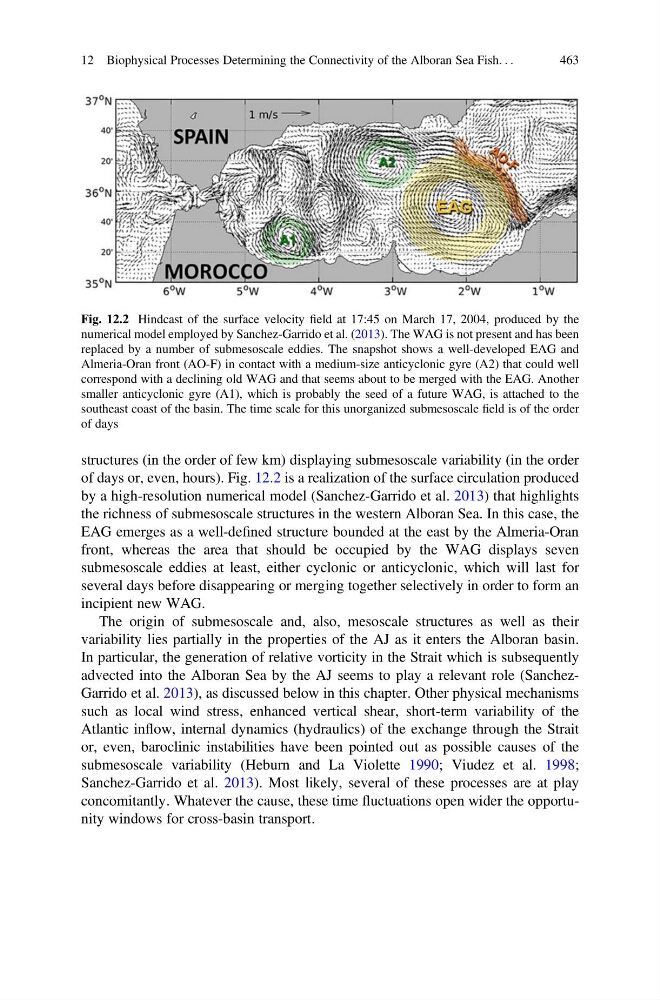
of days or, even, hours). Fig. 12.2 is a realization of the surface circulation produced
by a high-resolution numerical model (Sanchez-Garrido et al. 2013) that highlights
the richness of submesoscale structures in the western Alboran Sea. In this case, the
EAG emerges as a well-defined structure bounded at the east by the Almeria-Oran
front, whereas the area that should be occupied by the WAG displays seven
submesoscale eddies at least, either cyclonic or anticyclonic, which will last for
several days before disappearing or merging together selectively in order to form an
incipient new WAG.
The origin of submesoscale and, also, mesoscale structures as well as their
variability lies partially in the properties of the AJ as it enters the Alboran basin.
In particular, the generation of relative vorticity in the Strait which is subsequently
advected into the Alboran Sea by the AJ seems to play a relevant role (SanchezGarrido et al. 2013), as discussed below in this chapter. Other physical mechanisms
such as local wind stress, enhanced vertical shear, short-term variability of the
Atlantic inflow, internal dynamics (hydraulics) of the exchange through the Strait
or, even, baroclinic instabilities have been pointed out as possible causes of the
submesoscale variability (Heburn and La Violette 1990; Viudez et al. 1998;
Sanchez-Garrido et al. 2013). Most likely, several of these processes are at play
concomitantly. Whatever the cause, these time fluctuations open wider the opportunity windows for cross-basin transport.
Fig. 12.2 Hindcast of the surface velocity field at 17:45 on March 17, 2004, produced by the
numerical model employed by Sanchez-Garrido et al. (2013). The WAG is not present and has been
replaced by a number of submesoscale eddies. The snapshot shows a well-developed EAG and
Almeria-Oran front (AO-F) in contact with a medium-size anticyclonic gyre (A2) that could well
correspond with a declining old WAG and that seems about to be merged with the EAG. Another
smaller anticyclonic gyre (A1), which is probably the seed of a future WAG, is attached to the
southeast coast of the basin. The time scale for this unorganized submesoscale field is of the order
of days
12 Biophysical Processes Determining the Connectivity of the Alboran Sea Fish. . .
463
of days or, even, hours). Fig. 12.2 is a realization of the surface circulation produced
by a high-resolution numerical model (Sanchez-Garrido et al. 2013) that highlights
the richness of submesoscale structures in the western Alboran Sea. In this case, the
EAG emerges as a well-defined structure bounded at the east by the Almeria-Oran
front, whereas the area that should be occupied by the WAG displays seven
submesoscale eddies at least, either cyclonic or anticyclonic, which will last for
several days before disappearing or merging together selectively in order to form an
incipient new WAG.
The origin of submesoscale and, also, mesoscale structures as well as their
variability lies partially in the properties of the AJ as it enters the Alboran basin.
In particular, the generation of relative vorticity in the Strait which is subsequently
advected into the Alboran Sea by the AJ seems to play a relevant role (SanchezGarrido et al. 2013), as discussed below in this chapter. Other physical mechanisms
such as local wind stress, enhanced vertical shear, short-term variability of the
Atlantic inflow, internal dynamics (hydraulics) of the exchange through the Strait
or, even, baroclinic instabilities have been pointed out as possible causes of the
submesoscale variability (Heburn and La Violette 1990; Viudez et al. 1998;
Sanchez-Garrido et al. 2013). Most likely, several of these processes are at play
concomitantly. Whatever the cause, these time fluctuations open wider the opportunity windows for cross-basin transport.
Fig. 12.2 Hindcast of the surface velocity field at 17:45 on March 17, 2004, produced by the
numerical model employed by Sanchez-Garrido et al. (2013). The WAG is not present and has been
replaced by a number of submesoscale eddies. The snapshot shows a well-developed EAG and
Almeria-Oran front (AO-F) in contact with a medium-size anticyclonic gyre (A2) that could well
correspond with a declining old WAG and that seems about to be merged with the EAG. Another
smaller anticyclonic gyre (A1), which is probably the seed of a future WAG, is attached to the
southeast coast of the basin. The time scale for this unorganized submesoscale field is of the order
of days
12 Biophysical Processes Determining the Connectivity of the Alboran Sea Fish. . .
463