

the communities of native species, leaving ecological “niches” available. In this
sense, the introduced hermit Pagurus mbizi has been captured between 50 and 150 m
(maximum frequency over 70 m), depths in which many of the trawlers in the area
normally fish. In concurrence with this view, Froglia et al. (2017) pointed out that
there are major changes in the structure of decapod crustacean communities in the
Adriatic (in the western Meso-Adriatic depression) due to the synergistic action of
fisheries and global change.
11.7 Alien Species
Compared to other parts of the Mediterranean such as the eastern basin, the Adriatic
or the Gulf of Lion, the Alboran Sea has a low incidence of non-indigenous species.
One possible reason lies precisely in the richness and diversity of its indigenous
fauna and flora, which some scholars hold as a factor promoting resistance to
biological invasions (Stachowicz et al. 1999; Kennedy et al. 2002). While about a
thousand exotic species have been recorded in the Mediterranean, only a few
(Caprella scaura, Paracaprella pusilla, Godiva quadricolor, Anteaeolidiella
cacaotica, Marginella glabella, Oculina patagonica, Aplidium lobatum, and
Microcosmus squamiger) are definitely established in the Alboran Sea according
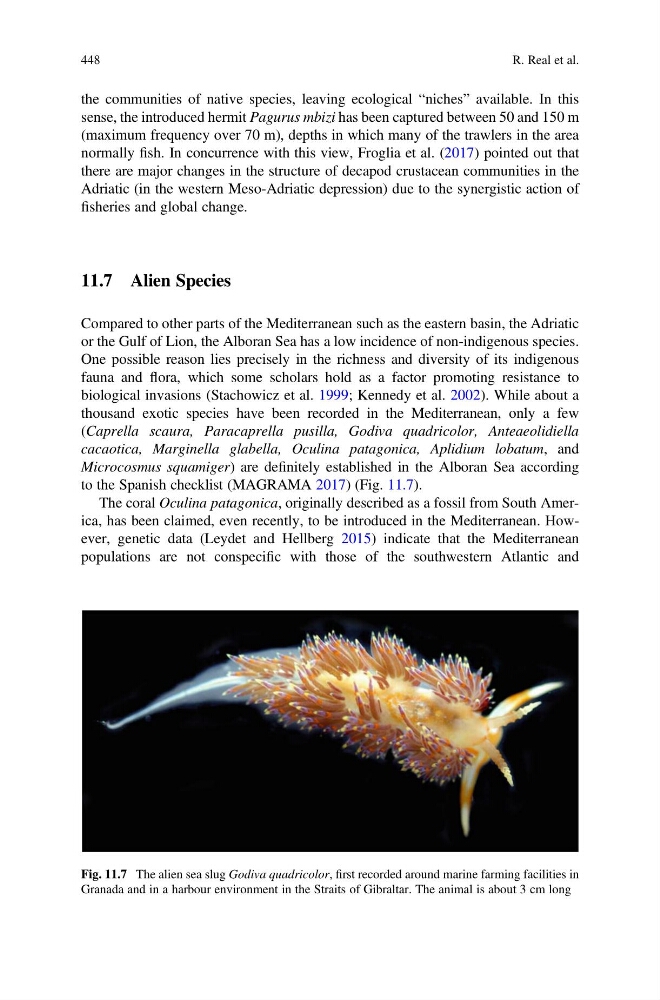
to the Spanish checklist (MAGRAMA 2017) (Fig. 11.7).
The coral Oculina patagonica, originally described as a fossil from South America, has been claimed, even recently, to be introduced in the Mediterranean. However, genetic data (Leydet and Hellberg 2015) indicate that the Mediterranean
populations are not conspecific with those of the southwestern Atlantic and
Fig. 11.7 The alien sea slug Godiva quadricolor, first recorded around marine farming facilities in
Granada and in a harbour environment in the Straits of Gibraltar. The animal is about 3 cm long
448
R. Real et al.
sense, the introduced hermit Pagurus mbizi has been captured between 50 and 150 m
(maximum frequency over 70 m), depths in which many of the trawlers in the area
normally fish. In concurrence with this view, Froglia et al. (2017) pointed out that
there are major changes in the structure of decapod crustacean communities in the
Adriatic (in the western Meso-Adriatic depression) due to the synergistic action of
fisheries and global change.
11.7 Alien Species
Compared to other parts of the Mediterranean such as the eastern basin, the Adriatic
or the Gulf of Lion, the Alboran Sea has a low incidence of non-indigenous species.
One possible reason lies precisely in the richness and diversity of its indigenous
fauna and flora, which some scholars hold as a factor promoting resistance to
biological invasions (Stachowicz et al. 1999; Kennedy et al. 2002). While about a
thousand exotic species have been recorded in the Mediterranean, only a few
(Caprella scaura, Paracaprella pusilla, Godiva quadricolor, Anteaeolidiella
cacaotica, Marginella glabella, Oculina patagonica, Aplidium lobatum, and
Microcosmus squamiger) are definitely established in the Alboran Sea according
to the Spanish checklist (MAGRAMA 2017) (Fig. 11.7).
The coral Oculina patagonica, originally described as a fossil from South America, has been claimed, even recently, to be introduced in the Mediterranean. However, genetic data (Leydet and Hellberg 2015) indicate that the Mediterranean
populations are not conspecific with those of the southwestern Atlantic and
Fig. 11.7 The alien sea slug Godiva quadricolor, first recorded around marine farming facilities in
Granada and in a harbour environment in the Straits of Gibraltar. The animal is about 3 cm long
448
R. Real et al.