

Paleomediterranean population, which adapted and persisted during this salinity
crisis and that may have participated in the repopulation of the current Mediterranean
since the Pliocene.
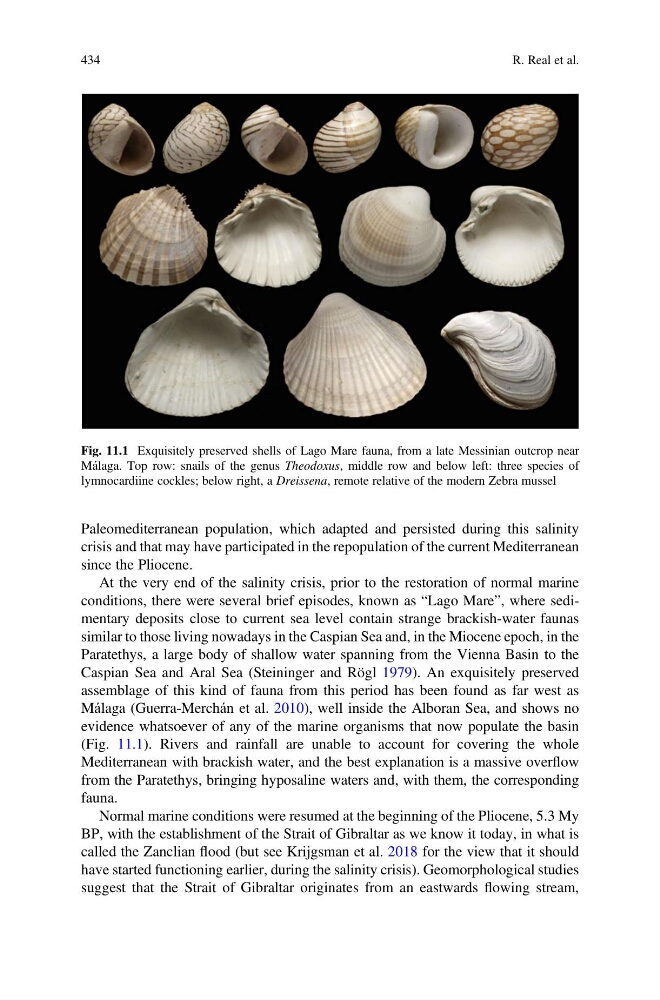
At the very end of the salinity crisis, prior to the restoration of normal marine
conditions, there were several brief episodes, known as “Lago Mare”, where sedimentary deposits close to current sea level contain strange brackish-water faunas
similar to those living nowadays in the Caspian Sea and, in the Miocene epoch, in the
Paratethys, a large body of shallow water spanning from the Vienna Basin to the
Caspian Sea and Aral Sea (Steininger and Rögl 1979). An exquisitely preserved
assemblage of this kind of fauna from this period has been found as far west as
Málaga (Guerra-Merchán et al. 2010), well inside the Alboran Sea, and shows no
evidence whatsoever of any of the marine organisms that now populate the basin
(Fig. 11.1). Rivers and rainfall are unable to account for covering the whole
Mediterranean with brackish water, and the best explanation is a massive overflow
from the Paratethys, bringing hyposaline waters and, with them, the corresponding
fauna.
Normal marine conditions were resumed at the beginning of the Pliocene, 5.3 My
BP, with the establishment of the Strait of Gibraltar as we know it today, in what is
called the Zanclian flood (but see Krijgsman et al. 2018 for the view that it should
have started functioning earlier, during the salinity crisis). Geomorphological studies
suggest that the Strait of Gibraltar originates from an eastwards flowing stream,
Fig. 11.1 Exquisitely preserved shells of Lago Mare fauna, from a late Messinian outcrop near
Málaga. Top row: snails of the genus Theodoxus, middle row and below left: three species of
lymnocardiine cockles; below right, a Dreissena, remote relative of the modern Zebra mussel
434
R. Real et al.
crisis and that may have participated in the repopulation of the current Mediterranean
since the Pliocene.
At the very end of the salinity crisis, prior to the restoration of normal marine
conditions, there were several brief episodes, known as “Lago Mare”, where sedimentary deposits close to current sea level contain strange brackish-water faunas
similar to those living nowadays in the Caspian Sea and, in the Miocene epoch, in the
Paratethys, a large body of shallow water spanning from the Vienna Basin to the
Caspian Sea and Aral Sea (Steininger and Rögl 1979). An exquisitely preserved
assemblage of this kind of fauna from this period has been found as far west as
Málaga (Guerra-Merchán et al. 2010), well inside the Alboran Sea, and shows no
evidence whatsoever of any of the marine organisms that now populate the basin
(Fig. 11.1). Rivers and rainfall are unable to account for covering the whole
Mediterranean with brackish water, and the best explanation is a massive overflow
from the Paratethys, bringing hyposaline waters and, with them, the corresponding
fauna.
Normal marine conditions were resumed at the beginning of the Pliocene, 5.3 My
BP, with the establishment of the Strait of Gibraltar as we know it today, in what is
called the Zanclian flood (but see Krijgsman et al. 2018 for the view that it should
have started functioning earlier, during the salinity crisis). Geomorphological studies
suggest that the Strait of Gibraltar originates from an eastwards flowing stream,
Fig. 11.1 Exquisitely preserved shells of Lago Mare fauna, from a late Messinian outcrop near
Málaga. Top row: snails of the genus Theodoxus, middle row and below left: three species of
lymnocardiine cockles; below right, a Dreissena, remote relative of the modern Zebra mussel
434
R. Real et al.