

et al. 2006b) and is likely to be present in the Alboran Sea. Furthermore, the West
Atlantic species Phanopathes rigida (Fig. 10.11) has been recently observed in the
Cabliers Coral Mound, where it is abundant and dominates in its northern sector
mainly in the depth range of 300–440 m (Corbera et al. 2019).
Antipatharians were rarely found shallower than 50 m, while the majority occurs
in the depth range between 100 and 300 m, only on rocky slopes and isolated shoals.
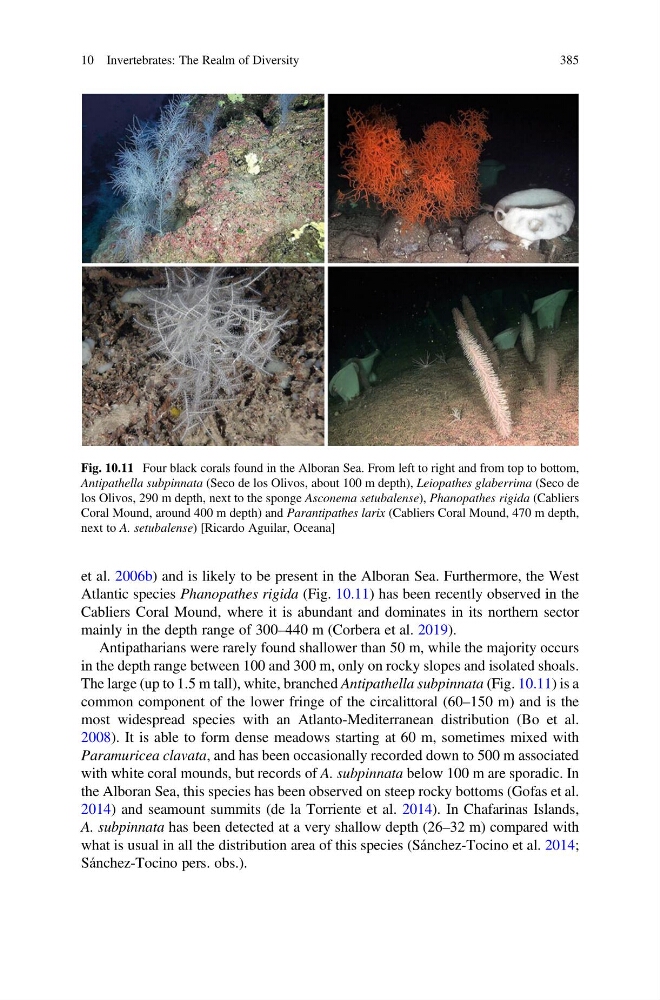
The large (up to 1.5 m tall), white, branched Antipathella subpinnata (Fig. 10.11) is a
common component of the lower fringe of the circalittoral (60–150 m) and is the
most widespread species with an Atlanto-Mediterranean distribution (Bo et al.
2008). It is able to form dense meadows starting at 60 m, sometimes mixed with
Paramuricea clavata, and has been occasionally recorded down to 500 m associated
with white coral mounds, but records of A. subpinnata below 100 m are sporadic. In
the Alboran Sea, this species has been observed on steep rocky bottoms (Gofas et al.
2014) and seamount summits (de la Torriente et al. 2014). In Chafarinas Islands,
A. subpinnata has been detected at a very shallow depth (26–32 m) compared with
what is usual in all the distribution area of this species (Sánchez-Tocino et al. 2014;
Sánchez-Tocino pers. obs.).
Fig. 10.11 Four black corals found in the Alboran Sea. From left to right and from top to bottom,
Antipathella subpinnata (Seco de los Olivos, about 100 m depth), Leiopathes glaberrima (Seco de
los Olivos, 290 m depth, next to the sponge Asconema setubalense), Phanopathes rigida (Cabliers
Coral Mound, around 400 m depth) and Parantipathes larix (Cabliers Coral Mound, 470 m depth,
next to A. setubalense) [Ricardo Aguilar, Oceana]
10 Invertebrates: The Realm of Diversity
385
Atlantic species Phanopathes rigida (Fig. 10.11) has been recently observed in the
Cabliers Coral Mound, where it is abundant and dominates in its northern sector
mainly in the depth range of 300–440 m (Corbera et al. 2019).
Antipatharians were rarely found shallower than 50 m, while the majority occurs
in the depth range between 100 and 300 m, only on rocky slopes and isolated shoals.
The large (up to 1.5 m tall), white, branched Antipathella subpinnata (Fig. 10.11) is a
common component of the lower fringe of the circalittoral (60–150 m) and is the
most widespread species with an Atlanto-Mediterranean distribution (Bo et al.
2008). It is able to form dense meadows starting at 60 m, sometimes mixed with
Paramuricea clavata, and has been occasionally recorded down to 500 m associated
with white coral mounds, but records of A. subpinnata below 100 m are sporadic. In
the Alboran Sea, this species has been observed on steep rocky bottoms (Gofas et al.
2014) and seamount summits (de la Torriente et al. 2014). In Chafarinas Islands,
A. subpinnata has been detected at a very shallow depth (26–32 m) compared with
what is usual in all the distribution area of this species (Sánchez-Tocino et al. 2014;
Sánchez-Tocino pers. obs.).
Fig. 10.11 Four black corals found in the Alboran Sea. From left to right and from top to bottom,
Antipathella subpinnata (Seco de los Olivos, about 100 m depth), Leiopathes glaberrima (Seco de
los Olivos, 290 m depth, next to the sponge Asconema setubalense), Phanopathes rigida (Cabliers
Coral Mound, around 400 m depth) and Parantipathes larix (Cabliers Coral Mound, 470 m depth,
next to A. setubalense) [Ricardo Aguilar, Oceana]
10 Invertebrates: The Realm of Diversity
385