

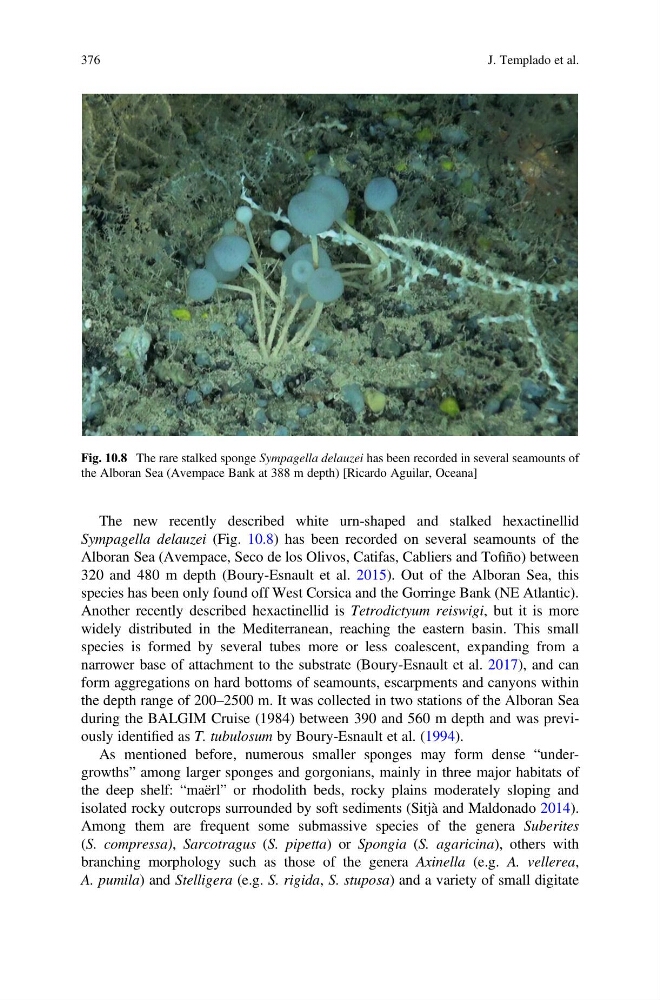
The new recently described white urn-shaped and stalked hexactinellid
Sympagella delauzei (Fig. 10.8) has been recorded on several seamounts of the
Alboran Sea (Avempace, Seco de los Olivos, Catifas, Cabliers and Tofiño) between
320 and 480 m depth (Boury-Esnault et al. 2015). Out of the Alboran Sea, this
species has been only found off West Corsica and the Gorringe Bank (NE Atlantic).
Another recently described hexactinellid is Tetrodictyum reiswigi, but it is more
widely distributed in the Mediterranean, reaching the eastern basin. This small
species is formed by several tubes more or less coalescent, expanding from a
narrower base of attachment to the substrate (Boury-Esnault et al. 2017), and can
form aggregations on hard bottoms of seamounts, escarpments and canyons within
the depth range of 200–2500 m. It was collected in two stations of the Alboran Sea
during the BALGIM Cruise (1984) between 390 and 560 m depth and was previously identified as T. tubulosum by Boury-Esnault et al. (1994).
As mentioned before, numerous smaller sponges may form dense “undergrowths” among larger sponges and gorgonians, mainly in three major habitats of
the deep shelf: “maërl” or rhodolith beds, rocky plains moderately sloping and
isolated rocky outcrops surrounded by soft sediments (Sitjà and Maldonado 2014).
Among them are frequent some submassive species of the genera Suberites
(S. compressa), Sarcotragus (S. pipetta) or Spongia (S. agaricina), others with
branching morphology such as those of the genera Axinella (e.g. A. vellerea,
A. pumila) and Stelligera (e.g. S. rigida, S. stuposa) and a variety of small digitate
Fig. 10.8 The rare stalked sponge Sympagella delauzei has been recorded in several seamounts of
the Alboran Sea (Avempace Bank at 388 m depth) [Ricardo Aguilar, Oceana]
376
J. Templado et al.
Sympagella delauzei (Fig. 10.8) has been recorded on several seamounts of the
Alboran Sea (Avempace, Seco de los Olivos, Catifas, Cabliers and Tofiño) between
320 and 480 m depth (Boury-Esnault et al. 2015). Out of the Alboran Sea, this
species has been only found off West Corsica and the Gorringe Bank (NE Atlantic).
Another recently described hexactinellid is Tetrodictyum reiswigi, but it is more
widely distributed in the Mediterranean, reaching the eastern basin. This small
species is formed by several tubes more or less coalescent, expanding from a
narrower base of attachment to the substrate (Boury-Esnault et al. 2017), and can
form aggregations on hard bottoms of seamounts, escarpments and canyons within
the depth range of 200–2500 m. It was collected in two stations of the Alboran Sea
during the BALGIM Cruise (1984) between 390 and 560 m depth and was previously identified as T. tubulosum by Boury-Esnault et al. (1994).
As mentioned before, numerous smaller sponges may form dense “undergrowths” among larger sponges and gorgonians, mainly in three major habitats of
the deep shelf: “maërl” or rhodolith beds, rocky plains moderately sloping and
isolated rocky outcrops surrounded by soft sediments (Sitjà and Maldonado 2014).
Among them are frequent some submassive species of the genera Suberites
(S. compressa), Sarcotragus (S. pipetta) or Spongia (S. agaricina), others with
branching morphology such as those of the genera Axinella (e.g. A. vellerea,
A. pumila) and Stelligera (e.g. S. rigida, S. stuposa) and a variety of small digitate
Fig. 10.8 The rare stalked sponge Sympagella delauzei has been recorded in several seamounts of
the Alboran Sea (Avempace Bank at 388 m depth) [Ricardo Aguilar, Oceana]
376
J. Templado et al.