

lobster (Homarus americanus). Nevertheless, molecular studies show that more
cryptic species can exist (Obst et al. 2005; Baker and Giribet 2007). Symbion
pandora is widely distributed in the eastern Atlantic and has been also recorded in
NE Spain (Catalonian coast), in the Tyrrhenian Sea and in the Alboran Sea (Granada
coast, Sánchez-Tocino and Tierno de Figueroa 2008) living on the mouthpieces of
the lobster Nephrops norvegicus.
10.2.6 Entoprocta
Only very few, small and poorly known species of the phylum Entoprocta are known
in the Mediterranean Sea, all of them belonging to the family Loxosomatidae.
Recently two new species of this small animal group have been described from the
shores of Granada: Loxosomella ameliae and Loxosomella almugnecarensis
(by Sánchez-Tocino and Tierno de Figueroa 2009a and Tierno de Figueroa and
Sánchez-Tocino 2009a, respectively). Furthermore, three other species of
Loxosomella have been recorded by these authors in the same area: L. crassicauda
(Tierno de Figueroa and Sánchez-Tocino 2008), L. pes (Sánchez-Tocino and Tierno
de Figueroa 2009a) and L. tethyae (Tierno de Figueroa and Sánchez-Tocino 2009b).
All of them are tiny (<5 mm), sessile stalked animals, commensal mainly on
sponges. Three of these species have been also found in the Chafarinas Islands,
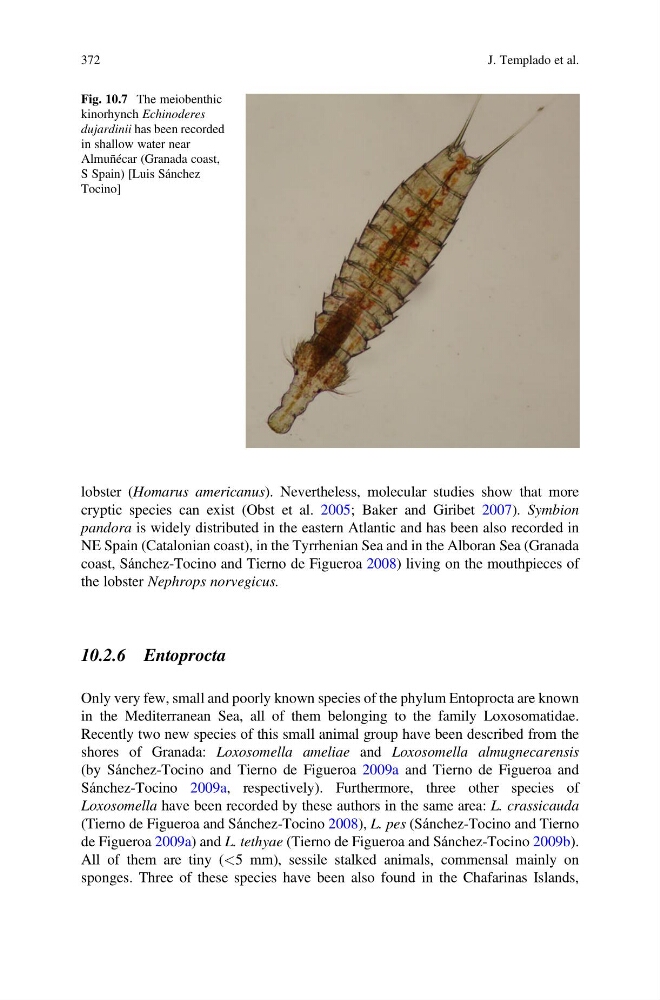
Fig. 10.7 The meiobenthic
kinorhynch Echinoderes
dujardinii has been recorded
in shallow water near
Almuñécar (Granada coast,
S Spain) [Luis Sánchez
Tocino]
372
J. Templado et al.
cryptic species can exist (Obst et al. 2005; Baker and Giribet 2007). Symbion
pandora is widely distributed in the eastern Atlantic and has been also recorded in
NE Spain (Catalonian coast), in the Tyrrhenian Sea and in the Alboran Sea (Granada
coast, Sánchez-Tocino and Tierno de Figueroa 2008) living on the mouthpieces of
the lobster Nephrops norvegicus.
10.2.6 Entoprocta
Only very few, small and poorly known species of the phylum Entoprocta are known
in the Mediterranean Sea, all of them belonging to the family Loxosomatidae.
Recently two new species of this small animal group have been described from the
shores of Granada: Loxosomella ameliae and Loxosomella almugnecarensis
(by Sánchez-Tocino and Tierno de Figueroa 2009a and Tierno de Figueroa and
Sánchez-Tocino 2009a, respectively). Furthermore, three other species of
Loxosomella have been recorded by these authors in the same area: L. crassicauda
(Tierno de Figueroa and Sánchez-Tocino 2008), L. pes (Sánchez-Tocino and Tierno
de Figueroa 2009a) and L. tethyae (Tierno de Figueroa and Sánchez-Tocino 2009b).
All of them are tiny (<5 mm), sessile stalked animals, commensal mainly on
sponges. Three of these species have been also found in the Chafarinas Islands,
Fig. 10.7 The meiobenthic
kinorhynch Echinoderes
dujardinii has been recorded
in shallow water near
Almuñécar (Granada coast,
S Spain) [Luis Sánchez
Tocino]
372
J. Templado et al.