

D. fallax in bathyal bottoms south of Malta (Strait of Sicily) and in the Seco de los
Olivos. Later, López-González and Cunha (2010) described these specimens
together with others obtained in the Gulf of Cadiz and in Al Idrisi Seamount
(Djibouti Plateau) as a new species (D. bonsai). More recently, Sartoretto (2012)
noted the presence of this species in five submarine canyons between 200 and 500 m
depth on the western coast of Corsica, mainly along the rocky walls and overhangs
of high cliffs. Likewise de la Torriente et al. (2014, 2018) and Ocaña et al. (2017)
found some colonies of D. bonsai in Catifas Bank and Seco de los Olivos between
380 and 450 m. Another small Atlantic gorgonian, Nicella granifera (Fig. 10.4), has
been recently found for the first time in the Mediterranean in the Seco de los Olivos
at 430 m depth (Ocaña et al. 2017) and then in the Emile Baudot Seamount in the
Balearic Promontory (Ricardo Aguilar, pers. obs.).
Species belonging to the genus Anthomastus were recently recorded in the
Cabliers and the Seco de los Olivos Banks (Pardo et al. 2011; de la Torriente et al.
2014, respectively). These deep-sea mushroom corals were previously known from
the Indo-Pacific, Atlantic and Antarctic waters (Molodtsova 2013), mainly associated to seamounts and knolls, and are very easily distinguished by their external
appearance with reddish tones and huge expanded autozooids, which are specialized
in feeding. The records of species of this genus in the Alboran Sea expand its
distribution to the Mediterranean Sea. In both Cabliers and Seco de los Olivos
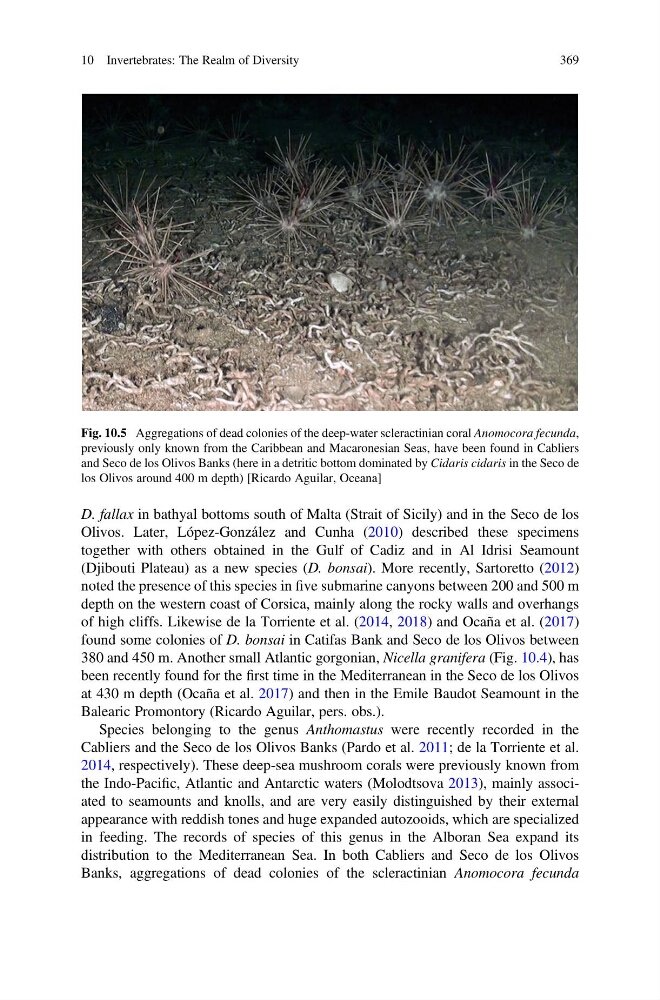
Banks, aggregations of dead colonies of the scleractinian Anomocora fecunda
Fig. 10.5 Aggregations of dead colonies of the deep-water scleractinian coral Anomocora fecunda,
previously only known from the Caribbean and Macaronesian Seas, have been found in Cabliers
and Seco de los Olivos Banks (here in a detritic bottom dominated by Cidaris cidaris in the Seco de
los Olivos around 400 m depth) [Ricardo Aguilar, Oceana]
10 Invertebrates: The Realm of Diversity
369
Olivos. Later, López-González and Cunha (2010) described these specimens
together with others obtained in the Gulf of Cadiz and in Al Idrisi Seamount
(Djibouti Plateau) as a new species (D. bonsai). More recently, Sartoretto (2012)
noted the presence of this species in five submarine canyons between 200 and 500 m
depth on the western coast of Corsica, mainly along the rocky walls and overhangs
of high cliffs. Likewise de la Torriente et al. (2014, 2018) and Ocaña et al. (2017)
found some colonies of D. bonsai in Catifas Bank and Seco de los Olivos between
380 and 450 m. Another small Atlantic gorgonian, Nicella granifera (Fig. 10.4), has
been recently found for the first time in the Mediterranean in the Seco de los Olivos
at 430 m depth (Ocaña et al. 2017) and then in the Emile Baudot Seamount in the
Balearic Promontory (Ricardo Aguilar, pers. obs.).
Species belonging to the genus Anthomastus were recently recorded in the
Cabliers and the Seco de los Olivos Banks (Pardo et al. 2011; de la Torriente et al.
2014, respectively). These deep-sea mushroom corals were previously known from
the Indo-Pacific, Atlantic and Antarctic waters (Molodtsova 2013), mainly associated to seamounts and knolls, and are very easily distinguished by their external
appearance with reddish tones and huge expanded autozooids, which are specialized
in feeding. The records of species of this genus in the Alboran Sea expand its
distribution to the Mediterranean Sea. In both Cabliers and Seco de los Olivos
Banks, aggregations of dead colonies of the scleractinian Anomocora fecunda
Fig. 10.5 Aggregations of dead colonies of the deep-water scleractinian coral Anomocora fecunda,
previously only known from the Caribbean and Macaronesian Seas, have been found in Cabliers
and Seco de los Olivos Banks (here in a detritic bottom dominated by Cidaris cidaris in the Seco de
los Olivos around 400 m depth) [Ricardo Aguilar, Oceana]
10 Invertebrates: The Realm of Diversity
369