

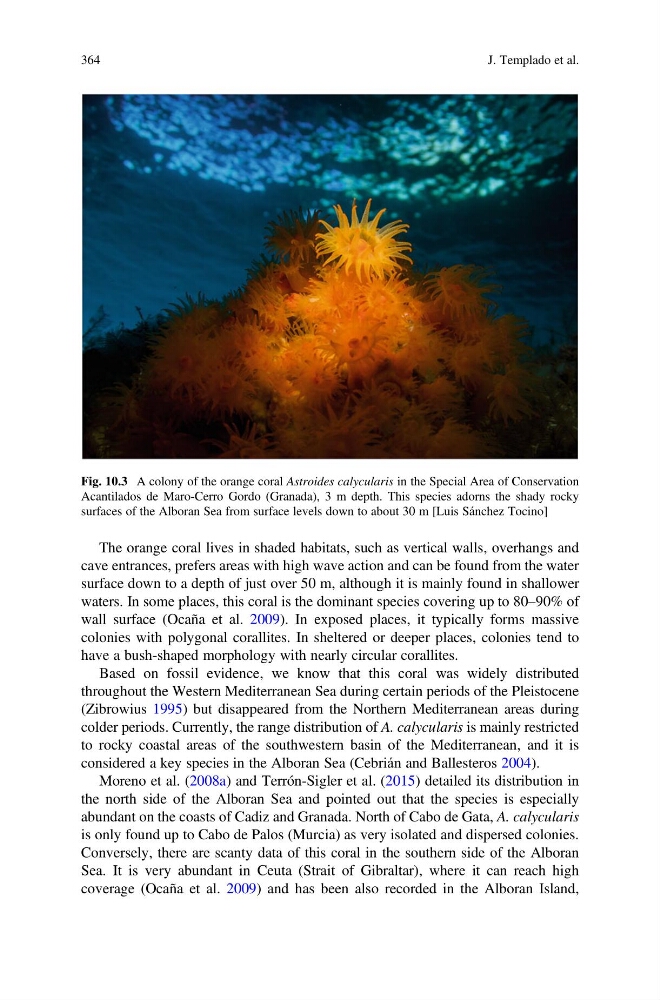
The orange coral lives in shaded habitats, such as vertical walls, overhangs and
cave entrances, prefers areas with high wave action and can be found from the water
surface down to a depth of just over 50 m, although it is mainly found in shallower
waters. In some places, this coral is the dominant species covering up to 80–90% of
wall surface (Ocaña et al. 2009). In exposed places, it typically forms massive
colonies with polygonal corallites. In sheltered or deeper places, colonies tend to
have a bush-shaped morphology with nearly circular corallites.
Based on fossil evidence, we know that this coral was widely distributed
throughout the Western Mediterranean Sea during certain periods of the Pleistocene
(Zibrowius 1995) but disappeared from the Northern Mediterranean areas during
colder periods. Currently, the range distribution of A. calycularis is mainly restricted
to rocky coastal areas of the southwestern basin of the Mediterranean, and it is
considered a key species in the Alboran Sea (Cebrián and Ballesteros 2004).
Moreno et al. (2008a) and Terrón-Sigler et al. (2015) detailed its distribution in
the north side of the Alboran Sea and pointed out that the species is especially
abundant on the coasts of Cadiz and Granada. North of Cabo de Gata, A. calycularis
is only found up to Cabo de Palos (Murcia) as very isolated and dispersed colonies.
Conversely, there are scanty data of this coral in the southern side of the Alboran
Sea. It is very abundant in Ceuta (Strait of Gibraltar), where it can reach high
coverage (Ocaña et al. 2009) and has been also recorded in the Alboran Island,
Fig. 10.3 A colony of the orange coral Astroides calycularis in the Special Area of Conservation
Acantilados de Maro-Cerro Gordo (Granada), 3 m depth. This species adorns the shady rocky
surfaces of the Alboran Sea from surface levels down to about 30 m [Luis Sánchez Tocino]
364
J. Templado et al.
cave entrances, prefers areas with high wave action and can be found from the water
surface down to a depth of just over 50 m, although it is mainly found in shallower
waters. In some places, this coral is the dominant species covering up to 80–90% of
wall surface (Ocaña et al. 2009). In exposed places, it typically forms massive
colonies with polygonal corallites. In sheltered or deeper places, colonies tend to
have a bush-shaped morphology with nearly circular corallites.
Based on fossil evidence, we know that this coral was widely distributed
throughout the Western Mediterranean Sea during certain periods of the Pleistocene
(Zibrowius 1995) but disappeared from the Northern Mediterranean areas during
colder periods. Currently, the range distribution of A. calycularis is mainly restricted
to rocky coastal areas of the southwestern basin of the Mediterranean, and it is
considered a key species in the Alboran Sea (Cebrián and Ballesteros 2004).
Moreno et al. (2008a) and Terrón-Sigler et al. (2015) detailed its distribution in
the north side of the Alboran Sea and pointed out that the species is especially
abundant on the coasts of Cadiz and Granada. North of Cabo de Gata, A. calycularis
is only found up to Cabo de Palos (Murcia) as very isolated and dispersed colonies.
Conversely, there are scanty data of this coral in the southern side of the Alboran
Sea. It is very abundant in Ceuta (Strait of Gibraltar), where it can reach high
coverage (Ocaña et al. 2009) and has been also recorded in the Alboran Island,
Fig. 10.3 A colony of the orange coral Astroides calycularis in the Special Area of Conservation
Acantilados de Maro-Cerro Gordo (Granada), 3 m depth. This species adorns the shady rocky
surfaces of the Alboran Sea from surface levels down to about 30 m [Luis Sánchez Tocino]
364
J. Templado et al.