

Ducarme et al. 2013). Although normally large vertebrates monopolized these
species, we selected here as examples three invertebrates: the limpet Patella
ferruginea, the gorgonian Ellisella paraplexauroides and the stony coral Astroides
calycularis.
10.1.1 Patella ferruginea
One of the most emblematic species of the Alboran Sea is the large limpet Patella
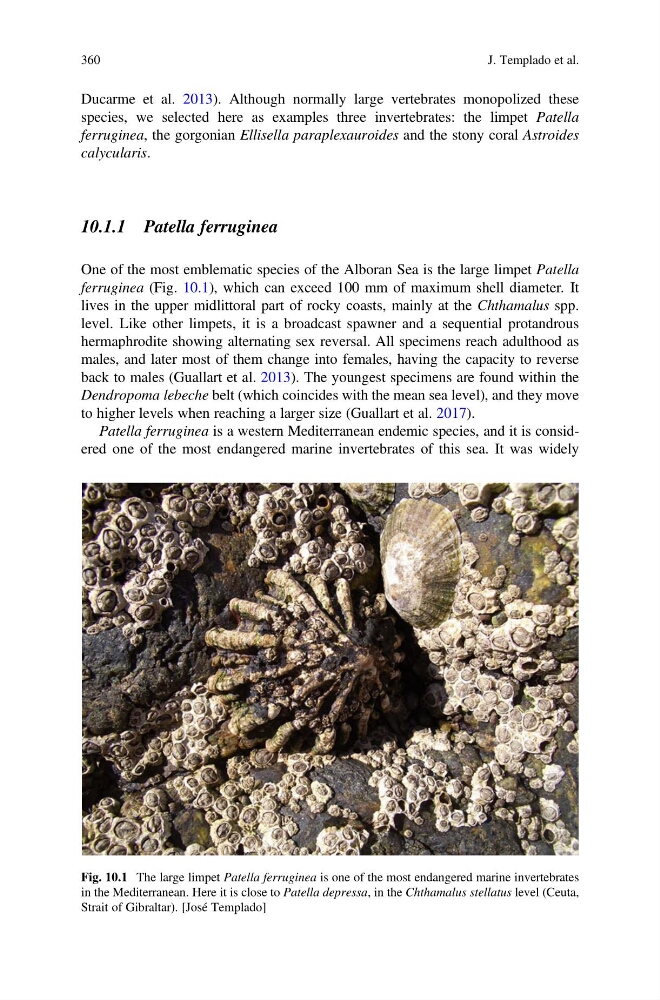
ferruginea (Fig. 10.1), which can exceed 100 mm of maximum shell diameter. It
lives in the upper midlittoral part of rocky coasts, mainly at the Chthamalus spp.
level. Like other limpets, it is a broadcast spawner and a sequential protandrous
hermaphrodite showing alternating sex reversal. All specimens reach adulthood as
males, and later most of them change into females, having the capacity to reverse
back to males (Guallart et al. 2013). The youngest specimens are found within the
Dendropoma lebeche belt (which coincides with the mean sea level), and they move
to higher levels when reaching a larger size (Guallart et al. 2017).
Patella ferruginea is a western Mediterranean endemic species, and it is considered one of the most endangered marine invertebrates of this sea. It was widely
Fig. 10.1 The large limpet Patella ferruginea is one of the most endangered marine invertebrates
in the Mediterranean. Here it is close to Patella depressa, in the Chthamalus stellatus level (Ceuta,
Strait of Gibraltar). [José Templado]
360
J. Templado et al.
species, we selected here as examples three invertebrates: the limpet Patella
ferruginea, the gorgonian Ellisella paraplexauroides and the stony coral Astroides
calycularis.
10.1.1 Patella ferruginea
One of the most emblematic species of the Alboran Sea is the large limpet Patella
ferruginea (Fig. 10.1), which can exceed 100 mm of maximum shell diameter. It
lives in the upper midlittoral part of rocky coasts, mainly at the Chthamalus spp.
level. Like other limpets, it is a broadcast spawner and a sequential protandrous
hermaphrodite showing alternating sex reversal. All specimens reach adulthood as
males, and later most of them change into females, having the capacity to reverse
back to males (Guallart et al. 2013). The youngest specimens are found within the
Dendropoma lebeche belt (which coincides with the mean sea level), and they move
to higher levels when reaching a larger size (Guallart et al. 2017).
Patella ferruginea is a western Mediterranean endemic species, and it is considered one of the most endangered marine invertebrates of this sea. It was widely
Fig. 10.1 The large limpet Patella ferruginea is one of the most endangered marine invertebrates
in the Mediterranean. Here it is close to Patella depressa, in the Chthamalus stellatus level (Ceuta,
Strait of Gibraltar). [José Templado]
360
J. Templado et al.