

Different species of sea stars can be present, most of them from the genus
Astropecten, such as A. irregularis, A. aranciacus, A. johnstoni or
A. platyacanthus. The nemertean Cerebratulus marginatus is also common. In the
littoral of Granada, the echinoderms Ophiocten affinis, Amphiura spp. and
Astropecten bispinosus were frequent (Marina et al. 2015). This assemblage did
not show a significant seasonal dynamic, probably due to the existence of low
dominances, high species richness and high complexity (Urra et al. 2013c).
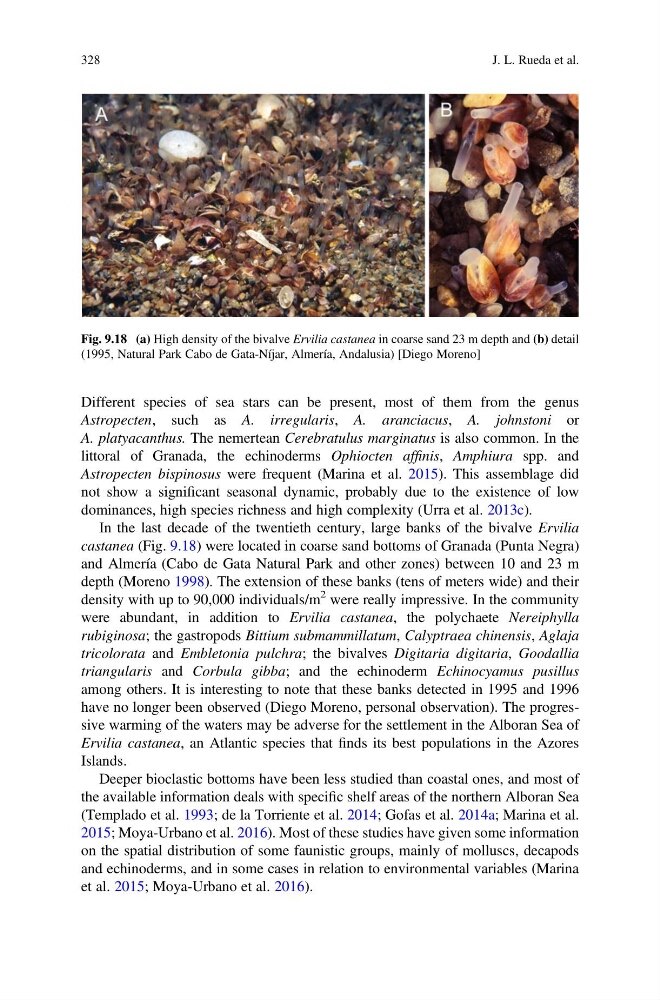
In the last decade of the twentieth century, large banks of the bivalve Ervilia
castanea (Fig. 9.18) were located in coarse sand bottoms of Granada (Punta Negra)
and Almería (Cabo de Gata Natural Park and other zones) between 10 and 23 m
depth (Moreno 1998). The extension of these banks (tens of meters wide) and their
density with up to 90,000 individuals/m
2 were really impressive. In the community
were abundant, in addition to Ervilia castanea, the polychaete Nereiphylla
rubiginosa; the gastropods Bittium submammillatum, Calyptraea chinensis, Aglaja
tricolorata and Embletonia pulchra; the bivalves Digitaria digitaria, Goodallia
triangularis and Corbula gibba; and the echinoderm Echinocyamus pusillus
among others. It is interesting to note that these banks detected in 1995 and 1996
have no longer been observed (Diego Moreno, personal observation). The progressive warming of the waters may be adverse for the settlement in the Alboran Sea of
Ervilia castanea, an Atlantic species that finds its best populations in the Azores
Islands.
Deeper bioclastic bottoms have been less studied than coastal ones, and most of
the available information deals with specific shelf areas of the northern Alboran Sea
(Templado et al. 1993; de la Torriente et al. 2014; Gofas et al. 2014a; Marina et al.
2015; Moya-Urbano et al. 2016). Most of these studies have given some information
on the spatial distribution of some faunistic groups, mainly of molluscs, decapods
and echinoderms, and in some cases in relation to environmental variables (Marina
et al. 2015; Moya-Urbano et al. 2016).
Fig. 9.18 (a) High density of the bivalve Ervilia castanea in coarse sand 23 m depth and (b) detail
(1995, Natural Park Cabo de Gata-Níjar, Almería, Andalusia) [Diego Moreno]
328
J. L. Rueda et al.
Astropecten, such as A. irregularis, A. aranciacus, A. johnstoni or
A. platyacanthus. The nemertean Cerebratulus marginatus is also common. In the
littoral of Granada, the echinoderms Ophiocten affinis, Amphiura spp. and
Astropecten bispinosus were frequent (Marina et al. 2015). This assemblage did
not show a significant seasonal dynamic, probably due to the existence of low
dominances, high species richness and high complexity (Urra et al. 2013c).
In the last decade of the twentieth century, large banks of the bivalve Ervilia
castanea (Fig. 9.18) were located in coarse sand bottoms of Granada (Punta Negra)
and Almería (Cabo de Gata Natural Park and other zones) between 10 and 23 m
depth (Moreno 1998). The extension of these banks (tens of meters wide) and their
density with up to 90,000 individuals/m
2 were really impressive. In the community
were abundant, in addition to Ervilia castanea, the polychaete Nereiphylla
rubiginosa; the gastropods Bittium submammillatum, Calyptraea chinensis, Aglaja
tricolorata and Embletonia pulchra; the bivalves Digitaria digitaria, Goodallia
triangularis and Corbula gibba; and the echinoderm Echinocyamus pusillus
among others. It is interesting to note that these banks detected in 1995 and 1996
have no longer been observed (Diego Moreno, personal observation). The progressive warming of the waters may be adverse for the settlement in the Alboran Sea of
Ervilia castanea, an Atlantic species that finds its best populations in the Azores
Islands.
Deeper bioclastic bottoms have been less studied than coastal ones, and most of
the available information deals with specific shelf areas of the northern Alboran Sea
(Templado et al. 1993; de la Torriente et al. 2014; Gofas et al. 2014a; Marina et al.
2015; Moya-Urbano et al. 2016). Most of these studies have given some information
on the spatial distribution of some faunistic groups, mainly of molluscs, decapods
and echinoderms, and in some cases in relation to environmental variables (Marina
et al. 2015; Moya-Urbano et al. 2016).
Fig. 9.18 (a) High density of the bivalve Ervilia castanea in coarse sand 23 m depth and (b) detail
(1995, Natural Park Cabo de Gata-Níjar, Almería, Andalusia) [Diego Moreno]
328
J. L. Rueda et al.