

9.6.2.1 Zostera marina Meadows
The Zostera marina meadows were common in the Andalusian coasts of the Alboran
Sea until a decade ago, mostly in Marine Protected Areas (e.g. Acantilados de MaroCerro Gordo Special Area of Conservation), but they suffered a strong decline, being
currently reduced to small patches in very specific areas of the coast of Granada and
Almería, and can be considered almost extinct (Urra et al. 2008; Rueda et al. 2009b;
Junta de Andalucía 2008–2019; Arroyo et al. 2015). Since Z. marina is an Atlantic
species, the progressive warming of the water in the Alboran Sea seems to be
unfavourable. In the Moroccan coasts, these meadows have been very little studied,
but they do seem to be still present (Hocein 2015).
The most studied eelgrass meadows are those that occurred between the coast of
Málaga and Granada. They were located in soft bottoms but at greater depths
(5–17 m) than those of other areas of the Iberian Peninsula (1–10 m); therefore
their biological communities presented certain differences with respect to other
shallower Z. marina meadows of the European Atlantic coasts (Luque and Templado
2004; Rueda et al. 2009a). More than 200 species have been recorded at the time
when these meadows were thriving (Luque and Templado 2004; González et al.
2007, 2008; Rueda et al. 2009a).
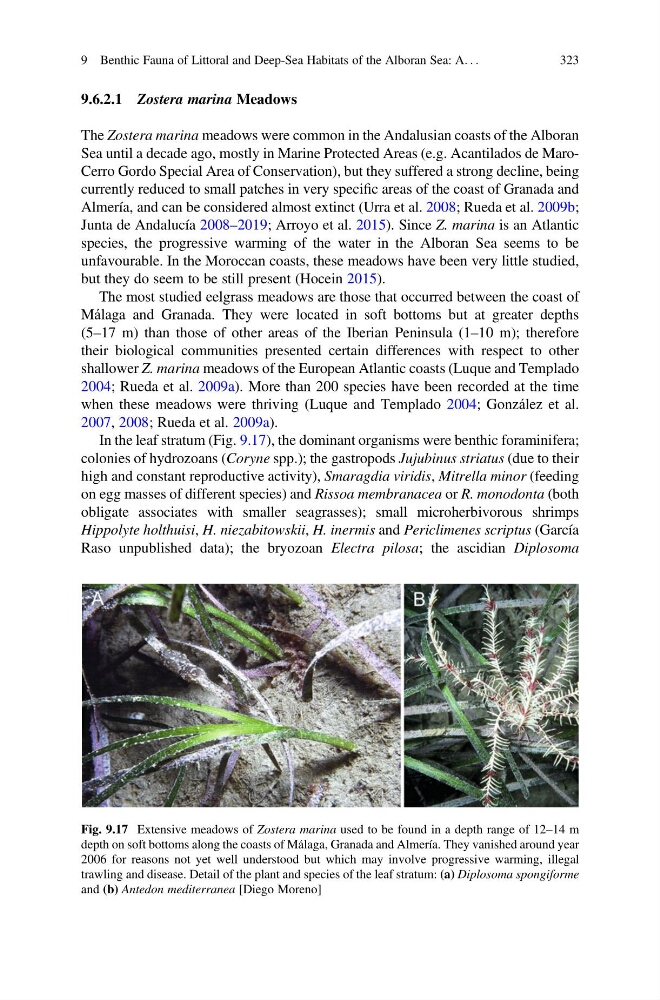
In the leaf stratum (Fig. 9.17), the dominant organisms were benthic foraminifera;
colonies of hydrozoans (Coryne spp.); the gastropods Jujubinus striatus (due to their
high and constant reproductive activity), Smaragdia viridis, Mitrella minor (feeding
on egg masses of different species) and Rissoa membranacea or R. monodonta (both
obligate associates with smaller seagrasses); small microherbivorous shrimps
Hippolyte holthuisi, H. niezabitowskii, H. inermis and Periclimenes scriptus (García
Raso unpublished data); the bryozoan Electra pilosa; the ascidian Diplosoma
Fig. 9.17 Extensive meadows of Zostera marina used to be found in a depth range of 12–14 m
depth on soft bottoms along the coasts of Málaga, Granada and Almería. They vanished around year
2006 for reasons not yet well understood but which may involve progressive warming, illegal
trawling and disease. Detail of the plant and species of the leaf stratum: (a) Diplosoma spongiforme
and (b) Antedon mediterranea [Diego Moreno]
9 Benthic Fauna of Littoral and Deep-Sea Habitats of the Alboran Sea: A. . .
323
The Zostera marina meadows were common in the Andalusian coasts of the Alboran
Sea until a decade ago, mostly in Marine Protected Areas (e.g. Acantilados de MaroCerro Gordo Special Area of Conservation), but they suffered a strong decline, being
currently reduced to small patches in very specific areas of the coast of Granada and
Almería, and can be considered almost extinct (Urra et al. 2008; Rueda et al. 2009b;
Junta de Andalucía 2008–2019; Arroyo et al. 2015). Since Z. marina is an Atlantic
species, the progressive warming of the water in the Alboran Sea seems to be
unfavourable. In the Moroccan coasts, these meadows have been very little studied,
but they do seem to be still present (Hocein 2015).
The most studied eelgrass meadows are those that occurred between the coast of
Málaga and Granada. They were located in soft bottoms but at greater depths
(5–17 m) than those of other areas of the Iberian Peninsula (1–10 m); therefore
their biological communities presented certain differences with respect to other
shallower Z. marina meadows of the European Atlantic coasts (Luque and Templado
2004; Rueda et al. 2009a). More than 200 species have been recorded at the time
when these meadows were thriving (Luque and Templado 2004; González et al.
2007, 2008; Rueda et al. 2009a).
In the leaf stratum (Fig. 9.17), the dominant organisms were benthic foraminifera;
colonies of hydrozoans (Coryne spp.); the gastropods Jujubinus striatus (due to their
high and constant reproductive activity), Smaragdia viridis, Mitrella minor (feeding
on egg masses of different species) and Rissoa membranacea or R. monodonta (both
obligate associates with smaller seagrasses); small microherbivorous shrimps
Hippolyte holthuisi, H. niezabitowskii, H. inermis and Periclimenes scriptus (García
Raso unpublished data); the bryozoan Electra pilosa; the ascidian Diplosoma
Fig. 9.17 Extensive meadows of Zostera marina used to be found in a depth range of 12–14 m
depth on soft bottoms along the coasts of Málaga, Granada and Almería. They vanished around year
2006 for reasons not yet well understood but which may involve progressive warming, illegal
trawling and disease. Detail of the plant and species of the leaf stratum: (a) Diplosoma spongiforme
and (b) Antedon mediterranea [Diego Moreno]
9 Benthic Fauna of Littoral and Deep-Sea Habitats of the Alboran Sea: A. . .
323