

echinoderms (Echinaster sepositus, Ophidiaster ophidianus, crinoids and brittle
stars) and fish species (e.g. Sciaena umbra, Scorpaena spp., Apogon imberbis)
(Templado et al. 2004).
The occurrence of coralligenous communities in the infralittoral zone is not only
triggered by topographic features such as slope and orientation of the substrate. The
ultimately important factor is reduction in the amount of light, and this can also be
caused by turbidity. For example, a highly diverse coralligenous community dominated by gorgonians, bryozoans, molluscs and decapods has been reported at
shallow depths of the Calahonda SAC due to the high turbidity levels in the water
column (García Raso et al. 2010; Urra et al. 2012).
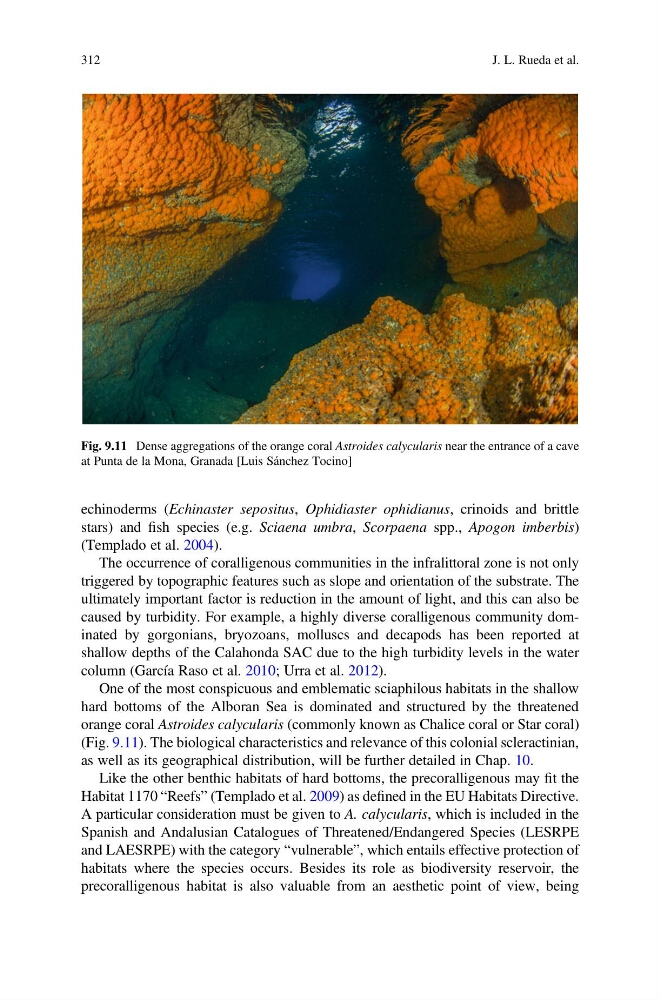
One of the most conspicuous and emblematic sciaphilous habitats in the shallow
hard bottoms of the Alboran Sea is dominated and structured by the threatened
orange coral Astroides calycularis (commonly known as Chalice coral or Star coral)
(Fig. 9.11). The biological characteristics and relevance of this colonial scleractinian,
as well as its geographical distribution, will be further detailed in Chap. 10.
Like the other benthic habitats of hard bottoms, the precoralligenous may fit the
Habitat 1170 “Reefs” (Templado et al. 2009) as defined in the EU Habitats Directive.
A particular consideration must be given to A. calycularis, which is included in the
Spanish and Andalusian Catalogues of Threatened/Endangered Species (LESRPE
and LAESRPE) with the category “vulnerable”, which entails effective protection of
habitats where the species occurs. Besides its role as biodiversity reservoir, the
precoralligenous habitat is also valuable from an aesthetic point of view, being
Fig. 9.11 Dense aggregations of the orange coral Astroides calycularis near the entrance of a cave
at Punta de la Mona, Granada [Luis Sánchez Tocino]
312
J. L. Rueda et al.
stars) and fish species (e.g. Sciaena umbra, Scorpaena spp., Apogon imberbis)
(Templado et al. 2004).
The occurrence of coralligenous communities in the infralittoral zone is not only
triggered by topographic features such as slope and orientation of the substrate. The
ultimately important factor is reduction in the amount of light, and this can also be
caused by turbidity. For example, a highly diverse coralligenous community dominated by gorgonians, bryozoans, molluscs and decapods has been reported at
shallow depths of the Calahonda SAC due to the high turbidity levels in the water
column (García Raso et al. 2010; Urra et al. 2012).
One of the most conspicuous and emblematic sciaphilous habitats in the shallow
hard bottoms of the Alboran Sea is dominated and structured by the threatened
orange coral Astroides calycularis (commonly known as Chalice coral or Star coral)
(Fig. 9.11). The biological characteristics and relevance of this colonial scleractinian,
as well as its geographical distribution, will be further detailed in Chap. 10.
Like the other benthic habitats of hard bottoms, the precoralligenous may fit the
Habitat 1170 “Reefs” (Templado et al. 2009) as defined in the EU Habitats Directive.
A particular consideration must be given to A. calycularis, which is included in the
Spanish and Andalusian Catalogues of Threatened/Endangered Species (LESRPE
and LAESRPE) with the category “vulnerable”, which entails effective protection of
habitats where the species occurs. Besides its role as biodiversity reservoir, the
precoralligenous habitat is also valuable from an aesthetic point of view, being
Fig. 9.11 Dense aggregations of the orange coral Astroides calycularis near the entrance of a cave
at Punta de la Mona, Granada [Luis Sánchez Tocino]
312
J. L. Rueda et al.