

gorgonians), the hydroids Nemertesia antennina (whose colonies can reach up to
30 cm in height) and some species of the genus Aglaophenia, several erect bryozoans of branched colonies (Myriapora truncata, Frondipora verrucosa, Pentapora
fascialis, Bugula spiralis), ascidians (Rhopalaea neapolitana, Phallusia
mammillata, Aplidium elegans, Polycarpa mamillaris, among others) (RamosEsplá 1991) and a large number of sponges, such as Crambe crambe, Oscarella
lobularis, Dysidea spp., Axinella damicornis or Aplysina aerophoba (Maldonado
1993). Many of these species of the basal stratum are also found deeper in
coralligenous communities.
Through this complex and shaded habitat, there are also a multitude of mobile
animals, mainly polychaetes, gastropods such as Calliostoma zizyphinum and Bolma
rugosa, crustaceans and echinoderms. Many species of fish also find refuge in these
kelp forests, like many wrasses (e.g. Coris julis and Labrus mixtus) and serranids
(mainly Serranus scriba), and the so-called three tails (Anthias anthias). Another
common fish among the recesses of the undergrowth is the so-called torillo (Blennius
ocellaris). Large schools of the sparid Pagellus acarne are frequent above the forest.
Despite representing a unique benthic community in the Mediterranean, kelp beds
do not receive any other protection than their eligibility as “1170 Reefs” (Templado
et al. 2009) of the EU Habitats Directive. Nevertheless, the kelp Laminaria
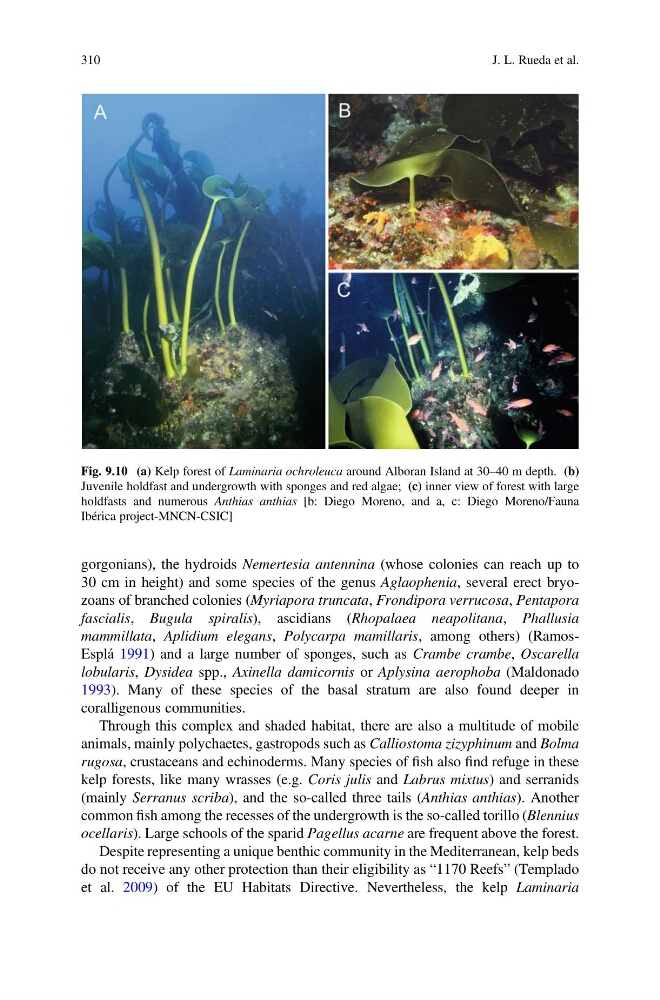
Fig. 9.10 (a) Kelp forest of Laminaria ochroleuca around Alboran Island at 30–40 m depth. (b)
Juvenile holdfast and undergrowth with sponges and red algae; (c) inner view of forest with large
holdfasts and numerous Anthias anthias [b: Diego Moreno, and a, c: Diego Moreno/Fauna
Ibérica project-MNCN-CSIC]
310
J. L. Rueda et al.
30 cm in height) and some species of the genus Aglaophenia, several erect bryozoans of branched colonies (Myriapora truncata, Frondipora verrucosa, Pentapora
fascialis, Bugula spiralis), ascidians (Rhopalaea neapolitana, Phallusia
mammillata, Aplidium elegans, Polycarpa mamillaris, among others) (RamosEsplá 1991) and a large number of sponges, such as Crambe crambe, Oscarella
lobularis, Dysidea spp., Axinella damicornis or Aplysina aerophoba (Maldonado
1993). Many of these species of the basal stratum are also found deeper in
coralligenous communities.
Through this complex and shaded habitat, there are also a multitude of mobile
animals, mainly polychaetes, gastropods such as Calliostoma zizyphinum and Bolma
rugosa, crustaceans and echinoderms. Many species of fish also find refuge in these
kelp forests, like many wrasses (e.g. Coris julis and Labrus mixtus) and serranids
(mainly Serranus scriba), and the so-called three tails (Anthias anthias). Another
common fish among the recesses of the undergrowth is the so-called torillo (Blennius
ocellaris). Large schools of the sparid Pagellus acarne are frequent above the forest.
Despite representing a unique benthic community in the Mediterranean, kelp beds
do not receive any other protection than their eligibility as “1170 Reefs” (Templado
et al. 2009) of the EU Habitats Directive. Nevertheless, the kelp Laminaria
Fig. 9.10 (a) Kelp forest of Laminaria ochroleuca around Alboran Island at 30–40 m depth. (b)
Juvenile holdfast and undergrowth with sponges and red algae; (c) inner view of forest with large
holdfasts and numerous Anthias anthias [b: Diego Moreno, and a, c: Diego Moreno/Fauna
Ibérica project-MNCN-CSIC]
310
J. L. Rueda et al.