

9.4.1 Communities of Photophilous Macroalgae
The community of photophilous algae is characteristic of shallow areas, although,
with adequate conditions of transparency of the water, it can reach 30 m depth or
more. In the Western Mediterranean, the infralittoral rocky bottoms with moderate to
high exposure to wave action are dominated by species of Fucales mainly belonging
to the genus Cystoseira. These are usually erect with a medium or large size (usually
between 20 cm and more than 1 m, in the case of C. usneoides) and provide a habitat
which can be compared to a miniature forest (Luque and Templado 2004; Templado
et al. 2012). Below this, there is a turf stratum formed by small algae and a basal
layer formed by encrusting calcareous algae and by sediment deposited in small
depressions of the substrate. In the Alboran Sea, well-structured communities
dominated by Cystoseira spp. only appear in the Eastern part (e.g. Cabo de Gata,
Almería, Alboran Island, Chafarinas Islands). In shallow, calmed environments of
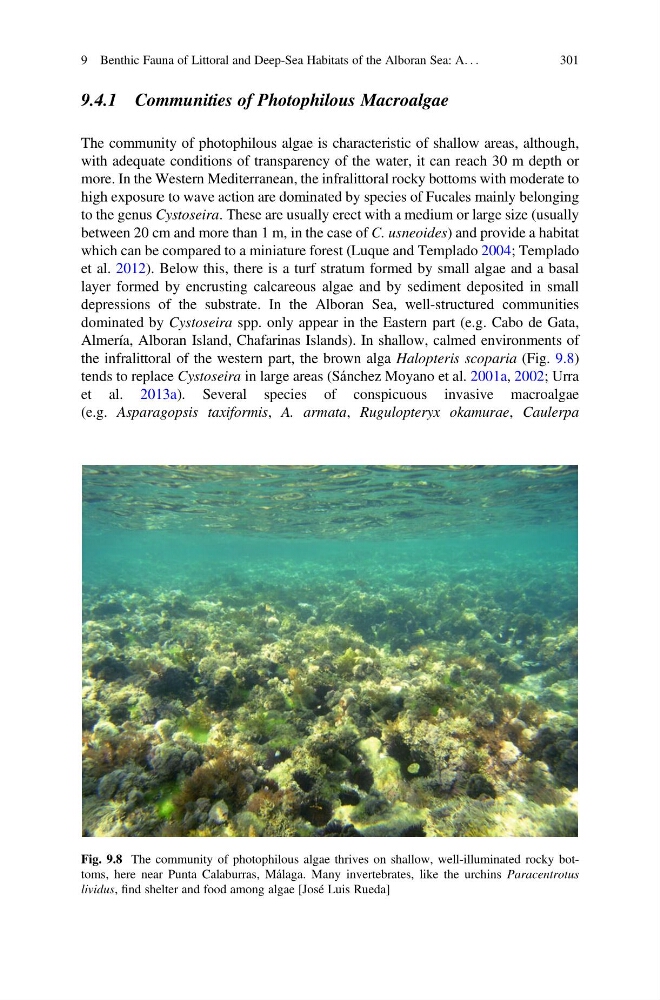
the infralittoral of the western part, the brown alga Halopteris scoparia (Fig. 9.8)
tends to replace Cystoseira in large areas (Sánchez Moyano et al. 2001a, 2002; Urra
et al. 2013a). Several species of conspicuous invasive macroalgae
(e.g. Asparagopsis taxiformis, A. armata, Rugulopteryx okamurae, Caulerpa
Fig. 9.8 The community of photophilous algae thrives on shallow, well-illuminated rocky bottoms, here near Punta Calaburras, Málaga. Many invertebrates, like the urchins Paracentrotus
lividus, find shelter and food among algae [José Luis Rueda]
9 Benthic Fauna of Littoral and Deep-Sea Habitats of the Alboran Sea: A. . .
301
The community of photophilous algae is characteristic of shallow areas, although,
with adequate conditions of transparency of the water, it can reach 30 m depth or
more. In the Western Mediterranean, the infralittoral rocky bottoms with moderate to
high exposure to wave action are dominated by species of Fucales mainly belonging
to the genus Cystoseira. These are usually erect with a medium or large size (usually
between 20 cm and more than 1 m, in the case of C. usneoides) and provide a habitat
which can be compared to a miniature forest (Luque and Templado 2004; Templado
et al. 2012). Below this, there is a turf stratum formed by small algae and a basal
layer formed by encrusting calcareous algae and by sediment deposited in small
depressions of the substrate. In the Alboran Sea, well-structured communities
dominated by Cystoseira spp. only appear in the Eastern part (e.g. Cabo de Gata,
Almería, Alboran Island, Chafarinas Islands). In shallow, calmed environments of
the infralittoral of the western part, the brown alga Halopteris scoparia (Fig. 9.8)
tends to replace Cystoseira in large areas (Sánchez Moyano et al. 2001a, 2002; Urra
et al. 2013a). Several species of conspicuous invasive macroalgae
(e.g. Asparagopsis taxiformis, A. armata, Rugulopteryx okamurae, Caulerpa
Fig. 9.8 The community of photophilous algae thrives on shallow, well-illuminated rocky bottoms, here near Punta Calaburras, Málaga. Many invertebrates, like the urchins Paracentrotus
lividus, find shelter and food among algae [José Luis Rueda]
9 Benthic Fauna of Littoral and Deep-Sea Habitats of the Alboran Sea: A. . .
301