

well delimited and structured by sessile organisms, mainly algae and barnacles,
whose composition and extent depend largely on the degree of wave action.
The upper belt of the midlittoral is characterized by the abundance of chthamalid
barnacles (Microeuraphia depressa, Chthamalus montagui and C. stellatus) which
can cover a large part of the substrate and the presence of the highly mobile crab
Pachygrapsus marmoratus. Among other algae, the rhodophyte Rissoella
verruculosa may appear in the upper levels in some well-preserved areas such as
the Chafarinas Islands. The limpets Patella rustica and P. ferruginea, the latter an
endangered species restricted to the Alboran Sea, North Africa, Sardinia and Corsica, are noteworthy elements at this level and compete for space with the barnacles,
which usually also settle on their shells. The trochids Phorcus articulatus
(in sheltered sites) and P. turbinatus (in sited exposed to wave action) retreat to
sheltered crevices at the time of low tide.
Below the horizon of barnacles, there is an algal turf in which the coralline alga
Ellisolandia elongata is prominent. In the most sheltered areas and in those with
high levels of eutrophication, the red algae are replaced by green algae such as Ulva
spp. As it happens in the supralittoral and infralittoral levels, the extension of these
communities is constrained by the extension of the rocky shoreline.
Species richness increases drastically in the middle and lower parts of the
midlittoral, where an algal turf usually develops (Guerra-García et al. 2011). There
is also a clear species turnover, where the abovementioned barnacles are replaced by
larger species (such as Perforatus perforatus and Amphibalanus amphitrite) and the
genus Pachygrapsus is represented instead by P. transversus and P. maurus (more
rare) in fissures of rocks. The most characteristic molluscs are the limpets Patella
caerulea (also P. depressa in the western part of Málaga coast and in the Strait of
Gibraltar) and Cymbula safiana (a prevalently West African species), which replace
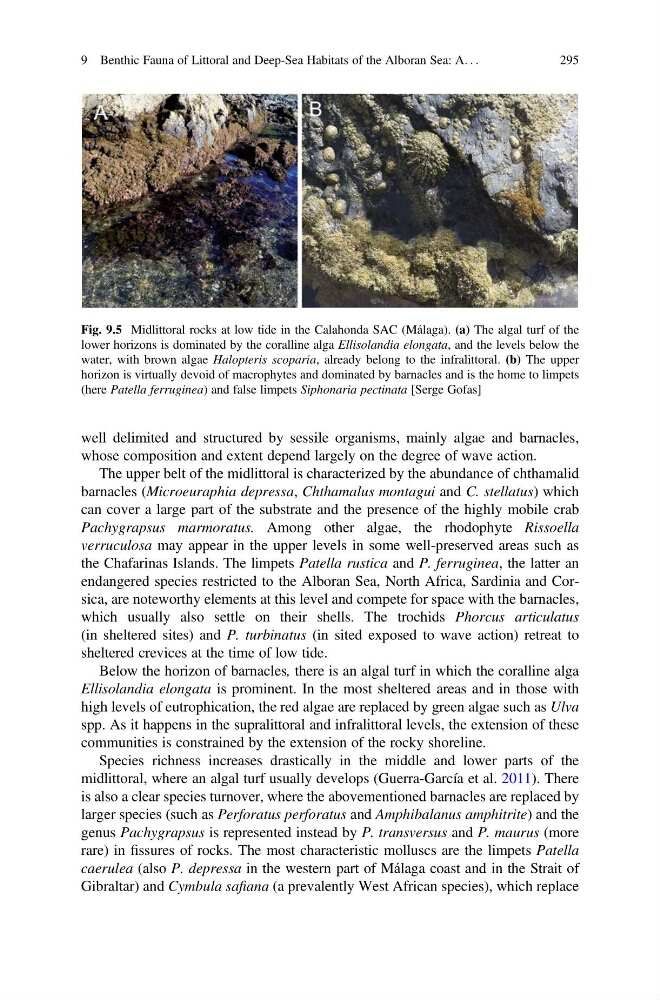
Fig. 9.5 Midlittoral rocks at low tide in the Calahonda SAC (Málaga). (a) The algal turf of the
lower horizons is dominated by the coralline alga Ellisolandia elongata, and the levels below the
water, with brown algae Halopteris scoparia, already belong to the infralittoral. (b) The upper
horizon is virtually devoid of macrophytes and dominated by barnacles and is the home to limpets
(here Patella ferruginea) and false limpets Siphonaria pectinata [Serge Gofas]
9 Benthic Fauna of Littoral and Deep-Sea Habitats of the Alboran Sea: A. . .
295
whose composition and extent depend largely on the degree of wave action.
The upper belt of the midlittoral is characterized by the abundance of chthamalid
barnacles (Microeuraphia depressa, Chthamalus montagui and C. stellatus) which
can cover a large part of the substrate and the presence of the highly mobile crab
Pachygrapsus marmoratus. Among other algae, the rhodophyte Rissoella
verruculosa may appear in the upper levels in some well-preserved areas such as
the Chafarinas Islands. The limpets Patella rustica and P. ferruginea, the latter an
endangered species restricted to the Alboran Sea, North Africa, Sardinia and Corsica, are noteworthy elements at this level and compete for space with the barnacles,
which usually also settle on their shells. The trochids Phorcus articulatus
(in sheltered sites) and P. turbinatus (in sited exposed to wave action) retreat to
sheltered crevices at the time of low tide.
Below the horizon of barnacles, there is an algal turf in which the coralline alga
Ellisolandia elongata is prominent. In the most sheltered areas and in those with
high levels of eutrophication, the red algae are replaced by green algae such as Ulva
spp. As it happens in the supralittoral and infralittoral levels, the extension of these
communities is constrained by the extension of the rocky shoreline.
Species richness increases drastically in the middle and lower parts of the
midlittoral, where an algal turf usually develops (Guerra-García et al. 2011). There
is also a clear species turnover, where the abovementioned barnacles are replaced by
larger species (such as Perforatus perforatus and Amphibalanus amphitrite) and the
genus Pachygrapsus is represented instead by P. transversus and P. maurus (more
rare) in fissures of rocks. The most characteristic molluscs are the limpets Patella
caerulea (also P. depressa in the western part of Málaga coast and in the Strait of
Gibraltar) and Cymbula safiana (a prevalently West African species), which replace
Fig. 9.5 Midlittoral rocks at low tide in the Calahonda SAC (Málaga). (a) The algal turf of the
lower horizons is dominated by the coralline alga Ellisolandia elongata, and the levels below the
water, with brown algae Halopteris scoparia, already belong to the infralittoral. (b) The upper
horizon is virtually devoid of macrophytes and dominated by barnacles and is the home to limpets
(here Patella ferruginea) and false limpets Siphonaria pectinata [Serge Gofas]
9 Benthic Fauna of Littoral and Deep-Sea Habitats of the Alboran Sea: A. . .
295