

9.2.1 Supralittoral Rocky Shore
The supralittoral stage corresponds to the “splash zone”, i.e. rock surfaces permanently emerged but receive moisture from wave action. Its vertical extension varies
between a few centimetres in calm areas, to a few meters, depending on the
topography of the coast, its inclination and exposure to surf. The extension of this
habitat in the Alboran Sea coincides with that of rocky shores, including artificial
substrates such as piers and groins.
The community of the supralittoral rock is mainly characterized by various
lichens, especially those of the genus Verrucaria (V. amphibia and V. maura). The
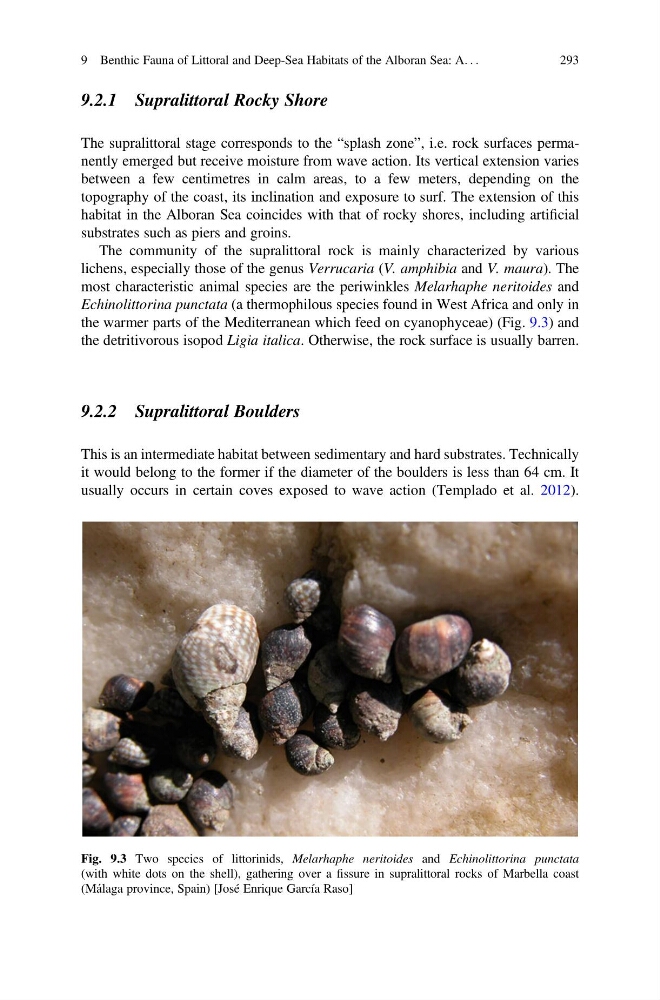
most characteristic animal species are the periwinkles Melarhaphe neritoides and
Echinolittorina punctata (a thermophilous species found in West Africa and only in
the warmer parts of the Mediterranean which feed on cyanophyceae) (Fig. 9.3) and
the detritivorous isopod Ligia italica. Otherwise, the rock surface is usually barren.
9.2.2 Supralittoral Boulders
This is an intermediate habitat between sedimentary and hard substrates. Technically
it would belong to the former if the diameter of the boulders is less than 64 cm. It
usually occurs in certain coves exposed to wave action (Templado et al. 2012).
Fig. 9.3 Two species of littorinids, Melarhaphe neritoides and Echinolittorina punctata
(with white dots on the shell), gathering over a fissure in supralittoral rocks of Marbella coast
(Málaga province, Spain) [José Enrique García Raso]
9 Benthic Fauna of Littoral and Deep-Sea Habitats of the Alboran Sea: A. . .
293
The supralittoral stage corresponds to the “splash zone”, i.e. rock surfaces permanently emerged but receive moisture from wave action. Its vertical extension varies
between a few centimetres in calm areas, to a few meters, depending on the
topography of the coast, its inclination and exposure to surf. The extension of this
habitat in the Alboran Sea coincides with that of rocky shores, including artificial
substrates such as piers and groins.
The community of the supralittoral rock is mainly characterized by various
lichens, especially those of the genus Verrucaria (V. amphibia and V. maura). The
most characteristic animal species are the periwinkles Melarhaphe neritoides and
Echinolittorina punctata (a thermophilous species found in West Africa and only in
the warmer parts of the Mediterranean which feed on cyanophyceae) (Fig. 9.3) and
the detritivorous isopod Ligia italica. Otherwise, the rock surface is usually barren.
9.2.2 Supralittoral Boulders
This is an intermediate habitat between sedimentary and hard substrates. Technically
it would belong to the former if the diameter of the boulders is less than 64 cm. It
usually occurs in certain coves exposed to wave action (Templado et al. 2012).
Fig. 9.3 Two species of littorinids, Melarhaphe neritoides and Echinolittorina punctata
(with white dots on the shell), gathering over a fissure in supralittoral rocks of Marbella coast
(Málaga province, Spain) [José Enrique García Raso]
9 Benthic Fauna of Littoral and Deep-Sea Habitats of the Alboran Sea: A. . .
293