

results, mainly obtained by scuba diving, are presented in a profusely illustrated
guide (Sánchez Tocino and Ocaña 2003). After her premature death in 2007, work
was continued there by Luis Sánchez Tocino who also set up a web site dedicated to
the benthic fauna of the Granada coast and co-supervised the doctoral thesis of
Carlos Navarro-Barranco (2015) on benthic fauna of marine caves from Granada and
Málaga coasts. In parallel, data on the benthic communities of the Granada coast
were also provided by Cebrián et al. (2000) and Cebrián and Ballesteros (2004).
The marine zoology group at the University of Málaga extended research to other
areas, including the outstanding site of Calahonda (Málaga) which was surveyed in
2006 and declared as a Special Area of Conservation in the Natura 2000 network in
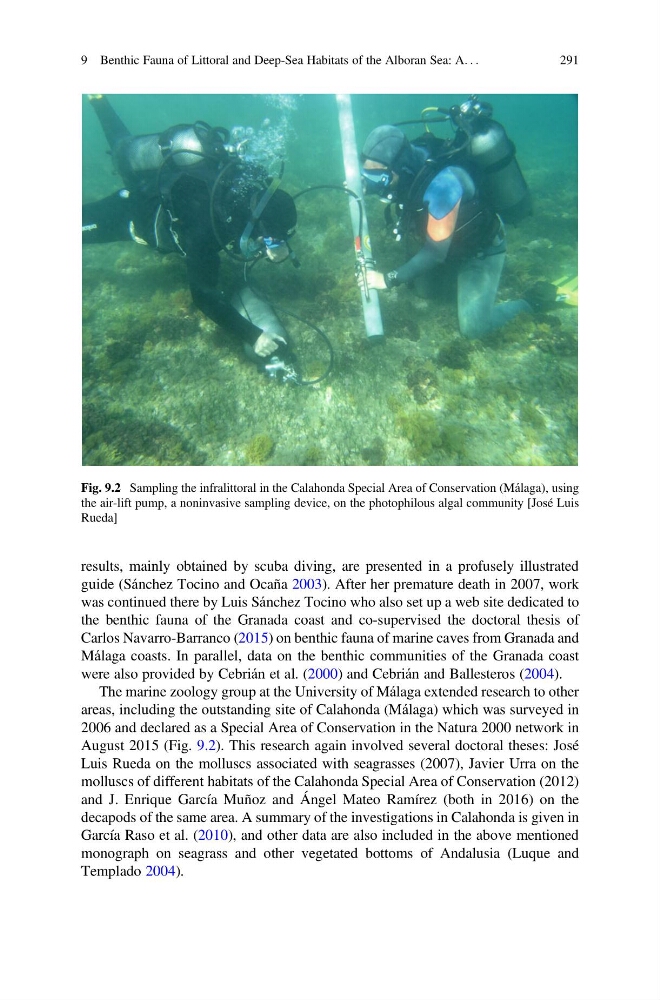
August 2015 (Fig. 9.2). This research again involved several doctoral theses: José
Luis Rueda on the molluscs associated with seagrasses (2007), Javier Urra on the
molluscs of different habitats of the Calahonda Special Area of Conservation (2012)
and J. Enrique García Muñoz and Ángel Mateo Ramírez (both in 2016) on the
decapods of the same area. A summary of the investigations in Calahonda is given in
García Raso et al. (2010), and other data are also included in the above mentioned
monograph on seagrass and other vegetated bottoms of Andalusia (Luque and
Templado 2004).
Fig. 9.2 Sampling the infralittoral in the Calahonda Special Area of Conservation (Málaga), using
the air-lift pump, a noninvasive sampling device, on the photophilous algal community [José Luis
Rueda]
9 Benthic Fauna of Littoral and Deep-Sea Habitats of the Alboran Sea: A. . .
291
guide (Sánchez Tocino and Ocaña 2003). After her premature death in 2007, work
was continued there by Luis Sánchez Tocino who also set up a web site dedicated to
the benthic fauna of the Granada coast and co-supervised the doctoral thesis of
Carlos Navarro-Barranco (2015) on benthic fauna of marine caves from Granada and
Málaga coasts. In parallel, data on the benthic communities of the Granada coast
were also provided by Cebrián et al. (2000) and Cebrián and Ballesteros (2004).
The marine zoology group at the University of Málaga extended research to other
areas, including the outstanding site of Calahonda (Málaga) which was surveyed in
2006 and declared as a Special Area of Conservation in the Natura 2000 network in
August 2015 (Fig. 9.2). This research again involved several doctoral theses: José
Luis Rueda on the molluscs associated with seagrasses (2007), Javier Urra on the
molluscs of different habitats of the Calahonda Special Area of Conservation (2012)
and J. Enrique García Muñoz and Ángel Mateo Ramírez (both in 2016) on the
decapods of the same area. A summary of the investigations in Calahonda is given in
García Raso et al. (2010), and other data are also included in the above mentioned
monograph on seagrass and other vegetated bottoms of Andalusia (Luque and
Templado 2004).
Fig. 9.2 Sampling the infralittoral in the Calahonda Special Area of Conservation (Málaga), using
the air-lift pump, a noninvasive sampling device, on the photophilous algal community [José Luis
Rueda]
9 Benthic Fauna of Littoral and Deep-Sea Habitats of the Alboran Sea: A. . .
291