

In 2008, a Training-Through Research Cruise funded by the UNESCO, under the
framework of the EU project HERMES, explored coral mounds and cold seeps in the
West Alboran Sea. These investigations confirmed the presence of large coral
buildups comparable by their dimensions to carbonate mud mounds of the NE
Atlantic Ocean. This was the first and very important documentation of large-scale
cold-water coral reefs in the Alboran basin. Detailed investigations of mud volcanoes revealed strong gas emissions (mainly in Carmen mud volcano), which fuelled
abundant chemosymbiotic organisms, including frenulate polychaetes and bivalves
(Comas and Suzyumov 2009).
Further exploration was carried out on the little known Djibouti Banks, located in
international waters of the northern part of Alboran Sea, on board R/V “Cornide de
Saavedra” of the Instituto Español de Oceanografía, in March–April 2009. Molluscs
from the Djibouti Banks were reported on by Gofas et al. (2014b).
At the same time, the German cruise POSEIDON POS 385 in May–June 2009
investigated the distribution and faunal composition of cold-water coral ecosystems
in the Alboran Sea (Hebbeln et al. 2009). By means of a “remotely operated vehicle”
(ROV), they targeted the Málaga mounds, Al Idrissi Bank in the Djibouti group, the
East Melilla area including Banc des Provençaux, the Alboran and Adra ridges and
the Seco de los Olivos (also known as Chella Bank). The video-based investigations
were completed by fauna and sediment sampling from the ROV or by standard
sampling methods (gravity corer, box corer). A remarkable finding was the occurrence of some living deep-sea oysters (Neopycnodonte zibrowii) that colonized a
steep cliff at 490 m water depth.
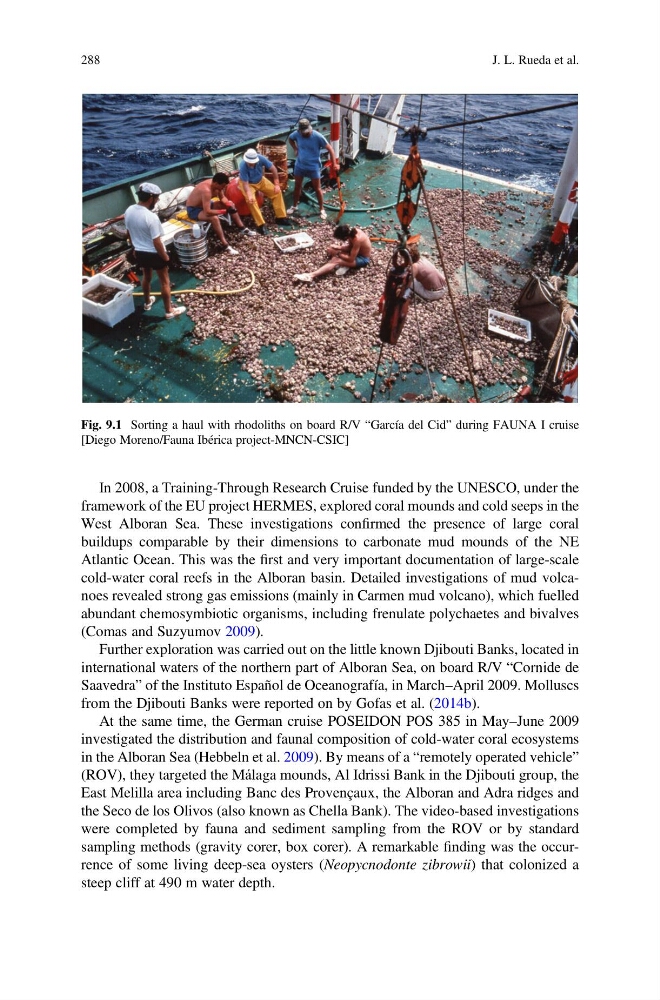
Fig. 9.1 Sorting a haul with rhodoliths on board R/V “García del Cid” during FAUNA I cruise
[Diego Moreno/Fauna Ibérica project-MNCN-CSIC]
288
J. L. Rueda et al.
framework of the EU project HERMES, explored coral mounds and cold seeps in the
West Alboran Sea. These investigations confirmed the presence of large coral
buildups comparable by their dimensions to carbonate mud mounds of the NE
Atlantic Ocean. This was the first and very important documentation of large-scale
cold-water coral reefs in the Alboran basin. Detailed investigations of mud volcanoes revealed strong gas emissions (mainly in Carmen mud volcano), which fuelled
abundant chemosymbiotic organisms, including frenulate polychaetes and bivalves
(Comas and Suzyumov 2009).
Further exploration was carried out on the little known Djibouti Banks, located in
international waters of the northern part of Alboran Sea, on board R/V “Cornide de
Saavedra” of the Instituto Español de Oceanografía, in March–April 2009. Molluscs
from the Djibouti Banks were reported on by Gofas et al. (2014b).
At the same time, the German cruise POSEIDON POS 385 in May–June 2009
investigated the distribution and faunal composition of cold-water coral ecosystems
in the Alboran Sea (Hebbeln et al. 2009). By means of a “remotely operated vehicle”
(ROV), they targeted the Málaga mounds, Al Idrissi Bank in the Djibouti group, the
East Melilla area including Banc des Provençaux, the Alboran and Adra ridges and
the Seco de los Olivos (also known as Chella Bank). The video-based investigations
were completed by fauna and sediment sampling from the ROV or by standard
sampling methods (gravity corer, box corer). A remarkable finding was the occurrence of some living deep-sea oysters (Neopycnodonte zibrowii) that colonized a
steep cliff at 490 m water depth.
Fig. 9.1 Sorting a haul with rhodoliths on board R/V “García del Cid” during FAUNA I cruise
[Diego Moreno/Fauna Ibérica project-MNCN-CSIC]
288
J. L. Rueda et al.