

observed from 25 to 30 m depth. Of particular interest are the photophilic and
hemisciaphilous algae forests of the different species of Cystoseira
(C. tamariscifolia, C. nodicaulis, C. usneoides) and the maerl beds with a rich
flora of corallinaceae and non-calcareous species. Details of the studies on the
algal flora from Alboran Island are presented in Sect. 8.1 of this chapter.
5. Acantilados de Calahonda-Castell de Ferro. This stretch of cliff coast is located
between the localities of the same name in the province of Granada. This
coastline extends approximately 9 km, with several coves or inlets. The SAC
of the Acantilados y Fondos Marinos de Calahonda-Castell de Ferro and other
nearby areas such as the SAC de Acantilados y Fondos Marinos de la Punta de la
Mona are hotspots for the conservation of marine biodiversity on the north
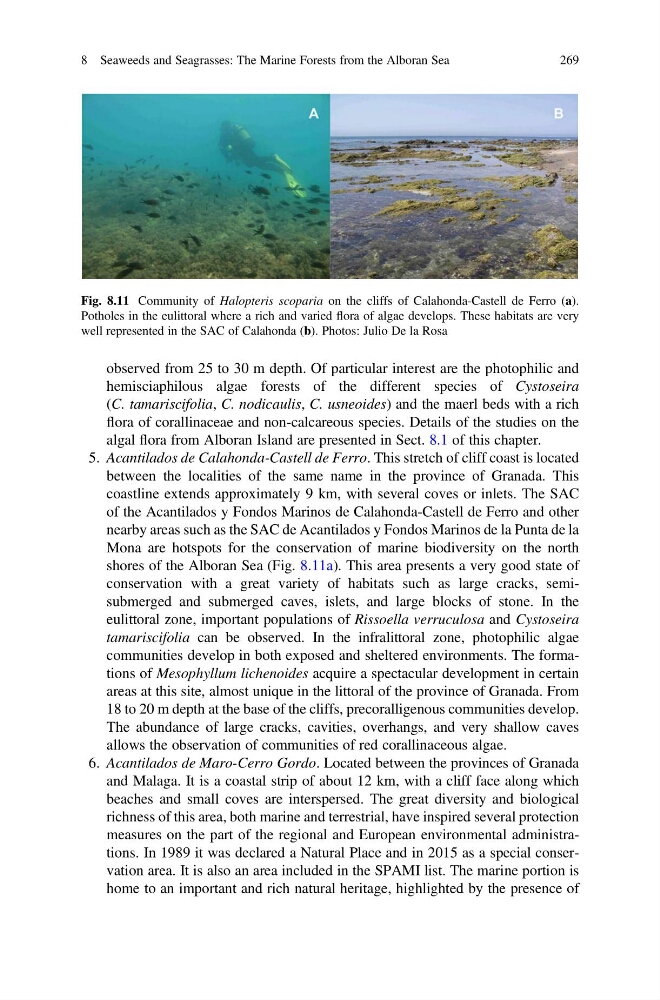
shores of the Alboran Sea (Fig. 8.11a). This area presents a very good state of
conservation with a great variety of habitats such as large cracks, semisubmerged and submerged caves, islets, and large blocks of stone. In the
eulittoral zone, important populations of Rissoella verruculosa and Cystoseira
tamariscifolia can be observed. In the infralittoral zone, photophilic algae
communities develop in both exposed and sheltered environments. The formations of Mesophyllum lichenoides acquire a spectacular development in certain
areas at this site, almost unique in the littoral of the province of Granada. From
18 to 20 m depth at the base of the cliffs, precoralligenous communities develop.
The abundance of large cracks, cavities, overhangs, and very shallow caves
allows the observation of communities of red corallinaceous algae.
6. Acantilados de Maro-Cerro Gordo. Located between the provinces of Granada
and Malaga. It is a coastal strip of about 12 km, with a cliff face along which
beaches and small coves are interspersed. The great diversity and biological
richness of this area, both marine and terrestrial, have inspired several protection
measures on the part of the regional and European environmental administrations. In 1989 it was declared a Natural Place and in 2015 as a special conservation area. It is also an area included in the SPAMI list. The marine portion is
home to an important and rich natural heritage, highlighted by the presence of
Fig. 8.11 Community of Halopteris scoparia on the cliffs of Calahonda-Castell de Ferro (a).
Potholes in the eulittoral where a rich and varied flora of algae develops. These habitats are very
well represented in the SAC of Calahonda (b). Photos: Julio De la Rosa
8 Seaweeds and Seagrasses: The Marine Forests from the Alboran Sea
269
hemisciaphilous algae forests of the different species of Cystoseira
(C. tamariscifolia, C. nodicaulis, C. usneoides) and the maerl beds with a rich
flora of corallinaceae and non-calcareous species. Details of the studies on the
algal flora from Alboran Island are presented in Sect. 8.1 of this chapter.
5. Acantilados de Calahonda-Castell de Ferro. This stretch of cliff coast is located
between the localities of the same name in the province of Granada. This
coastline extends approximately 9 km, with several coves or inlets. The SAC
of the Acantilados y Fondos Marinos de Calahonda-Castell de Ferro and other
nearby areas such as the SAC de Acantilados y Fondos Marinos de la Punta de la
Mona are hotspots for the conservation of marine biodiversity on the north
shores of the Alboran Sea (Fig. 8.11a). This area presents a very good state of
conservation with a great variety of habitats such as large cracks, semisubmerged and submerged caves, islets, and large blocks of stone. In the
eulittoral zone, important populations of Rissoella verruculosa and Cystoseira
tamariscifolia can be observed. In the infralittoral zone, photophilic algae
communities develop in both exposed and sheltered environments. The formations of Mesophyllum lichenoides acquire a spectacular development in certain
areas at this site, almost unique in the littoral of the province of Granada. From
18 to 20 m depth at the base of the cliffs, precoralligenous communities develop.
The abundance of large cracks, cavities, overhangs, and very shallow caves
allows the observation of communities of red corallinaceous algae.
6. Acantilados de Maro-Cerro Gordo. Located between the provinces of Granada
and Malaga. It is a coastal strip of about 12 km, with a cliff face along which
beaches and small coves are interspersed. The great diversity and biological
richness of this area, both marine and terrestrial, have inspired several protection
measures on the part of the regional and European environmental administrations. In 1989 it was declared a Natural Place and in 2015 as a special conservation area. It is also an area included in the SPAMI list. The marine portion is
home to an important and rich natural heritage, highlighted by the presence of
Fig. 8.11 Community of Halopteris scoparia on the cliffs of Calahonda-Castell de Ferro (a).
Potholes in the eulittoral where a rich and varied flora of algae develops. These habitats are very
well represented in the SAC of Calahonda (b). Photos: Julio De la Rosa
8 Seaweeds and Seagrasses: The Marine Forests from the Alboran Sea
269