

Fucales are clearly declining along much of the coastline of the Alboran Sea
(Ballesteros and Pinedo 2004; Templado et al. 2012; Gofas et al. 2014). Their
presence is currently restricted to certain areas such as Alboran Island, the
Chafarinas Islands, or sites on the North African coast (Templado et al. 2006;
Gofas et al. 2014). They have practically disappeared from the northern coasts of
the Alboran Sea. Among the factors that may have caused this decline is pollution,
because Cystoseira spp. are very sensitive to eutrophication. Other factors are
overgrazing by sea urchins and competition with exotic species of marked invasive
nature such as Asparagopsis spp. (Ballesteros and Pinedo 2004). The result is that
this community is replaced by a shrubby biotype dominated mainly by the brown
algae Cladostephus spongiosus and Halopteris scoparia, accompanied by many
others, such as Halopithys incurvus, Jania rubens, Haliptilon virgatum, Amphiroa
rigida, Liagora viscida, Colpomenia sinuosa, Dictyotales such as Padina pavonica,
Dictyota dichotoma, D. cyanoloma, Taonia atomaria or Dilophus spiralis,
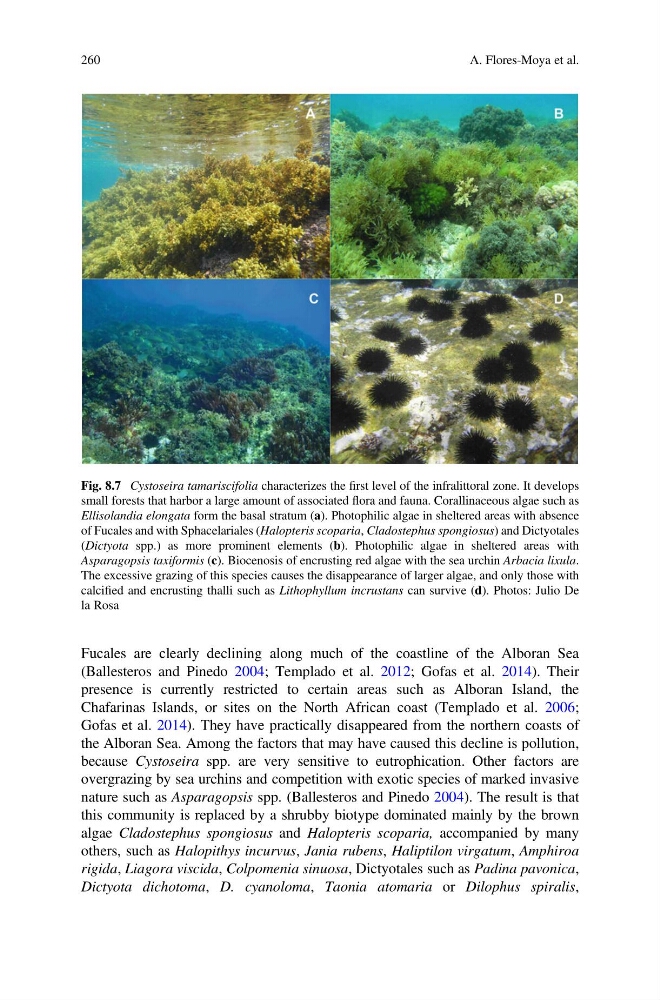
Fig. 8.7 Cystoseira tamariscifolia characterizes the first level of the infralittoral zone. It develops
small forests that harbor a large amount of associated flora and fauna. Corallinaceous algae such as
Ellisolandia elongata form the basal stratum (a). Photophilic algae in sheltered areas with absence
of Fucales and with Sphacelariales (Halopteris scoparia, Cladostephus spongiosus) and Dictyotales
(Dictyota spp.) as more prominent elements (b). Photophilic algae in sheltered areas with
Asparagopsis taxiformis (c). Biocenosis of encrusting red algae with the sea urchin Arbacia lixula.
The excessive grazing of this species causes the disappearance of larger algae, and only those with
calcified and encrusting thalli such as Lithophyllum incrustans can survive (d). Photos: Julio De
la Rosa
260
A. Flores-Moya et al.
(Ballesteros and Pinedo 2004; Templado et al. 2012; Gofas et al. 2014). Their
presence is currently restricted to certain areas such as Alboran Island, the
Chafarinas Islands, or sites on the North African coast (Templado et al. 2006;
Gofas et al. 2014). They have practically disappeared from the northern coasts of
the Alboran Sea. Among the factors that may have caused this decline is pollution,
because Cystoseira spp. are very sensitive to eutrophication. Other factors are
overgrazing by sea urchins and competition with exotic species of marked invasive
nature such as Asparagopsis spp. (Ballesteros and Pinedo 2004). The result is that
this community is replaced by a shrubby biotype dominated mainly by the brown
algae Cladostephus spongiosus and Halopteris scoparia, accompanied by many
others, such as Halopithys incurvus, Jania rubens, Haliptilon virgatum, Amphiroa
rigida, Liagora viscida, Colpomenia sinuosa, Dictyotales such as Padina pavonica,
Dictyota dichotoma, D. cyanoloma, Taonia atomaria or Dilophus spiralis,
Fig. 8.7 Cystoseira tamariscifolia characterizes the first level of the infralittoral zone. It develops
small forests that harbor a large amount of associated flora and fauna. Corallinaceous algae such as
Ellisolandia elongata form the basal stratum (a). Photophilic algae in sheltered areas with absence
of Fucales and with Sphacelariales (Halopteris scoparia, Cladostephus spongiosus) and Dictyotales
(Dictyota spp.) as more prominent elements (b). Photophilic algae in sheltered areas with
Asparagopsis taxiformis (c). Biocenosis of encrusting red algae with the sea urchin Arbacia lixula.
The excessive grazing of this species causes the disappearance of larger algae, and only those with
calcified and encrusting thalli such as Lithophyllum incrustans can survive (d). Photos: Julio De
la Rosa
260
A. Flores-Moya et al.