

to the substrate, especially after winter storms and in spring due to increased water
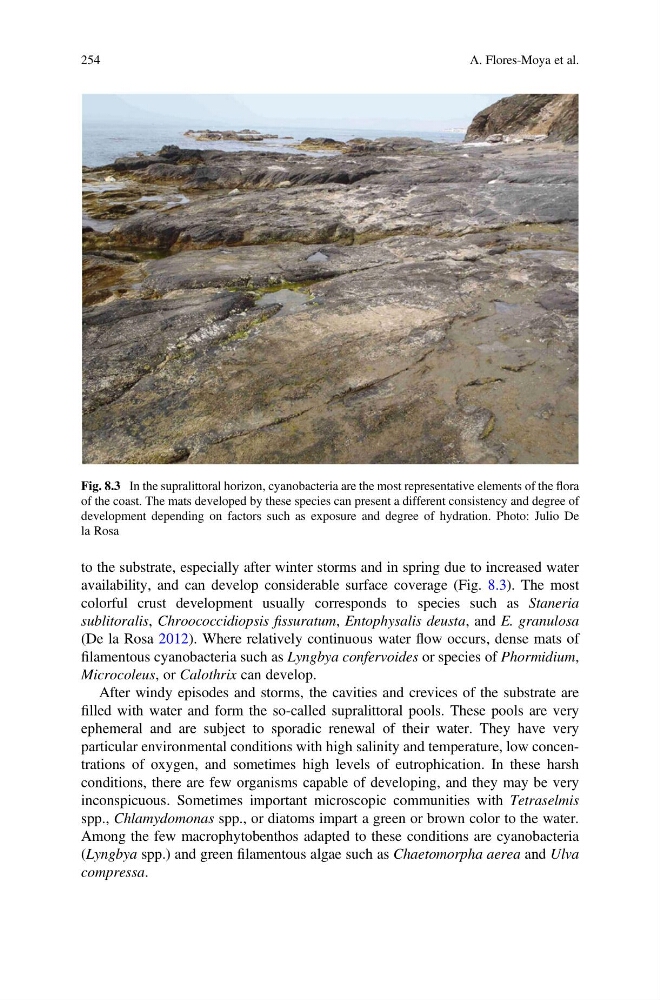
availability, and can develop considerable surface coverage (Fig. 8.3). The most
colorful crust development usually corresponds to species such as Staneria
sublitoralis, Chroococcidiopsis fissuratum, Entophysalis deusta, and E. granulosa
(De la Rosa 2012). Where relatively continuous water flow occurs, dense mats of
filamentous cyanobacteria such as Lyngbya confervoides or species of Phormidium,
Microcoleus, or Calothrix can develop.
After windy episodes and storms, the cavities and crevices of the substrate are
filled with water and form the so-called supralittoral pools. These pools are very
ephemeral and are subject to sporadic renewal of their water. They have very
particular environmental conditions with high salinity and temperature, low concentrations of oxygen, and sometimes high levels of eutrophication. In these harsh
conditions, there are few organisms capable of developing, and they may be very
inconspicuous. Sometimes important microscopic communities with Tetraselmis
spp., Chlamydomonas spp., or diatoms impart a green or brown color to the water.
Among the few macrophytobenthos adapted to these conditions are cyanobacteria
(Lyngbya spp.) and green filamentous algae such as Chaetomorpha aerea and Ulva
compressa.
Fig. 8.3 In the supralittoral horizon, cyanobacteria are the most representative elements of the flora
of the coast. The mats developed by these species can present a different consistency and degree of
development depending on factors such as exposure and degree of hydration. Photo: Julio De
la Rosa
254
A. Flores-Moya et al.
availability, and can develop considerable surface coverage (Fig. 8.3). The most
colorful crust development usually corresponds to species such as Staneria
sublitoralis, Chroococcidiopsis fissuratum, Entophysalis deusta, and E. granulosa
(De la Rosa 2012). Where relatively continuous water flow occurs, dense mats of
filamentous cyanobacteria such as Lyngbya confervoides or species of Phormidium,
Microcoleus, or Calothrix can develop.
After windy episodes and storms, the cavities and crevices of the substrate are
filled with water and form the so-called supralittoral pools. These pools are very
ephemeral and are subject to sporadic renewal of their water. They have very
particular environmental conditions with high salinity and temperature, low concentrations of oxygen, and sometimes high levels of eutrophication. In these harsh
conditions, there are few organisms capable of developing, and they may be very
inconspicuous. Sometimes important microscopic communities with Tetraselmis
spp., Chlamydomonas spp., or diatoms impart a green or brown color to the water.
Among the few macrophytobenthos adapted to these conditions are cyanobacteria
(Lyngbya spp.) and green filamentous algae such as Chaetomorpha aerea and Ulva
compressa.
Fig. 8.3 In the supralittoral horizon, cyanobacteria are the most representative elements of the flora
of the coast. The mats developed by these species can present a different consistency and degree of
development depending on factors such as exposure and degree of hydration. Photo: Julio De
la Rosa
254
A. Flores-Moya et al.