

areas in the Alboran Sea (as result of the different upwelling events previously
described). The high productivity in these areas is reflected in high Chl-a concentrations and high phytoplankton abundance, in comparison with adjacent areas of the
Western Alboran Sea, as those of the center of the WAG (Rodríguez et al. 1998;
Reul et al. 2005; Mercado et al. 2014). In the Eastern Alboran Sea, when the EAG is
well developed, the most productive zones are found at the northern edge of the EAG
(Leblanc et al. 2004). But when the EAG collapses, Chl-a is enhanced at the southern
part (Claustre et al. 1994).
As a general pattern, the upwelling area in the NW Alboran Sea is characterized
by Chl-a concentrations higher than 1 μgÁl
À1 and high PP, whereas lower Chl-a
concentrations (<1 μgÁl
À1 ) and low PP are found in the central WAG (Rodríguez
et al. 1998; Reul et al. 2005: Morán and Estrada 2001; Mercado et al. 2014). The
southern sector of the Alboran Sea, occupied by nutrient-poor Atlantic waters, is
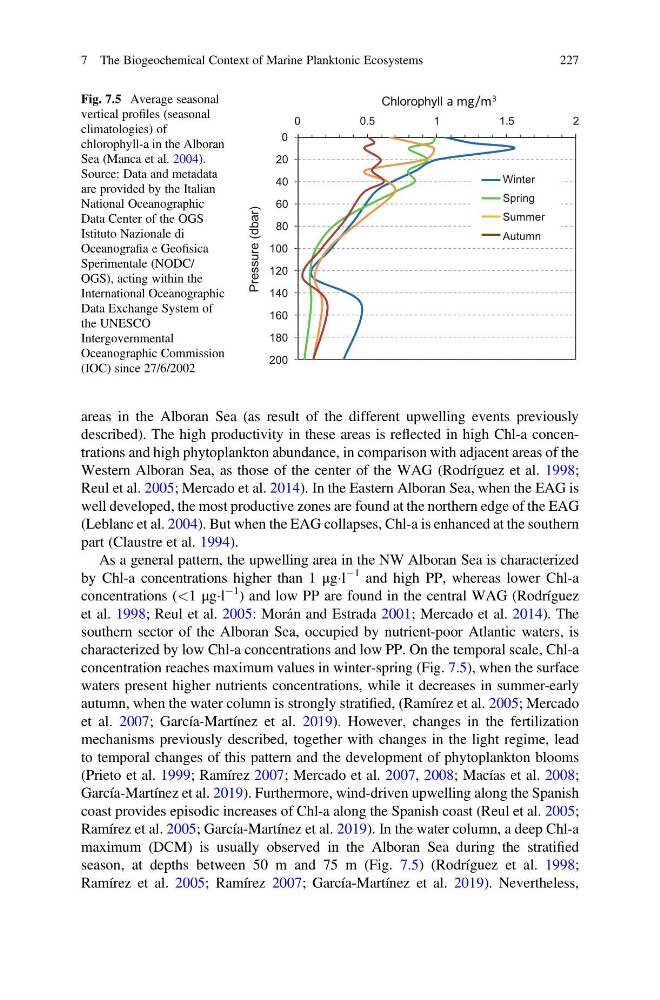
characterized by low Chl-a concentrations and low PP. On the temporal scale, Chl-a
concentration reaches maximum values in winter-spring (Fig. 7.5), when the surface
waters present higher nutrients concentrations, while it decreases in summer-early
autumn, when the water column is strongly stratified, (Ramírez et al. 2005; Mercado
et al. 2007; García-Martínez et al. 2019). However, changes in the fertilization
mechanisms previously described, together with changes in the light regime, lead
to temporal changes of this pattern and the development of phytoplankton blooms
(Prieto et al. 1999; Ramírez 2007; Mercado et al. 2007, 2008; Macías et al. 2008;
García-Martínez et al. 2019). Furthermore, wind-driven upwelling along the Spanish
coast provides episodic increases of Chl-a along the Spanish coast (Reul et al. 2005;
Ramírez et al. 2005; García-Martínez et al. 2019). In the water column, a deep Chl-a
maximum (DCM) is usually observed in the Alboran Sea during the stratified
season, at depths between 50 m and 75 m (Fig. 7.5) (Rodríguez et al. 1998;
Ramírez et al. 2005; Ramírez 2007; García-Martínez et al. 2019). Nevertheless,
0
20
40
60
80
100
120
140
160
180
200
0
0 . 5
1
1 . 5
2
Chlorophyll a mg/m 3
Pressure (dbar)
Winter
Spring
Summer
Autumn
Fig. 7.5 Average seasonal
vertical profiles (seasonal
climatologies) of
chlorophyll-a in the Alboran
Sea (Manca et al. 2004).
Source: Data and metadata
are provided by the Italian
National Oceanographic
Data Center of the OGS
Istituto Nazionale di
Oceanografia e Geofisica
Sperimentale (NODC/
OGS), acting within the
International Oceanographic
Data Exchange System of
the UNESCO
Intergovernmental
Oceanographic Commission
(IOC) since 27/6/2002
7 The Biogeochemical Context of Marine Planktonic Ecosystems
227
described). The high productivity in these areas is reflected in high Chl-a concentrations and high phytoplankton abundance, in comparison with adjacent areas of the
Western Alboran Sea, as those of the center of the WAG (Rodríguez et al. 1998;
Reul et al. 2005; Mercado et al. 2014). In the Eastern Alboran Sea, when the EAG is
well developed, the most productive zones are found at the northern edge of the EAG
(Leblanc et al. 2004). But when the EAG collapses, Chl-a is enhanced at the southern
part (Claustre et al. 1994).
As a general pattern, the upwelling area in the NW Alboran Sea is characterized
by Chl-a concentrations higher than 1 μgÁl
À1 and high PP, whereas lower Chl-a
concentrations (<1 μgÁl
À1 ) and low PP are found in the central WAG (Rodríguez
et al. 1998; Reul et al. 2005: Morán and Estrada 2001; Mercado et al. 2014). The
southern sector of the Alboran Sea, occupied by nutrient-poor Atlantic waters, is
characterized by low Chl-a concentrations and low PP. On the temporal scale, Chl-a
concentration reaches maximum values in winter-spring (Fig. 7.5), when the surface
waters present higher nutrients concentrations, while it decreases in summer-early
autumn, when the water column is strongly stratified, (Ramírez et al. 2005; Mercado
et al. 2007; García-Martínez et al. 2019). However, changes in the fertilization
mechanisms previously described, together with changes in the light regime, lead
to temporal changes of this pattern and the development of phytoplankton blooms
(Prieto et al. 1999; Ramírez 2007; Mercado et al. 2007, 2008; Macías et al. 2008;
García-Martínez et al. 2019). Furthermore, wind-driven upwelling along the Spanish
coast provides episodic increases of Chl-a along the Spanish coast (Reul et al. 2005;
Ramírez et al. 2005; García-Martínez et al. 2019). In the water column, a deep Chl-a
maximum (DCM) is usually observed in the Alboran Sea during the stratified
season, at depths between 50 m and 75 m (Fig. 7.5) (Rodríguez et al. 1998;
Ramírez et al. 2005; Ramírez 2007; García-Martínez et al. 2019). Nevertheless,
0
20
40
60
80
100
120
140
160
180
200
0
0 . 5
1
1 . 5
2
Chlorophyll a mg/m 3
Pressure (dbar)
Winter
Spring
Summer
Autumn
Fig. 7.5 Average seasonal
vertical profiles (seasonal
climatologies) of
chlorophyll-a in the Alboran
Sea (Manca et al. 2004).
Source: Data and metadata
are provided by the Italian
National Oceanographic
Data Center of the OGS
Istituto Nazionale di
Oceanografia e Geofisica
Sperimentale (NODC/
OGS), acting within the
International Oceanographic
Data Exchange System of
the UNESCO
Intergovernmental
Oceanographic Commission
(IOC) since 27/6/2002
7 The Biogeochemical Context of Marine Planktonic Ecosystems
227