

6.5.3 Recent Sediments: Facies Model
The surface and spatial distribution of recent sediments have been determined by
several regional studies (Zamarreño et al. 1983; El Moumni and Gensous 1992;
Ercilla 1992; Hernández Molina et al. 1993; El Moumni 1994; Ercilla et al. 1994,
2019; Bárcenas 2002, 2012). Sedimentation is mainly siliciclastic; only locally it is
mixed (terrigenous-carbonate) in the eastern Iberian sector (Almería margin) and on
the main, shallowest, and isolated seamounts (Alboran Ridge, Xauen Bank, and
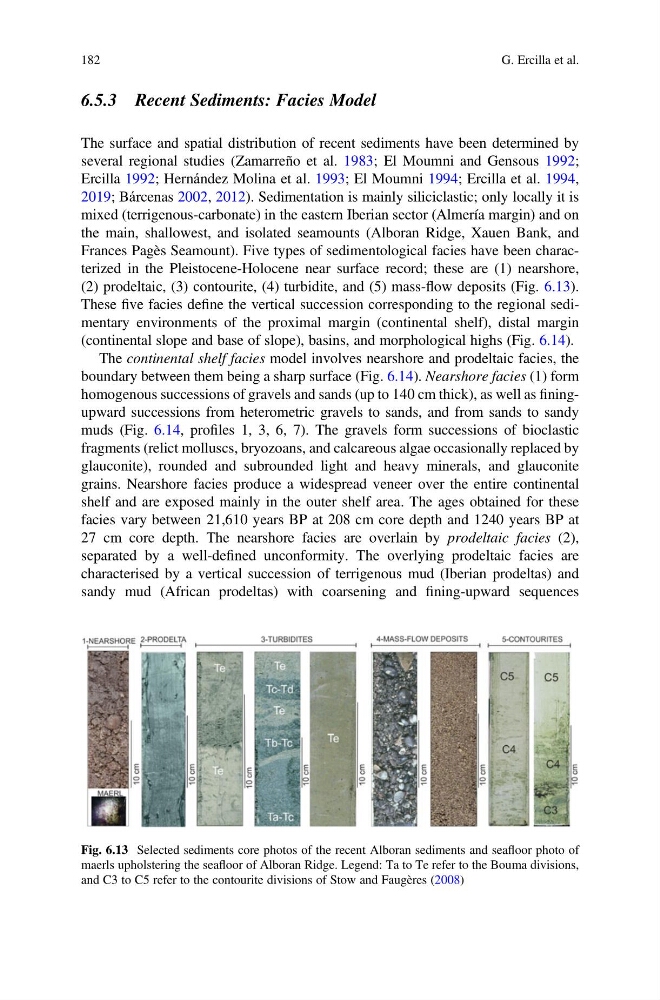
Frances Pagès Seamount). Five types of sedimentological facies have been characterized in the Pleistocene-Holocene near surface record; these are (1) nearshore,
(2) prodeltaic, (3) contourite, (4) turbidite, and (5) mass-flow deposits (Fig. 6.13).
These five facies define the vertical succession corresponding to the regional sedimentary environments of the proximal margin (continental shelf), distal margin
(continental slope and base of slope), basins, and morphological highs (Fig. 6.14).
The continental shelf facies model involves nearshore and prodeltaic facies, the
boundary between them being a sharp surface (Fig. 6.14). Nearshore facies (1) form
homogenous successions of gravels and sands (up to 140 cm thick), as well as finingupward successions from heterometric gravels to sands, and from sands to sandy
muds (Fig. 6.14, profiles 1, 3, 6, 7). The gravels form successions of bioclastic
fragments (relict molluscs, bryozoans, and calcareous algae occasionally replaced by
glauconite), rounded and subrounded light and heavy minerals, and glauconite
grains. Nearshore facies produce a widespread veneer over the entire continental
shelf and are exposed mainly in the outer shelf area. The ages obtained for these
facies vary between 21,610 years BP at 208 cm core depth and 1240 years BP at
27 cm core depth. The nearshore facies are overlain by prodeltaic facies (2),
separated by a well-defined unconformity. The overlying prodeltaic facies are
characterised by a vertical succession of terrigenous mud (Iberian prodeltas) and
sandy mud (African prodeltas) with coarsening and fining-upward sequences
Fig. 6.13 Selected sediments core photos of the recent Alboran sediments and seafloor photo of
maerls upholstering the seafloor of Alboran Ridge. Legend: Ta to Te refer to the Bouma divisions,
and C3 to C5 refer to the contourite divisions of Stow and Faugères (2008)
182
G. Ercilla et al.
The surface and spatial distribution of recent sediments have been determined by
several regional studies (Zamarreño et al. 1983; El Moumni and Gensous 1992;
Ercilla 1992; Hernández Molina et al. 1993; El Moumni 1994; Ercilla et al. 1994,
2019; Bárcenas 2002, 2012). Sedimentation is mainly siliciclastic; only locally it is
mixed (terrigenous-carbonate) in the eastern Iberian sector (Almería margin) and on
the main, shallowest, and isolated seamounts (Alboran Ridge, Xauen Bank, and
Frances Pagès Seamount). Five types of sedimentological facies have been characterized in the Pleistocene-Holocene near surface record; these are (1) nearshore,
(2) prodeltaic, (3) contourite, (4) turbidite, and (5) mass-flow deposits (Fig. 6.13).
These five facies define the vertical succession corresponding to the regional sedimentary environments of the proximal margin (continental shelf), distal margin
(continental slope and base of slope), basins, and morphological highs (Fig. 6.14).
The continental shelf facies model involves nearshore and prodeltaic facies, the
boundary between them being a sharp surface (Fig. 6.14). Nearshore facies (1) form
homogenous successions of gravels and sands (up to 140 cm thick), as well as finingupward successions from heterometric gravels to sands, and from sands to sandy
muds (Fig. 6.14, profiles 1, 3, 6, 7). The gravels form successions of bioclastic
fragments (relict molluscs, bryozoans, and calcareous algae occasionally replaced by
glauconite), rounded and subrounded light and heavy minerals, and glauconite
grains. Nearshore facies produce a widespread veneer over the entire continental
shelf and are exposed mainly in the outer shelf area. The ages obtained for these
facies vary between 21,610 years BP at 208 cm core depth and 1240 years BP at
27 cm core depth. The nearshore facies are overlain by prodeltaic facies (2),
separated by a well-defined unconformity. The overlying prodeltaic facies are
characterised by a vertical succession of terrigenous mud (Iberian prodeltas) and
sandy mud (African prodeltas) with coarsening and fining-upward sequences
Fig. 6.13 Selected sediments core photos of the recent Alboran sediments and seafloor photo of
maerls upholstering the seafloor of Alboran Ridge. Legend: Ta to Te refer to the Bouma divisions,
and C3 to C5 refer to the contourite divisions of Stow and Faugères (2008)
182
G. Ercilla et al.