

expression on the surface, forming relatively small seamounts tens of metres high
(Pérez-Belzuz et al. 1997).
Mud volcanoes can be defined as conical edifices built up by mud sediments and
fluids expelled from a deep source layer as the result of degassing processes (Kopf
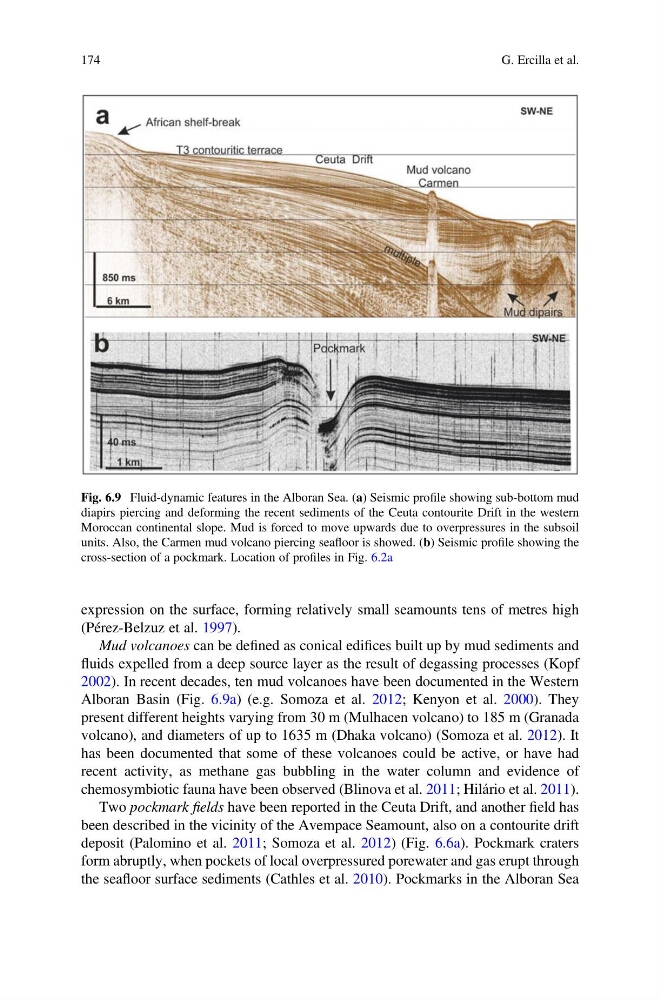
2002). In recent decades, ten mud volcanoes have been documented in the Western
Alboran Basin (Fig. 6.9a) (e.g. Somoza et al. 2012; Kenyon et al. 2000). They
present different heights varying from 30 m (Mulhacen volcano) to 185 m (Granada
volcano), and diameters of up to 1635 m (Dhaka volcano) (Somoza et al. 2012). It
has been documented that some of these volcanoes could be active, or have had
recent activity, as methane gas bubbling in the water column and evidence of
chemosymbiotic fauna have been observed (Blinova et al. 2011; Hilário et al. 2011).
Two pockmark fields have been reported in the Ceuta Drift, and another field has
been described in the vicinity of the Avempace Seamount, also on a contourite drift
deposit (Palomino et al. 2011; Somoza et al. 2012) (Fig. 6.6a). Pockmark craters
form abruptly, when pockets of local overpressured porewater and gas erupt through
the seafloor surface sediments (Cathles et al. 2010). Pockmarks in the Alboran Sea
Fig. 6.9 Fluid-dynamic features in the Alboran Sea. (a) Seismic profile showing sub-bottom mud
diapirs piercing and deforming the recent sediments of the Ceuta contourite Drift in the western
Moroccan continental slope. Mud is forced to move upwards due to overpressures in the subsoil
units. Also, the Carmen mud volcano piercing seafloor is showed. (b) Seismic profile showing the
cross-section of a pockmark. Location of profiles in Fig. 6.2a
174
G. Ercilla et al.
(Pérez-Belzuz et al. 1997).
Mud volcanoes can be defined as conical edifices built up by mud sediments and
fluids expelled from a deep source layer as the result of degassing processes (Kopf
2002). In recent decades, ten mud volcanoes have been documented in the Western
Alboran Basin (Fig. 6.9a) (e.g. Somoza et al. 2012; Kenyon et al. 2000). They
present different heights varying from 30 m (Mulhacen volcano) to 185 m (Granada
volcano), and diameters of up to 1635 m (Dhaka volcano) (Somoza et al. 2012). It
has been documented that some of these volcanoes could be active, or have had
recent activity, as methane gas bubbling in the water column and evidence of
chemosymbiotic fauna have been observed (Blinova et al. 2011; Hilário et al. 2011).
Two pockmark fields have been reported in the Ceuta Drift, and another field has
been described in the vicinity of the Avempace Seamount, also on a contourite drift
deposit (Palomino et al. 2011; Somoza et al. 2012) (Fig. 6.6a). Pockmark craters
form abruptly, when pockets of local overpressured porewater and gas erupt through
the seafloor surface sediments (Cathles et al. 2010). Pockmarks in the Alboran Sea
Fig. 6.9 Fluid-dynamic features in the Alboran Sea. (a) Seismic profile showing sub-bottom mud
diapirs piercing and deforming the recent sediments of the Ceuta contourite Drift in the western
Moroccan continental slope. Mud is forced to move upwards due to overpressures in the subsoil
units. Also, the Carmen mud volcano piercing seafloor is showed. (b) Seismic profile showing the
cross-section of a pockmark. Location of profiles in Fig. 6.2a
174
G. Ercilla et al.