

reverse flank of the Alboran Ridge, the Al-Idrissi left-lateral transfer fault
(Estrada et al. 2018), and compressive structures at the southern limit of the
Rifian belt (Jimenez-Munt et al. 2003; Chalouan et al. 2006, 2014; Pedrera et al.
2011) (Fig. 5.1). In the Gulf of Cadiz sector, the contemporary WNW-ESE
convergence produces the SWIM right-lateral transfer zone as well as compressive structures of NE trend that affect the Miocene Allochthonous Unit of the
Gulf of Cadiz and several oceanic features (Medialdea et al. 2004; Zitellini et al.
2009; Terrinha et al. 2009; Rosas et al. 2009, 2012; Duarte et al. 2011; Cunha
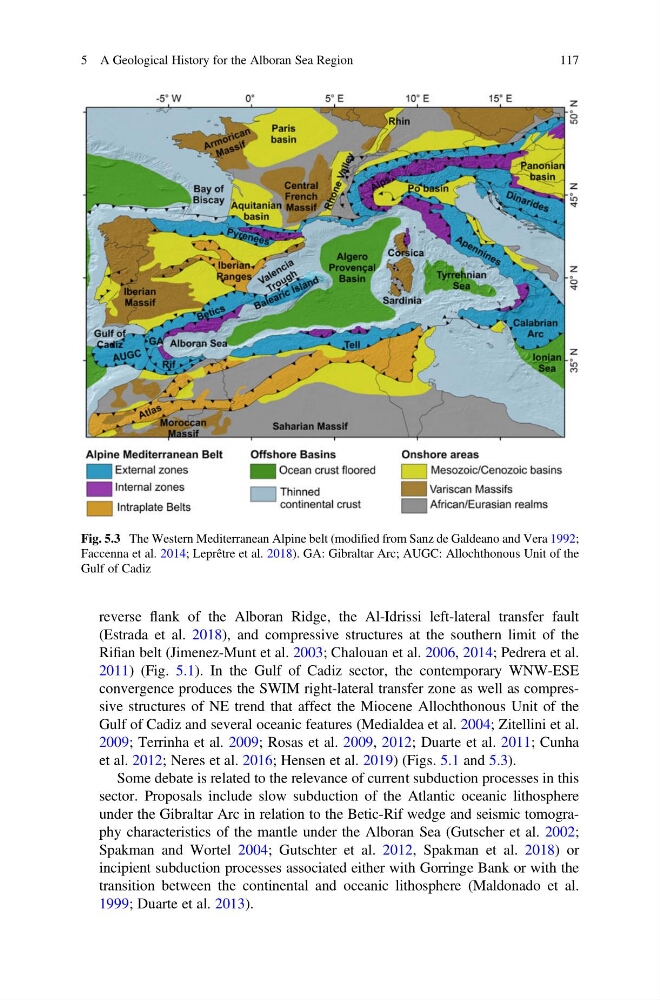
et al. 2012; Neres et al. 2016; Hensen et al. 2019) (Figs. 5.1 and 5.3).
Some debate is related to the relevance of current subduction processes in this
sector. Proposals include slow subduction of the Atlantic oceanic lithosphere
under the Gibraltar Arc in relation to the Betic-Rif wedge and seismic tomography characteristics of the mantle under the Alboran Sea (Gutscher et al. 2002;
Spakman and Wortel 2004; Gutschter et al. 2012, Spakman et al. 2018) or
incipient subduction processes associated either with Gorringe Bank or with the
transition between the continental and oceanic lithosphere (Maldonado et al.
1999; Duarte et al. 2013).
Fig. 5.3 The Western Mediterranean Alpine belt (modified from Sanz de Galdeano and Vera 1992;
Faccenna et al. 2014; Leprêtre et al. 2018). GA: Gibraltar Arc; AUGC: Allochthonous Unit of the
Gulf of Cadiz
5 A Geological History for the Alboran Sea Region
117
(Estrada et al. 2018), and compressive structures at the southern limit of the
Rifian belt (Jimenez-Munt et al. 2003; Chalouan et al. 2006, 2014; Pedrera et al.
2011) (Fig. 5.1). In the Gulf of Cadiz sector, the contemporary WNW-ESE
convergence produces the SWIM right-lateral transfer zone as well as compressive structures of NE trend that affect the Miocene Allochthonous Unit of the
Gulf of Cadiz and several oceanic features (Medialdea et al. 2004; Zitellini et al.
2009; Terrinha et al. 2009; Rosas et al. 2009, 2012; Duarte et al. 2011; Cunha
et al. 2012; Neres et al. 2016; Hensen et al. 2019) (Figs. 5.1 and 5.3).
Some debate is related to the relevance of current subduction processes in this
sector. Proposals include slow subduction of the Atlantic oceanic lithosphere
under the Gibraltar Arc in relation to the Betic-Rif wedge and seismic tomography characteristics of the mantle under the Alboran Sea (Gutscher et al. 2002;
Spakman and Wortel 2004; Gutschter et al. 2012, Spakman et al. 2018) or
incipient subduction processes associated either with Gorringe Bank or with the
transition between the continental and oceanic lithosphere (Maldonado et al.
1999; Duarte et al. 2013).
Fig. 5.3 The Western Mediterranean Alpine belt (modified from Sanz de Galdeano and Vera 1992;
Faccenna et al. 2014; Leprêtre et al. 2018). GA: Gibraltar Arc; AUGC: Allochthonous Unit of the
Gulf of Cadiz
5 A Geological History for the Alboran Sea Region
117