

Solutions to exercises
81
The equilibrium conditions between the various phases leads to
WE
CE
O
O
2
2
μ
μ
=
−
−
u
u
because J(e) = 0 (blocking electrode),
with
4F (
)
CE
WE
WE
CE
O
O
2
2
ϕ
ϕ
μ
μ
−
=
−
and
U
4F
1
4F
1
CE
WE
WE
CE
O
O
O
2
2
2
ϕ
ϕ
μ
μ
μ
Δ
=
−
=
−
=
`
j
where φ
i
is the electrical potential of phase i.
Given that
RT ln a
i
0 ,i
i
O
O
O
2
2
2
μ
μ
=
+
we finally obtain
ln
U
F
RT
a
a
4
O
CE
O
WE
2
2
=
or
a
a e
WE
CE
O
O
RT
UF
4
2
2
=
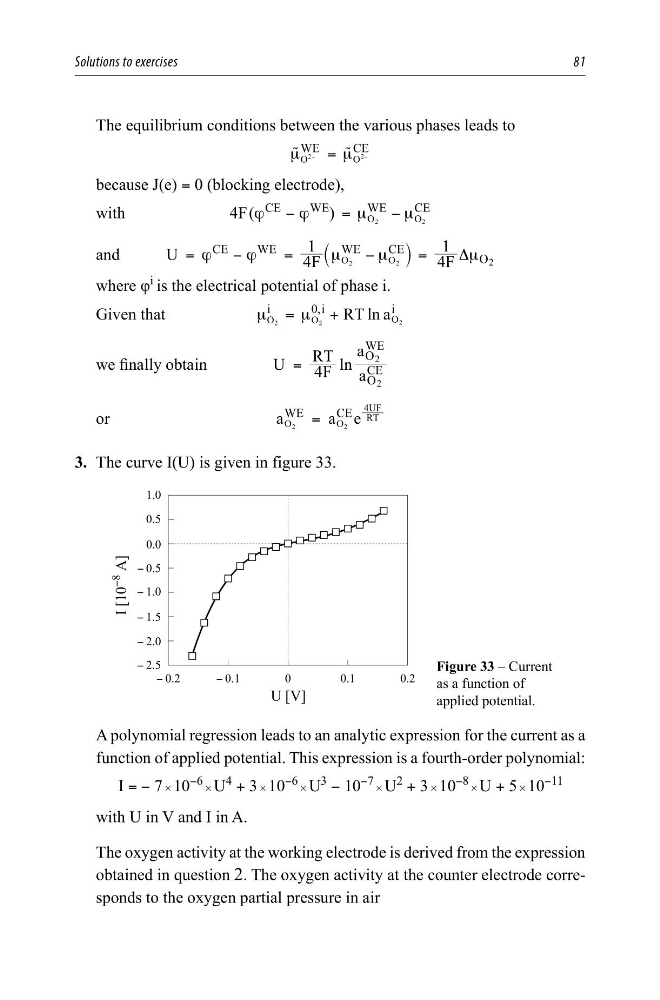
3. The curve I(U) is given in figure 33.
Figure 33 – Current
as a function of
applied potential.
A polynomial regression leads to an analytic expression for the current as a
function of applied potential. This expression is a fourth-order polynomial:
I = − 7 # 10
−6 # U
4 + 3 # 10
−6 # U
3 − 10
−7 # U
2 + 3 # 10
−8 # U + 5 # 10
−11
with U in V and I in A.
The oxygen activity at the working electrode is derived from the expression
obtained in question 2. The oxygen activity at the counter electrode corresponds to the oxygen partial pressure in air
<
<
<
<
<
<
<
,>
<
$@
8>9@
81
The equilibrium conditions between the various phases leads to
WE
CE
O
O
2
2
μ
μ
=
−
−
u
u
because J(e) = 0 (blocking electrode),
with
4F (
)
CE
WE
WE
CE
O
O
2
2
ϕ
ϕ
μ
μ
−
=
−
and
U
4F
1
4F
1
CE
WE
WE
CE
O
O
O
2
2
2
ϕ
ϕ
μ
μ
μ
Δ
=
−
=
−
=
`
j
where φ
i
is the electrical potential of phase i.
Given that
RT ln a
i
0 ,i
i
O
O
O
2
2
2
μ
μ
=
+
we finally obtain
ln
U
F
RT
a
a
4
O
CE
O
WE
2
2
=
or
a
a e
WE
CE
O
O
RT
UF
4
2
2
=
3. The curve I(U) is given in figure 33.
Figure 33 – Current
as a function of
applied potential.
A polynomial regression leads to an analytic expression for the current as a
function of applied potential. This expression is a fourth-order polynomial:
I = − 7 # 10
−6 # U
4 + 3 # 10
−6 # U
3 − 10
−7 # U
2 + 3 # 10
−8 # U + 5 # 10
−11
with U in V and I in A.
The oxygen activity at the working electrode is derived from the expression
obtained in question 2. The oxygen activity at the counter electrode corresponds to the oxygen partial pressure in air
<
<
<
<
<
<
<
,>
<
$@
8>9@