

Solutions to exercises
35
Solution 1.8 – Departure from stoichiometry of barium fluoride BaF 2
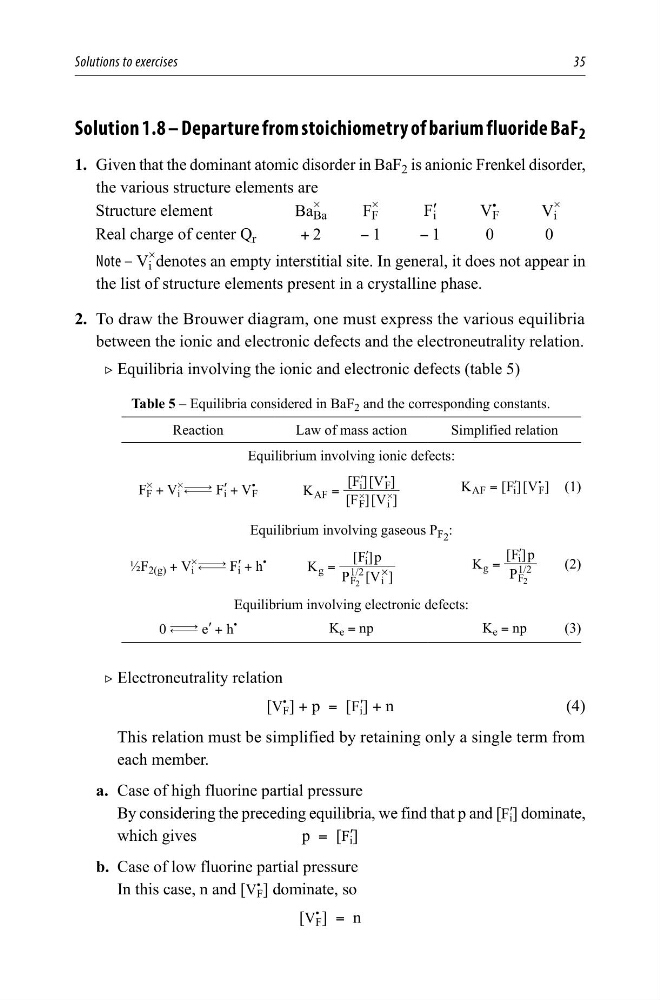
1. Given that the dominant atomic disorder in BaF 2 is anionic Frenkel disorder,
the various structure elements are
Structure element
Ba
#
Ba
F
#
F
F ′
i
V
•
F
V
#
i
Real charge of center Q r
+ 2
− 1
− 1
0
0
Note – V
#
i denotes an empty interstitial site. In general, it does not appear in
the list of structure elements present in a crystalline phase.
2. To draw the Brouwer diagram, one must express the various equilibria
between the ionic and electronic defects and the electroneutrality relation.
2 Equilibria involving the ionic and electronic defects (table 5)
Table 5 – Equilibria considered in BaF 2 and the corresponding constants.
Reaction
Law of mass action
Simplified relation
Equilibrium involving ionic defects:
F
#
F + V
#
i m F′ i + V
•
F
]
]
]
]
[ [
[ [
K
F V
F V
AF
F
i
i
F
=
:
#
#
l
]
]
[ [
K
F V
AF
i
F
=
:
l
(1)
Equilibrium involving gaseous P F 2 :
½F 2(g) + V
#
i m F′ i + h
•
]
]
[
[
K
p
P V
F
/
g
F
i
i
1 2
2
=
#
l
[ ]
K
F p
P
/
g
i
F
1 2
2
=
l
(2)
Equilibrium involving electronic defects:
0 m e′ + h
•
K e = np
K e = np
(3)
2 Electroneutrality relation
[V
•
F ] + p = [F′ i ] + n
(4)
This relation must be simplified by retaining only a single term from
each member.
a. Case of high fluorine partial pressure
By considering the preceding equilibria, we find that p and [F′ i ] dominate,
which gives
p = [F′ i ]
b. Case of low fluorine partial pressure
In this case, n and [V
•
F ] dominate, so
[V
•
F ] = n
35
Solution 1.8 – Departure from stoichiometry of barium fluoride BaF 2
1. Given that the dominant atomic disorder in BaF 2 is anionic Frenkel disorder,
the various structure elements are
Structure element
Ba
#
Ba
F
#
F
F ′
i
V
•
F
V
#
i
Real charge of center Q r
+ 2
− 1
− 1
0
0
Note – V
#
i denotes an empty interstitial site. In general, it does not appear in
the list of structure elements present in a crystalline phase.
2. To draw the Brouwer diagram, one must express the various equilibria
between the ionic and electronic defects and the electroneutrality relation.
2 Equilibria involving the ionic and electronic defects (table 5)
Table 5 – Equilibria considered in BaF 2 and the corresponding constants.
Reaction
Law of mass action
Simplified relation
Equilibrium involving ionic defects:
F
#
F + V
#
i m F′ i + V
•
F
]
]
]
]
[ [
[ [
K
F V
F V
AF
F
i
i
F
=
:
#
#
l
]
]
[ [
K
F V
AF
i
F
=
:
l
(1)
Equilibrium involving gaseous P F 2 :
½F 2(g) + V
#
i m F′ i + h
•
]
]
[
[
K
p
P V
F
/
g
F
i
i
1 2
2
=
#
l
[ ]
K
F p
P
/
g
i
F
1 2
2
=
l
(2)
Equilibrium involving electronic defects:
0 m e′ + h
•
K e = np
K e = np
(3)
2 Electroneutrality relation
[V
•
F ] + p = [F′ i ] + n
(4)
This relation must be simplified by retaining only a single term from
each member.
a. Case of high fluorine partial pressure
By considering the preceding equilibria, we find that p and [F′ i ] dominate,
which gives
p = [F′ i ]
b. Case of low fluorine partial pressure
In this case, n and [V
•
F ] dominate, so
[V
•
F ] = n