

28
1 – Description of ionic crystals
2 This material is used for cathodes in solid oxide fuel cells (SOFCs).
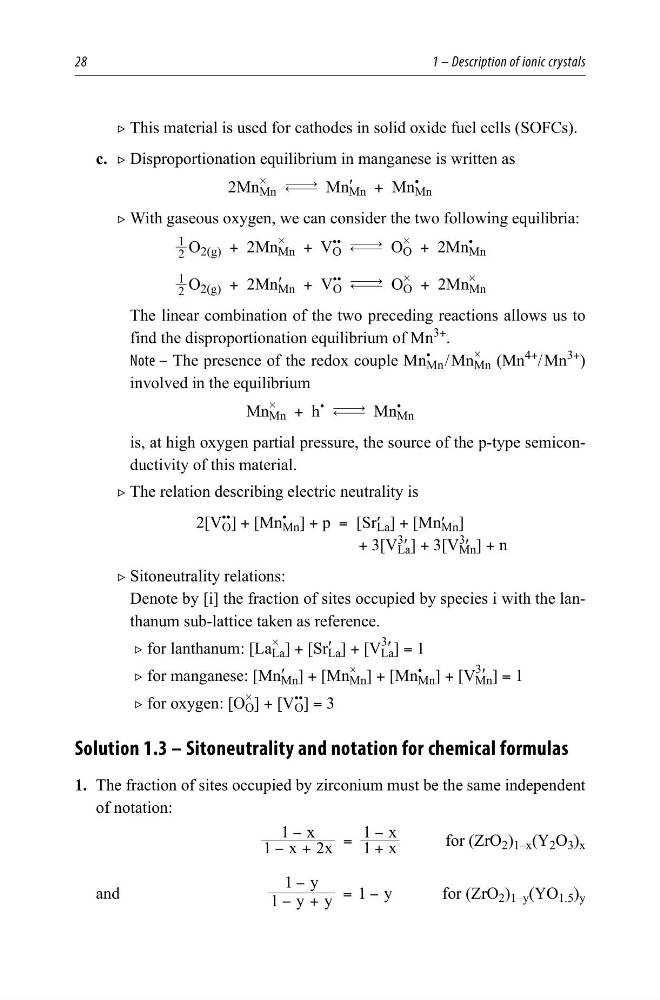
c. 2 Disproportionation equilibrium in manganese is written as
2Mn
#
Mn m Mn ′
Mn + Mn
•
Mn
2 With gaseous oxygen, we can consider the two following equilibria:
2
1
O 2(g) + 2Mn
#
Mn + V
••
O m O
#
O + 2Mn
•
Mn
2
1
O 2(g) + 2Mn ′
Mn + V
••
O m O
#
O + 2Mn
#
Mn
The linear combination of the two preceding reactions allows us to
find the disproportionation equilibrium of Mn
3+
.
Note – The presence of the redox couple Mn
•
Mn /Mn
#
Mn (Mn
4+
/Mn
3+
)
involved in the equilibrium
Mn
#
Mn + h
•
m Mn
•
Mn
is, at high oxygen partial pressure, the source of the p-type semiconductivity of this material.
2 The relation describing electric neutrality is
2[V
••
O ] + [Mn
•
Mn ] + p = [Sr′ La ] + [Mn′ Mn ]
+ 3[V
3
′
La ] + 3[V
3
′
Mn ] + n
2 Sitoneutrality relations:
Denote by [i] the fraction of sites occupied by species i with the lanthanum sub-lattice taken as reference.
2 for lanthanum: [La
#
La ] + [Sr ′
La ] + [V
3
′
La ] = 1
2 for manganese: [Mn ′
Mn ] + [Mn
#
Mn ] + [Mn
•
Mn ] + [V
3
′
Mn ] = 1
2 for oxygen: [O
#
O ] + [V
••
O ] = 3
Solution 1.3 – Sitoneutrality and notation for chemical formulas
1. The fraction of sites occupied by zirconium must be the same independent
of notation:
x
x
x
x
x
1
2
1
1
1
− +
−
= +
−
for (ZrO 2 ) 1–x (Y 2 O 3 ) x
and
y y
y
y
1
1
1
− +
−
= −
for (ZrO 2 ) 1–y (YO 1.5 ) y
1 – Description of ionic crystals
2 This material is used for cathodes in solid oxide fuel cells (SOFCs).
c. 2 Disproportionation equilibrium in manganese is written as
2Mn
#
Mn m Mn ′
Mn + Mn
•
Mn
2 With gaseous oxygen, we can consider the two following equilibria:
2
1
O 2(g) + 2Mn
#
Mn + V
••
O m O
#
O + 2Mn
•
Mn
2
1
O 2(g) + 2Mn ′
Mn + V
••
O m O
#
O + 2Mn
#
Mn
The linear combination of the two preceding reactions allows us to
find the disproportionation equilibrium of Mn
3+
.
Note – The presence of the redox couple Mn
•
Mn /Mn
#
Mn (Mn
4+
/Mn
3+
)
involved in the equilibrium
Mn
#
Mn + h
•
m Mn
•
Mn
is, at high oxygen partial pressure, the source of the p-type semiconductivity of this material.
2 The relation describing electric neutrality is
2[V
••
O ] + [Mn
•
Mn ] + p = [Sr′ La ] + [Mn′ Mn ]
+ 3[V
3
′
La ] + 3[V
3
′
Mn ] + n
2 Sitoneutrality relations:
Denote by [i] the fraction of sites occupied by species i with the lanthanum sub-lattice taken as reference.
2 for lanthanum: [La
#
La ] + [Sr ′
La ] + [V
3
′
La ] = 1
2 for manganese: [Mn ′
Mn ] + [Mn
#
Mn ] + [Mn
•
Mn ] + [V
3
′
Mn ] = 1
2 for oxygen: [O
#
O ] + [V
••
O ] = 3
Solution 1.3 – Sitoneutrality and notation for chemical formulas
1. The fraction of sites occupied by zirconium must be the same independent
of notation:
x
x
x
x
x
1
2
1
1
1
− +
−
= +
−
for (ZrO 2 ) 1–x (Y 2 O 3 ) x
and
y y
y
y
1
1
1
− +
−
= −
for (ZrO 2 ) 1–y (YO 1.5 ) y