

Appendix
Fick’s laws of diffusion
Fick’s law describes the fluxes and concentrations of a species as a function of
time t and of distance x with respect to an origin, which is generally fixed at
the electrode-electrolyte interface.
First law
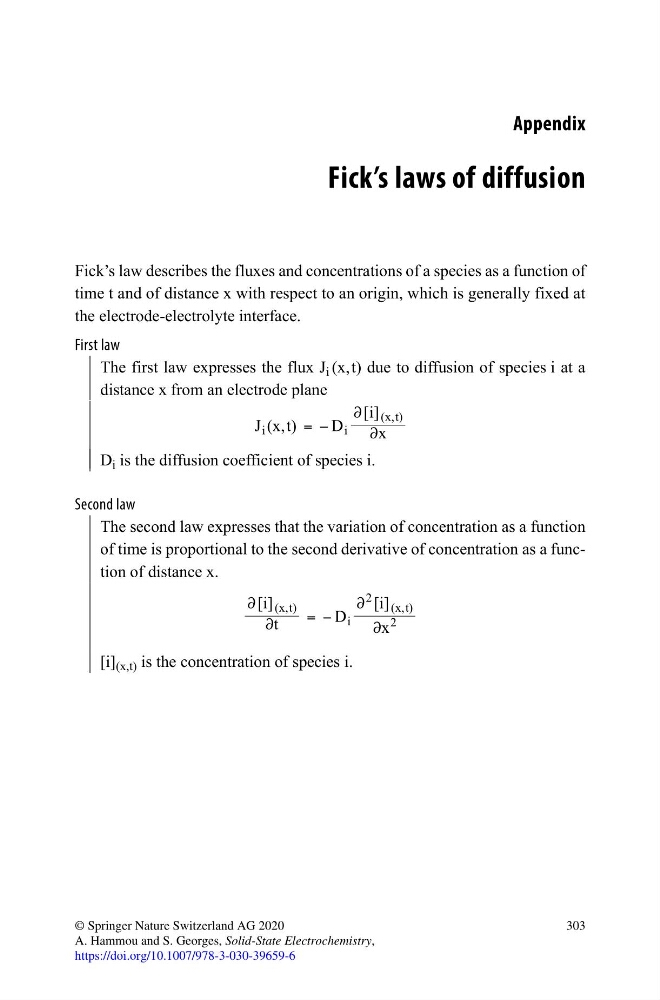
The first law expresses the flux J i (x,t) due to diffusion of species i at a
distance x from an electrode plane
J (x, t)
D
x
[i]
i
i
(x,t)
2
2
= −
D i is the diffusion coefficient of species i.
Second law
The second law expresses that the variation of concentration as a function
of time is proportional to the second derivative of concentration as a function of distance x.
t
[i]
D
x
[i]
(x,t)
i
2
2
(x,t)
2
2
2
2
= −
[i] (x,t) is the concentration of species i.
© Springer Nature Switzerland AG 2020
A. Hammou and S. Georges, Solid-State Electrochemistry,
https://doi.org/10.1007/978-3-030-39659-6
303
Fick’s laws of diffusion
Fick’s law describes the fluxes and concentrations of a species as a function of
time t and of distance x with respect to an origin, which is generally fixed at
the electrode-electrolyte interface.
First law
The first law expresses the flux J i (x,t) due to diffusion of species i at a
distance x from an electrode plane
J (x, t)
D
x
[i]
i
i
(x,t)
2
2
= −
D i is the diffusion coefficient of species i.
Second law
The second law expresses that the variation of concentration as a function
of time is proportional to the second derivative of concentration as a function of distance x.
t
[i]
D
x
[i]
(x,t)
i
2
2
(x,t)
2
2
2
2
= −
[i] (x,t) is the concentration of species i.
© Springer Nature Switzerland AG 2020
A. Hammou and S. Georges, Solid-State Electrochemistry,
https://doi.org/10.1007/978-3-030-39659-6
303