

300
5 – Applications
4. As shown by the equation
E
E° 4 F
RT
ln P
P
P
P
CO
H O
2
CH
O
2(c)
2
2
4
2
Δ
Δ
=
+
#
#
#
when P H 2 O increases, ΔE decreases.
Furthermore,
2 water vapor enables the steam reforming reaction, which is rapid and
thermodynamically favorable. This reaction leads to the formation of hydrogen and carbon monoxide, which in turn may be electrochemically
oxidized. This results in a release of 8 electrons, as is the case for total
electrochemical oxidation.
2 water vapor strongly limits the risk of carbon deposition by cracking or
by the Boudouard reaction, which poisons the electrocatalytic sites of the
anode. Nevertheless, the strong endothermicity of the steam reforming
reaction leads to a thermal gradient at the cell input, which manifests
itself as a delamination of the anode due to the significant mechanical
stress exerted on the ceramic assembly.
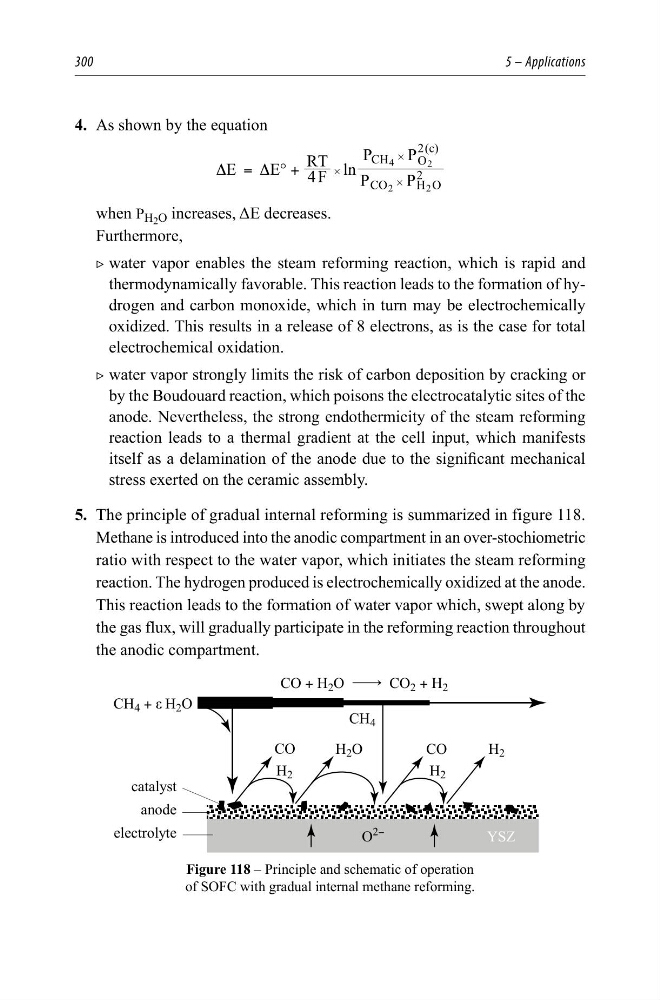
5. The principle of gradual internal reforming is summarized in figure 118.
Methane is introduced into the anodic compartment in an over-stochiometric
ratio with respect to the water vapor, which initiates the steam reforming
reaction. The hydrogen produced is electrochemically oxidized at the anode.
This reaction leads to the formation of water vapor which, swept along by
the gas flux, will gradually participate in the reforming reaction throughout
the anodic compartment.
2
<
<6=
DQRGH
FDWDO\VW
HOHFWURO\WH
&2
+ 2$&2
+
&2
+
+
&+
&+
İ + 2
&2
+ 2
+
Figure 118 – Principle and schematic of operation
of SOFC with gradual internal methane reforming.
5 – Applications
4. As shown by the equation
E
E° 4 F
RT
ln P
P
P
P
CO
H O
2
CH
O
2(c)
2
2
4
2
Δ
Δ
=
+
#
#
#
when P H 2 O increases, ΔE decreases.
Furthermore,
2 water vapor enables the steam reforming reaction, which is rapid and
thermodynamically favorable. This reaction leads to the formation of hydrogen and carbon monoxide, which in turn may be electrochemically
oxidized. This results in a release of 8 electrons, as is the case for total
electrochemical oxidation.
2 water vapor strongly limits the risk of carbon deposition by cracking or
by the Boudouard reaction, which poisons the electrocatalytic sites of the
anode. Nevertheless, the strong endothermicity of the steam reforming
reaction leads to a thermal gradient at the cell input, which manifests
itself as a delamination of the anode due to the significant mechanical
stress exerted on the ceramic assembly.
5. The principle of gradual internal reforming is summarized in figure 118.
Methane is introduced into the anodic compartment in an over-stochiometric
ratio with respect to the water vapor, which initiates the steam reforming
reaction. The hydrogen produced is electrochemically oxidized at the anode.
This reaction leads to the formation of water vapor which, swept along by
the gas flux, will gradually participate in the reforming reaction throughout
the anodic compartment.
2
<
<6=
DQRGH
FDWDO\VW
HOHFWURO\WH
&2
+ 2$&2
+
&2
+
+
&+
&+
İ + 2
&2
+ 2
+
Figure 118 – Principle and schematic of operation
of SOFC with gradual internal methane reforming.