

290
5 – Applications
b. At zero current, we measure the thermodynamic potential difference ΔE th .
At low current densities (domain I), ΔE is controlled by the activation
overpotentials due to charge-transfer phenomena. At high current densities
(domain III), ΔE is controlled by the concentration overpotentials due to
diffusion phenomena. In the intermediate (domain II), ΔE is controlled
by ohmic voltage-drop phenomena.
The optimal use of the cell corresponds theoretically to the operating
point that delivers the maximum power P max . The corresponding current
density is thus i P max and is obtained for a given potential difference ΔE P max .
Solution 5.16 – Solid oxide fuel cell (SOFC)
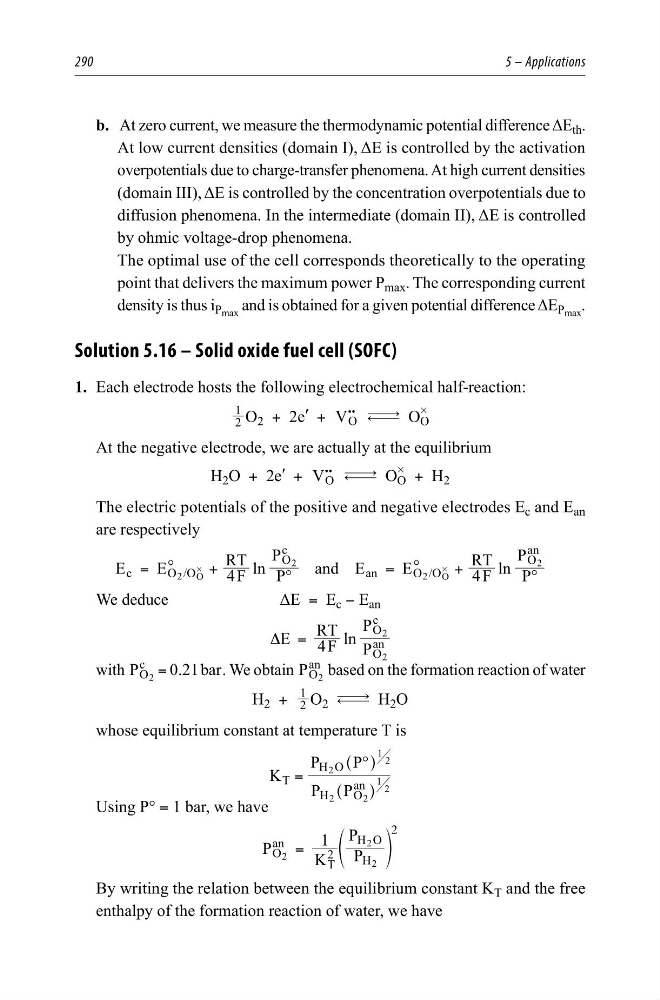
1. Each electrode hosts the following electrochemical half-reaction:
2
1
O 2 + 2e ′ + V O
::
m O
#
O
At the negative electrode, we are actually at the equilibrium
H 2 O + 2e ′ + V O
::
m O
#
O + H 2
The electric potentials of the positive and negative electrodes E c and E an
are respectively
°
°
ln
ln
E
E
F
RT
P
P
and E
E
F
RT
P
P
4
4
/
/
c
O O
O
c
an
O O
O
an
O
O
2
2
2
2
=
+
=
+
#
#
°
°
We deduce
ΔE = E c − E an
E
4 F
RT
ln P
P
O
an
O
c
2
2
Δ =
with
.
P
b ar
0 21
O
c
2
=
. We obtain P O
an
2
based on the formation reaction of water
H 2 + 2
1
O 2 m H 2 O
whose equilibrium constant at temperature T is
°
K
P P
P
P
T
H
O
an
H O
2
2
1 2
2
1 2
=
^
^
h
h
Using P° = 1 bar, we have
P
K
P
P
1
O
an
T
H
H O
2
2
2
2
2
=
e
o
By writing the relation between the equilibrium constant K T and the free
enthalpy of the formation reaction of water, we have
5 – Applications
b. At zero current, we measure the thermodynamic potential difference ΔE th .
At low current densities (domain I), ΔE is controlled by the activation
overpotentials due to charge-transfer phenomena. At high current densities
(domain III), ΔE is controlled by the concentration overpotentials due to
diffusion phenomena. In the intermediate (domain II), ΔE is controlled
by ohmic voltage-drop phenomena.
The optimal use of the cell corresponds theoretically to the operating
point that delivers the maximum power P max . The corresponding current
density is thus i P max and is obtained for a given potential difference ΔE P max .
Solution 5.16 – Solid oxide fuel cell (SOFC)
1. Each electrode hosts the following electrochemical half-reaction:
2
1
O 2 + 2e ′ + V O
::
m O
#
O
At the negative electrode, we are actually at the equilibrium
H 2 O + 2e ′ + V O
::
m O
#
O + H 2
The electric potentials of the positive and negative electrodes E c and E an
are respectively
°
°
ln
ln
E
E
F
RT
P
P
and E
E
F
RT
P
P
4
4
/
/
c
O O
O
c
an
O O
O
an
O
O
2
2
2
2
=
+
=
+
#
#
°
°
We deduce
ΔE = E c − E an
E
4 F
RT
ln P
P
O
an
O
c
2
2
Δ =
with
.
P
b ar
0 21
O
c
2
=
. We obtain P O
an
2
based on the formation reaction of water
H 2 + 2
1
O 2 m H 2 O
whose equilibrium constant at temperature T is
°
K
P P
P
P
T
H
O
an
H O
2
2
1 2
2
1 2
=
^
^
h
h
Using P° = 1 bar, we have
P
K
P
P
1
O
an
T
H
H O
2
2
2
2
2
=
e
o
By writing the relation between the equilibrium constant K T and the free
enthalpy of the formation reaction of water, we have