

Solutions to exercises
283
B – Type (II) cell involving solid O
2−
ionic conducting electrolyte
(ZrO 2 -Y 2 O 3 , ZrO 2 -MgO)
1. Let us write out the electrochemical reactions
2 at the reference electrode 2
1
O 2
Ref + 2e m O
2−
2 at the measurement electrode NO
Mes + 2O
2−
m NO 3
− + 3e
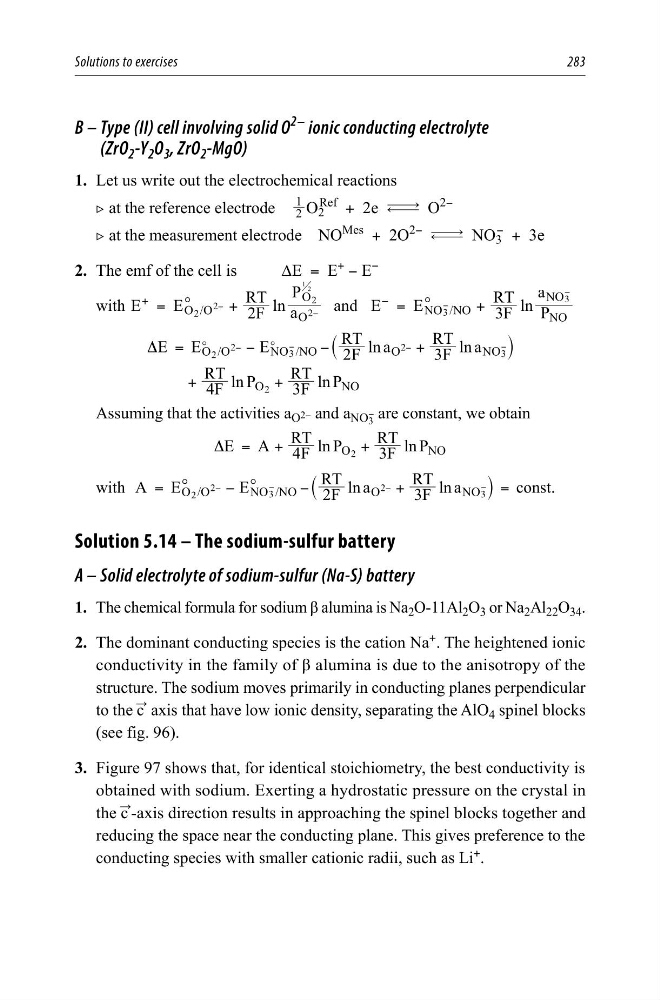
2. The emf of the cell is
∆E = E
+ − E
−
with
ln
ln
E
E
F
RT a
P
and E
E
F
RT
P
a
2
3
/
/
O O
O
O
NO NO
NO
NO
2
2
2
2
3
3
1 2
=
+
=
+
+
−
−
−
−
−
°
°
E E
E
2F
RT
ln a
3F
RT
ln a
4F
RT
ln P
3F
RT
ln P
O /O
N O /NO
O
N O
O
N O
2
2
3
2
3
2
Δ =
−
−
+
+
+
−
−
−
−
°
°
`
j
Assuming that the activities a O 2− and a NO 3
− are constant, we obtain
E A 4F
RT
ln P
3F
RT
ln P
O
N O
2
Δ = +
+
with A E
E
2F
RT
ln a
3F
RT
ln a
c onst.
O /O
N O /NO
O
N O
2
2
3
2
3
=
−
−
+
=
−
−
−
−
°
°
`
j
Solution 5.14 – The sodium-sulfur battery
A – Solid electrolyte of sodium-sulfur (Na-S) battery
1. The chemical formula for sodium β alumina is Na 2 O-11Al 2 O 3 or Na 2 Al 22 O 34 .
2. The dominant conducting species is the cation Na
+
. The heightened ionic
conductivity in the family of β alumina is due to the anisotropy of the
structure. The sodium moves primarily in conducting planes perpendicular
to the c
→
axis that have low ionic density, separating the AlO 4 spinel blocks
(see fig. 96).
3. Figure 97 shows that, for identical stoichiometry, the best conductivity is
obtained with sodium. Exerting a hydrostatic pressure on the crystal in
the c
→
-axis direction results in approaching the spinel blocks together and
reducing the space near the conducting plane. This gives preference to the
conducting species with smaller cationic radii, such as Li
+
.
283
B – Type (II) cell involving solid O
2−
ionic conducting electrolyte
(ZrO 2 -Y 2 O 3 , ZrO 2 -MgO)
1. Let us write out the electrochemical reactions
2 at the reference electrode 2
1
O 2
Ref + 2e m O
2−
2 at the measurement electrode NO
Mes + 2O
2−
m NO 3
− + 3e
2. The emf of the cell is
∆E = E
+ − E
−
with
ln
ln
E
E
F
RT a
P
and E
E
F
RT
P
a
2
3
/
/
O O
O
O
NO NO
NO
NO
2
2
2
2
3
3
1 2
=
+
=
+
+
−
−
−
−
−
°
°
E E
E
2F
RT
ln a
3F
RT
ln a
4F
RT
ln P
3F
RT
ln P
O /O
N O /NO
O
N O
O
N O
2
2
3
2
3
2
Δ =
−
−
+
+
+
−
−
−
−
°
°
`
j
Assuming that the activities a O 2− and a NO 3
− are constant, we obtain
E A 4F
RT
ln P
3F
RT
ln P
O
N O
2
Δ = +
+
with A E
E
2F
RT
ln a
3F
RT
ln a
c onst.
O /O
N O /NO
O
N O
2
2
3
2
3
=
−
−
+
=
−
−
−
−
°
°
`
j
Solution 5.14 – The sodium-sulfur battery
A – Solid electrolyte of sodium-sulfur (Na-S) battery
1. The chemical formula for sodium β alumina is Na 2 O-11Al 2 O 3 or Na 2 Al 22 O 34 .
2. The dominant conducting species is the cation Na
+
. The heightened ionic
conductivity in the family of β alumina is due to the anisotropy of the
structure. The sodium moves primarily in conducting planes perpendicular
to the c
→
axis that have low ionic density, separating the AlO 4 spinel blocks
(see fig. 96).
3. Figure 97 shows that, for identical stoichiometry, the best conductivity is
obtained with sodium. Exerting a hydrostatic pressure on the crystal in
the c
→
-axis direction results in approaching the spinel blocks together and
reducing the space near the conducting plane. This gives preference to the
conducting species with smaller cationic radii, such as Li
+
.