

Solutions to exercises
281
Na
+ + NO + 2
1
O 2 + e m NaNO 2
2
1
F
NaNO
Na
NaNO
NO
O
e
Au
2
Au
2
2
2
μ
μ
μ
μ
μ
ϕ
=
+
+
+
−
+
l
u
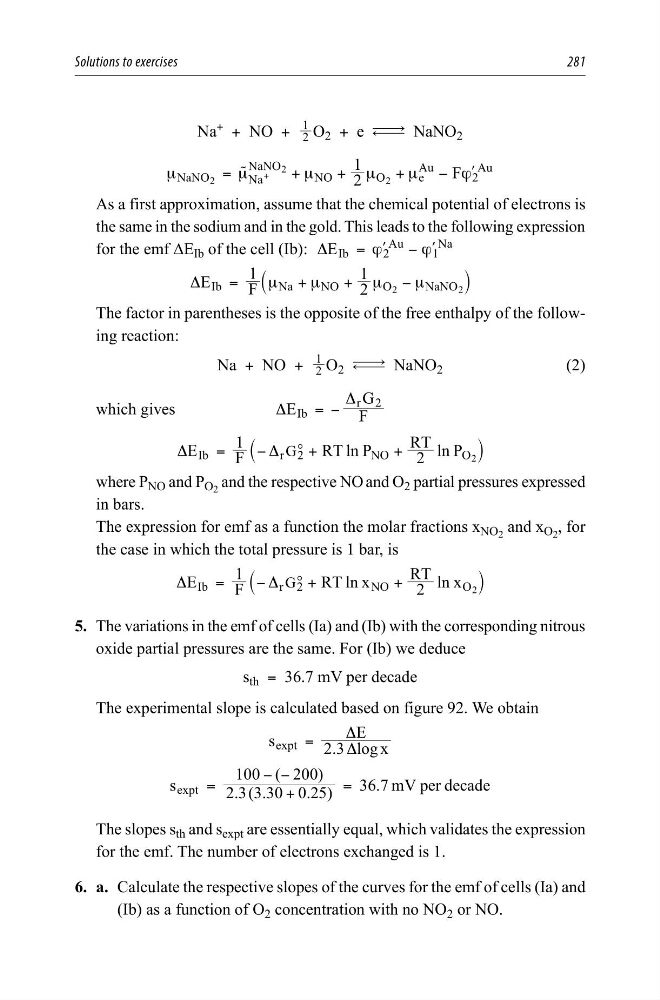
As a first approximation, assume that the chemical potential of electrons is
the same in the sodium and in the gold. This leads to the following expression
for the emf ∆E Ib of the cell (Ib): E Ib
2
Au
1
Na
ϕ
ϕ
Δ
=
−
l
l
E
F
1
2
1
Ib
Na
NO
O
N aNO
2
2
μ
μ
μ
μ
Δ
=
+
+
−
`
j
The factor in parentheses is the opposite of the free enthalpy of the following reaction:
Na + NO + 2
1
O 2 m NaNO 2
(2)
which gives
E
F
G
Ib
r 2
Δ
Δ
= −
E
F
1
RT ln P
2
RT
ln P
G
Ib
r 2
NO
O 2
Δ
Δ
=
−
+
+
°
`
j
where P NO and P O 2 and the respective NO and O 2 partial pressures expressed
in bars.
The expression for emf as a function the molar fractions x NO 2 and x O 2 , for
the case in which the total pressure is 1 bar, is
E
F
1
RT ln x
2
RT
ln x
G
Ib
r 2
NO
O 2
Δ
Δ
=
−
+
+
°
`
j
5. The variations in the emf of cells (Ia) and (Ib) with the corresponding nitrous
oxide partial pressures are the same. For (Ib) we deduce
s th = 36.7 mV per decade
The experimental slope is calculated based on figure 92. We obtain
s
2.3 log x
E
expt
Δ
Δ
=
. ( .
. )
(
)
.
s
m V per decade
2 3 3 30 0 25
100
200
36 7
expt =
+
− −
=
The slopes s th and s expt are essentially equal, which validates the expression
for the emf. The number of electrons exchanged is 1.
6. a. Calculate the respective slopes of the curves for the emf of cells (Ia) and
(Ib) as a function of O 2 concentration with no NO 2 or NO.
281
Na
+ + NO + 2
1
O 2 + e m NaNO 2
2
1
F
NaNO
Na
NaNO
NO
O
e
Au
2
Au
2
2
2
μ
μ
μ
μ
μ
ϕ
=
+
+
+
−
+
l
u
As a first approximation, assume that the chemical potential of electrons is
the same in the sodium and in the gold. This leads to the following expression
for the emf ∆E Ib of the cell (Ib): E Ib
2
Au
1
Na
ϕ
ϕ
Δ
=
−
l
l
E
F
1
2
1
Ib
Na
NO
O
N aNO
2
2
μ
μ
μ
μ
Δ
=
+
+
−
`
j
The factor in parentheses is the opposite of the free enthalpy of the following reaction:
Na + NO + 2
1
O 2 m NaNO 2
(2)
which gives
E
F
G
Ib
r 2
Δ
Δ
= −
E
F
1
RT ln P
2
RT
ln P
G
Ib
r 2
NO
O 2
Δ
Δ
=
−
+
+
°
`
j
where P NO and P O 2 and the respective NO and O 2 partial pressures expressed
in bars.
The expression for emf as a function the molar fractions x NO 2 and x O 2 , for
the case in which the total pressure is 1 bar, is
E
F
1
RT ln x
2
RT
ln x
G
Ib
r 2
NO
O 2
Δ
Δ
=
−
+
+
°
`
j
5. The variations in the emf of cells (Ia) and (Ib) with the corresponding nitrous
oxide partial pressures are the same. For (Ib) we deduce
s th = 36.7 mV per decade
The experimental slope is calculated based on figure 92. We obtain
s
2.3 log x
E
expt
Δ
Δ
=
. ( .
. )
(
)
.
s
m V per decade
2 3 3 30 0 25
100
200
36 7
expt =
+
− −
=
The slopes s th and s expt are essentially equal, which validates the expression
for the emf. The number of electrons exchanged is 1.
6. a. Calculate the respective slopes of the curves for the emf of cells (Ia) and
(Ib) as a function of O 2 concentration with no NO 2 or NO.