

272
5 – Applications
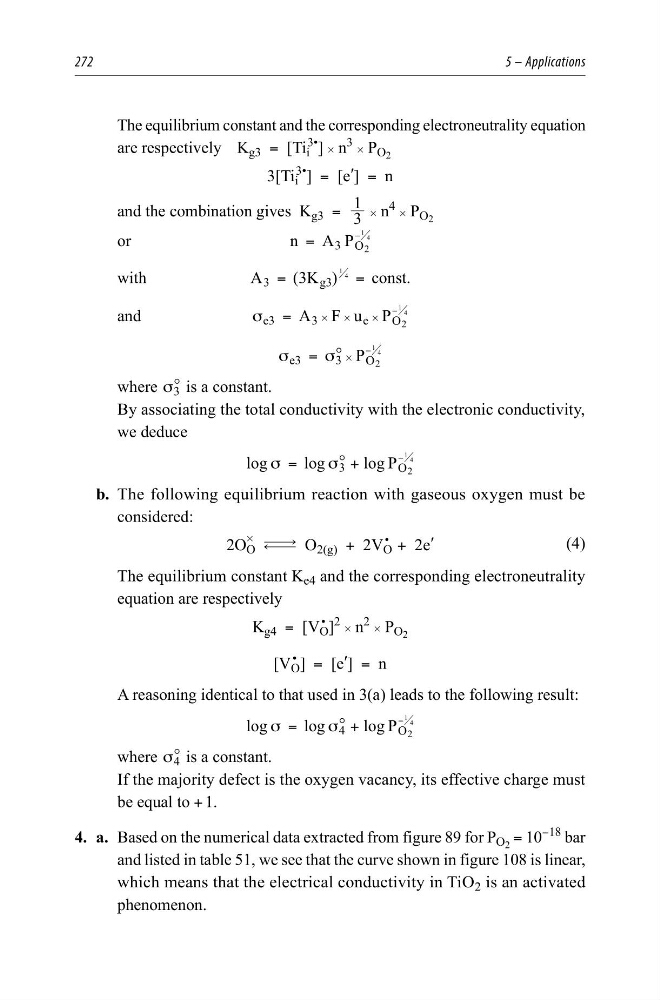
The equilibrium constant and the corresponding electroneutrality equation
are respectively K g3 = [Ti i
3•
] # n
3 # P O 2
3[Ti i
3•
] = [e ′ ] = n
and the combination gives K g3 = 3
1
# n
4 # P O 2
or
n A P
3 O 2
1 4
=
−
with
A
(3K )
const.
3
g 3
1 4
=
=
and
A F u P
e3
3
e
O 2
1 4
σ =
#
#
#
−
P
e3
3
O 2
1 4
σ
σ
=
#
−
°
where 3
σ ° is a constant.
By associating the total conductivity with the electronic conductivity,
we deduce
log
log
log P
3
O 2
1 4
σ
σ
=
+
−
°
b. The following equilibrium reaction with gaseous oxygen must be
considered:
2O
#
O m O 2(g) + 2V O
• + 2e ′
(4)
The equilibrium constant K e4 and the corresponding electroneutrality
equation are respectively
K g4 = [V O
•
]
2 # n
2 # P O 2
[V O
•
] = [e ′ ] = n
A reasoning identical to that used in 3(a) leads to the following result:
log
log
log P
4
O 2
1 4
σ
σ
=
+
−
°
where 4
σ ° is a constant.
If the majority defect is the oxygen vacancy, its effective charge must
be equal to + 1.
4. a. Based on the numerical data extracted from figure 89 for P O 2 = 10
−18
bar
and listed in table 51, we see that the curve shown in figure 108 is linear,
which means that the electrical conductivity in TiO 2 is an activated
phenomenon.
5 – Applications
The equilibrium constant and the corresponding electroneutrality equation
are respectively K g3 = [Ti i
3•
] # n
3 # P O 2
3[Ti i
3•
] = [e ′ ] = n
and the combination gives K g3 = 3
1
# n
4 # P O 2
or
n A P
3 O 2
1 4
=
−
with
A
(3K )
const.
3
g 3
1 4
=
=
and
A F u P
e3
3
e
O 2
1 4
σ =
#
#
#
−
P
e3
3
O 2
1 4
σ
σ
=
#
−
°
where 3
σ ° is a constant.
By associating the total conductivity with the electronic conductivity,
we deduce
log
log
log P
3
O 2
1 4
σ
σ
=
+
−
°
b. The following equilibrium reaction with gaseous oxygen must be
considered:
2O
#
O m O 2(g) + 2V O
• + 2e ′
(4)
The equilibrium constant K e4 and the corresponding electroneutrality
equation are respectively
K g4 = [V O
•
]
2 # n
2 # P O 2
[V O
•
] = [e ′ ] = n
A reasoning identical to that used in 3(a) leads to the following result:
log
log
log P
4
O 2
1 4
σ
σ
=
+
−
°
where 4
σ ° is a constant.
If the majority defect is the oxygen vacancy, its effective charge must
be equal to + 1.
4. a. Based on the numerical data extracted from figure 89 for P O 2 = 10
−18
bar
and listed in table 51, we see that the curve shown in figure 108 is linear,
which means that the electrical conductivity in TiO 2 is an activated
phenomenon.