

270
5 – Applications
Solution 5.10 – Oxygen semiconductor sensor
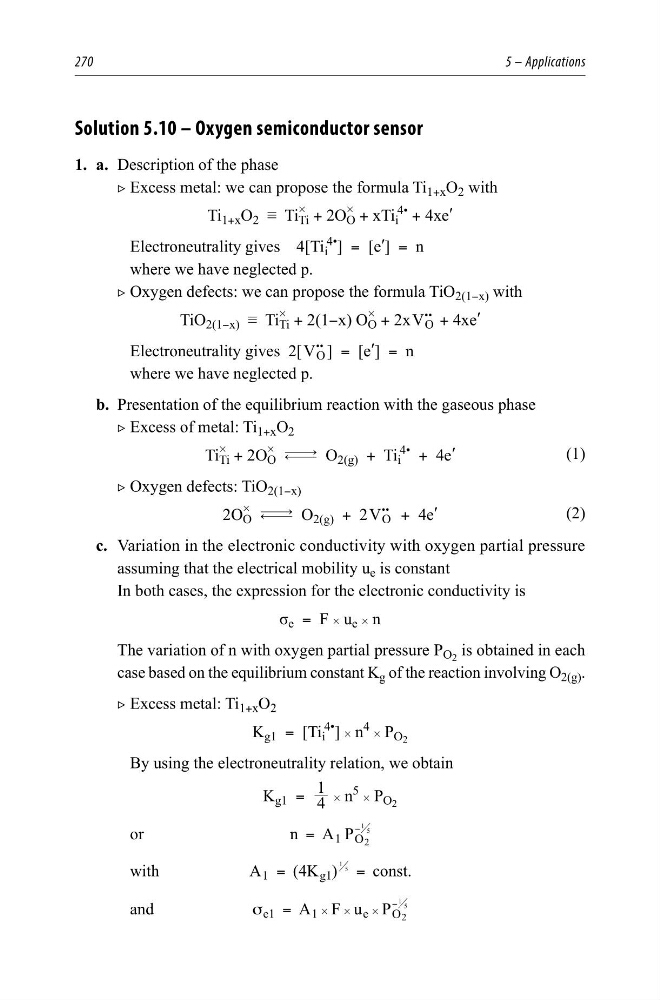
1. a. Description of the phase
2 Excess metal: we can propose the formula Ti 1+x O 2 with
Ti 1+x O 2 ≡ Ti
#
Ti + 2O
#
O + xTi i
4• + 4xe ′
Electroneutrality gives 4[Ti i
4•
] = [e ′ ] = n
where we have neglected p.
2 Oxygen defects: we can propose the formula TiO 2(1−x) with
TiO 2(1−x) ≡ Ti
#
Ti + 2(1−x) O
#
O + 2xV O
:: + 4xe ′
Electroneutrality gives 2[V O
::
] = [e ′ ] = n
where we have neglected p.
b. Presentation of the equilibrium reaction with the gaseous phase
2 Excess of metal: Ti 1+x O 2
Ti
#
Ti + 2O
#
O m O 2(g) + Ti i
4• + 4e ′
(1)
2 Oxygen defects: TiO 2(1−x)
2O
#
O m O 2(g) + 2V O
:: + 4e ′
(2)
c. Variation in the electronic conductivity with oxygen partial pressure
assuming that the electrical mobility u e is constant
In both cases, the expression for the electronic conductivity is
σ e = F # u e # n
The variation of n with oxygen partial pressure P O 2 is obtained in each
case based on the equilibrium constant K g of the reaction involving O 2(g) .
2 Excess metal: Ti 1+x O 2
K g1 = [Ti i
4•
] # n
4 # P O 2
By using the electroneutrality relation, we obtain
K g1 = 4
1
# n
5 # P O 2
or
n A P
1 O 2
1 5
=
−
with
(
)
.
A
K
const
4 g
1
1
1 5
=
=
and
A F u P
e1
1
e
O 2
1 5
σ =
#
#
#
−
5 – Applications
Solution 5.10 – Oxygen semiconductor sensor
1. a. Description of the phase
2 Excess metal: we can propose the formula Ti 1+x O 2 with
Ti 1+x O 2 ≡ Ti
#
Ti + 2O
#
O + xTi i
4• + 4xe ′
Electroneutrality gives 4[Ti i
4•
] = [e ′ ] = n
where we have neglected p.
2 Oxygen defects: we can propose the formula TiO 2(1−x) with
TiO 2(1−x) ≡ Ti
#
Ti + 2(1−x) O
#
O + 2xV O
:: + 4xe ′
Electroneutrality gives 2[V O
::
] = [e ′ ] = n
where we have neglected p.
b. Presentation of the equilibrium reaction with the gaseous phase
2 Excess of metal: Ti 1+x O 2
Ti
#
Ti + 2O
#
O m O 2(g) + Ti i
4• + 4e ′
(1)
2 Oxygen defects: TiO 2(1−x)
2O
#
O m O 2(g) + 2V O
:: + 4e ′
(2)
c. Variation in the electronic conductivity with oxygen partial pressure
assuming that the electrical mobility u e is constant
In both cases, the expression for the electronic conductivity is
σ e = F # u e # n
The variation of n with oxygen partial pressure P O 2 is obtained in each
case based on the equilibrium constant K g of the reaction involving O 2(g) .
2 Excess metal: Ti 1+x O 2
K g1 = [Ti i
4•
] # n
4 # P O 2
By using the electroneutrality relation, we obtain
K g1 = 4
1
# n
5 # P O 2
or
n A P
1 O 2
1 5
=
−
with
(
)
.
A
K
const
4 g
1
1
1 5
=
=
and
A F u P
e1
1
e
O 2
1 5
σ =
#
#
#
−