

268
5 – Applications
100 e
1 0 0.21 e
o
6
1.38 10
773
0.8 1.6 10
1.38 10
773
3.5 1.6 10
23
19
1 4
23
19
σ =
+
−
−
#
#
#
#
#
#
#
#
#
−
−
−
−
−
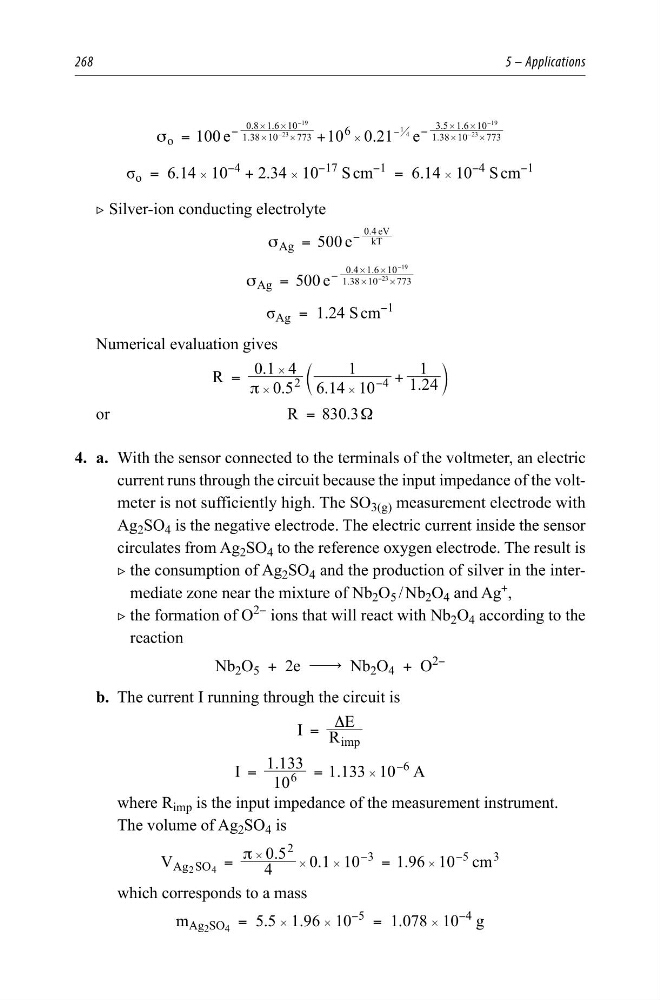
σ o = 6.14 # 10
−4 + 2.34 # 10
−17
S cm
−1 = 6.14 # 10
−4
S cm
−1
2 Silver-ion conducting electrolyte
500 e
Ag
kT
0.4 eV
σ =
−
500 e
Ag
1.38 10
773
0.4 1.6 10
23
19
σ =
−
#
#
#
#
−
−
σ Ag = 1.24 S cm
−1
Numerical evaluation gives
R
0.5
0.1 4
6.14 10
1
1.24
1
2
4
π
=
+
−
#
#
#
c
m
or
R 830.3 Ω
=
4. a. With the sensor connected to the terminals of the voltmeter, an electric
current runs through the circuit because the input impedance of the voltmeter is not sufficiently high. The SO 3(g) measurement electrode with
Ag 2 SO 4 is the negative electrode. The electric current inside the sensor
circulates from Ag 2 SO 4 to the reference oxygen electrode. The result is
2 the consumption of Ag 2 SO 4 and the production of silver in the intermediate zone near the mixture of Nb 2 O 5 / Nb 2 O 4 and Ag
+
,
2 the formation of O
2−
ions that will react with Nb 2 O 4 according to the
reaction
Nb 2 O 5 + 2e $ Nb 2 O 4 + O
2−
b. The current I running through the circuit is
I
R
E
imp
Δ
=
I
10
1.133
1.133 10 A
6
6
=
=
−
#
where R imp is the input impedance of the measurement instrument.
The volume of Ag 2 SO 4 is
V
4
0.5
0.1 10
1.96 10 cm
Ag SO
2
3
5
3
2
4
π
=
=
−
−
#
#
#
#
which corresponds to a mass
m Ag 2 SO 4 = 5.5 # 1.96 # 10
−5 = 1.078 # 10
−4
g
5 – Applications
100 e
1 0 0.21 e
o
6
1.38 10
773
0.8 1.6 10
1.38 10
773
3.5 1.6 10
23
19
1 4
23
19
σ =
+
−
−
#
#
#
#
#
#
#
#
#
−
−
−
−
−
σ o = 6.14 # 10
−4 + 2.34 # 10
−17
S cm
−1 = 6.14 # 10
−4
S cm
−1
2 Silver-ion conducting electrolyte
500 e
Ag
kT
0.4 eV
σ =
−
500 e
Ag
1.38 10
773
0.4 1.6 10
23
19
σ =
−
#
#
#
#
−
−
σ Ag = 1.24 S cm
−1
Numerical evaluation gives
R
0.5
0.1 4
6.14 10
1
1.24
1
2
4
π
=
+
−
#
#
#
c
m
or
R 830.3 Ω
=
4. a. With the sensor connected to the terminals of the voltmeter, an electric
current runs through the circuit because the input impedance of the voltmeter is not sufficiently high. The SO 3(g) measurement electrode with
Ag 2 SO 4 is the negative electrode. The electric current inside the sensor
circulates from Ag 2 SO 4 to the reference oxygen electrode. The result is
2 the consumption of Ag 2 SO 4 and the production of silver in the intermediate zone near the mixture of Nb 2 O 5 / Nb 2 O 4 and Ag
+
,
2 the formation of O
2−
ions that will react with Nb 2 O 4 according to the
reaction
Nb 2 O 5 + 2e $ Nb 2 O 4 + O
2−
b. The current I running through the circuit is
I
R
E
imp
Δ
=
I
10
1.133
1.133 10 A
6
6
=
=
−
#
where R imp is the input impedance of the measurement instrument.
The volume of Ag 2 SO 4 is
V
4
0.5
0.1 10
1.96 10 cm
Ag SO
2
3
5
3
2
4
π
=
=
−
−
#
#
#
#
which corresponds to a mass
m Ag 2 SO 4 = 5.5 # 1.96 # 10
−5 = 1.078 # 10
−4
g