

266
5 – Applications
RT ln P
2
2
2F
2
1
2
RT
ln P
SO
SO
Mes
Ag
e
Mes
O
O
Mes
Ag SO
3
3
2
2
2
4
μ
μ
μ
ϕ
μ
μ
+
+
+
−
+
+
=
+
°
°
°
u
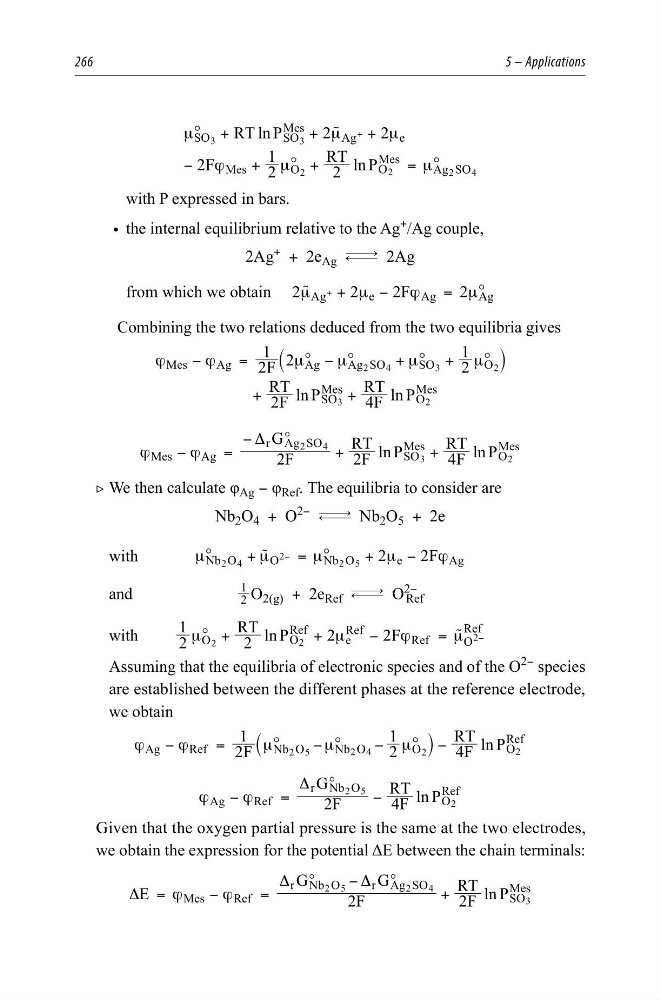
with P expressed in bars.
• the internal equilibrium relative to the Ag
+
/Ag couple,
2Ag
+ + 2e Ag m 2Ag
from which we obtain 2
2
2F
2
Ag
e
A g
A g
μ
μ
ϕ
μ
+
−
=
+
°
u
Combining the two relations deduced from the two equilibria gives
2F
1
2
2
1
2F
RT
ln P
4F
RT
ln P
Mes
Ag
A g
Ag SO
S O
O
SO
Mes
O
Mes
2
4
3
2
3
2
ϕ
ϕ
μ
μ
μ
μ
−
=
−
+
+
+
+
°
°
°
°
`
j
2F
G
2F
RT
ln P
4F
RT
ln P
Mes
Ag
r Ag SO
SO
Mes
O
Mes
2
4
3
2
ϕ
ϕ
Δ
−
=
−
+
+
°
2 We then calculate φ Ag − φ Ref . The equilibria to consider are
Nb 2 O 4 + O
2−
m Nb 2 O 5 + 2e
with
2
2F
Nb O
O
Nb O
e
Ag
2 4
2
2 5
μ
μ
μ
μ
ϕ
+
=
+
−
−
°
°
u
and
2
1
O 2(g) + 2e Ref m O
2−
Ref
with
2
1
2
RT
ln P
2
2F
O
O
Ref
e
Ref
Ref
O
Ref
2
2
2
μ
μ
ϕ
μ
+
+
−
=
−
°
u
Assuming that the equilibria of electronic species and of the O
2−
species
are established between the different phases at the reference electrode,
we obtain
2F
1
4F
RT
ln P
Ag
Ref
N b O
Nb O
O
O
Ref
2
1
2 5
2 4
2
2
ϕ
ϕ
μ
μ
μ
−
=
−
−
−
°
°
°
`
j
2F
G
4F
RT
ln P
Ag
Ref
r Nb O
O
Ref
2 5
2
ϕ
ϕ
Δ
−
=
−
°
Given that the oxygen partial pressure is the same at the two electrodes,
we obtain the expression for the potential ΔE between the chain terminals:
E
2F
G
G
2F
RT
ln P
Mes
Ref
r Nb O
r Ag SO
SO
Mes
2 5
2
4
3
ϕ
ϕ
Δ
Δ
Δ
=
−
=
−
+
°
°
5 – Applications
RT ln P
2
2
2F
2
1
2
RT
ln P
SO
SO
Mes
Ag
e
Mes
O
O
Mes
Ag SO
3
3
2
2
2
4
μ
μ
μ
ϕ
μ
μ
+
+
+
−
+
+
=
+
°
°
°
u
with P expressed in bars.
• the internal equilibrium relative to the Ag
+
/Ag couple,
2Ag
+ + 2e Ag m 2Ag
from which we obtain 2
2
2F
2
Ag
e
A g
A g
μ
μ
ϕ
μ
+
−
=
+
°
u
Combining the two relations deduced from the two equilibria gives
2F
1
2
2
1
2F
RT
ln P
4F
RT
ln P
Mes
Ag
A g
Ag SO
S O
O
SO
Mes
O
Mes
2
4
3
2
3
2
ϕ
ϕ
μ
μ
μ
μ
−
=
−
+
+
+
+
°
°
°
°
`
j
2F
G
2F
RT
ln P
4F
RT
ln P
Mes
Ag
r Ag SO
SO
Mes
O
Mes
2
4
3
2
ϕ
ϕ
Δ
−
=
−
+
+
°
2 We then calculate φ Ag − φ Ref . The equilibria to consider are
Nb 2 O 4 + O
2−
m Nb 2 O 5 + 2e
with
2
2F
Nb O
O
Nb O
e
Ag
2 4
2
2 5
μ
μ
μ
μ
ϕ
+
=
+
−
−
°
°
u
and
2
1
O 2(g) + 2e Ref m O
2−
Ref
with
2
1
2
RT
ln P
2
2F
O
O
Ref
e
Ref
Ref
O
Ref
2
2
2
μ
μ
ϕ
μ
+
+
−
=
−
°
u
Assuming that the equilibria of electronic species and of the O
2−
species
are established between the different phases at the reference electrode,
we obtain
2F
1
4F
RT
ln P
Ag
Ref
N b O
Nb O
O
O
Ref
2
1
2 5
2 4
2
2
ϕ
ϕ
μ
μ
μ
−
=
−
−
−
°
°
°
`
j
2F
G
4F
RT
ln P
Ag
Ref
r Nb O
O
Ref
2 5
2
ϕ
ϕ
Δ
−
=
−
°
Given that the oxygen partial pressure is the same at the two electrodes,
we obtain the expression for the potential ΔE between the chain terminals:
E
2F
G
G
2F
RT
ln P
Mes
Ref
r Nb O
r Ag SO
SO
Mes
2 5
2
4
3
ϕ
ϕ
Δ
Δ
Δ
=
−
=
−
+
°
°