

Solutions to exercises
263
2F E 2
2
2 RT ln a
a
RT ln P
2
RT
ln P
NaBr
AgBr
AgBr
NaBr
Na CO
CO
CO
O
2
3
2
2
2
μ
μ
μ
μ
Δ =
−
+
−
+
+
+
°
°
°
°
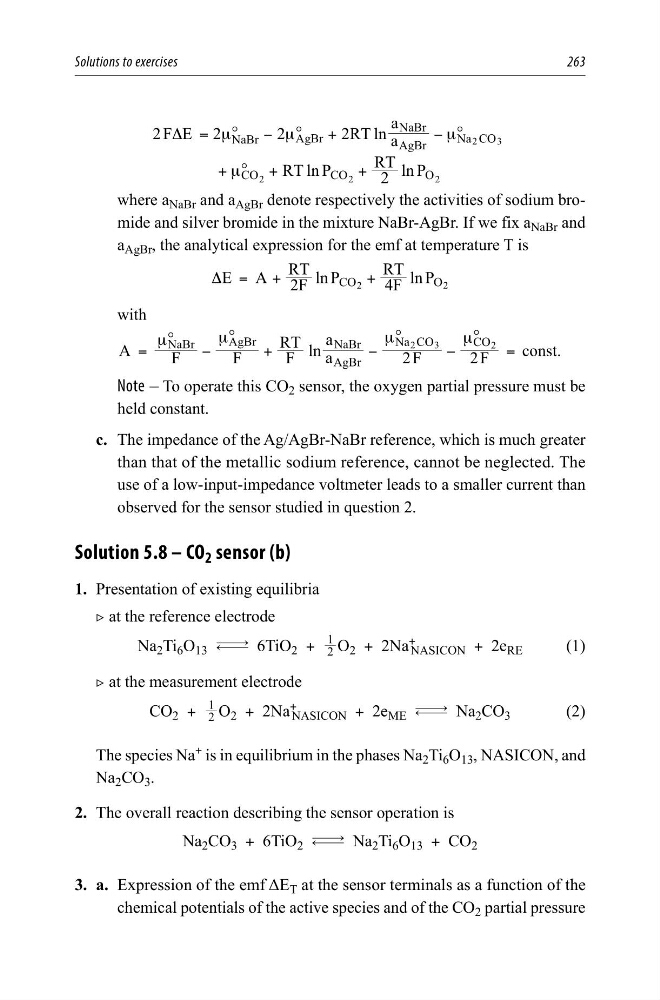
where a NaBr and a AgBr denote respectively the activities of sodium bromide and silver bromide in the mixture NaBr-AgBr. If we fix a NaBr and
a AgBr , the analytical expression for the emf at temperature T is
E A 2F
RT
ln P
4F
RT
ln P
CO
O
2
2
Δ = +
+
with
A
F
F
F
RT
ln a
a
2F
2F
const.
NaBr
AgBr
AgBr
NaBr
Na CO
CO
2
3
2
μ
μ
μ
μ
=
−
+
−
−
=
°
°
°
°
Note – To operate this CO 2 sensor, the oxygen partial pressure must be
held constant.
c. The impedance of the Ag/AgBr-NaBr reference, which is much greater
than that of the metallic sodium reference, cannot be neglected. The
use of a low-input-impedance voltmeter leads to a smaller current than
observed for the sensor studied in question 2.
Solution 5.8 – CO 2 sensor (b)
1. Presentation of existing equilibria
2 at the reference electrode
Na 2 Ti 6 O 13 m 6TiO 2 + 2
1
O 2 + 2Na
+
NASICON + 2e RE
(1)
2 at the measurement electrode
CO 2 + 2
1
O 2 + 2Na
+
NASICON + 2e ME m Na 2 CO 3
(2)
The species Na
+
is in equilibrium in the phases Na 2 Ti 6 O 13 , NASICON, and
Na 2 CO 3 .
2. The overall reaction describing the sensor operation is
Na 2 CO 3 + 6TiO 2 m Na 2 Ti 6 O 13 + CO 2
3. a. Expression of the emf ΔE T at the sensor terminals as a function of the
chemical potentials of the active species and of the CO 2 partial pressure
263
2F E 2
2
2 RT ln a
a
RT ln P
2
RT
ln P
NaBr
AgBr
AgBr
NaBr
Na CO
CO
CO
O
2
3
2
2
2
μ
μ
μ
μ
Δ =
−
+
−
+
+
+
°
°
°
°
where a NaBr and a AgBr denote respectively the activities of sodium bromide and silver bromide in the mixture NaBr-AgBr. If we fix a NaBr and
a AgBr , the analytical expression for the emf at temperature T is
E A 2F
RT
ln P
4F
RT
ln P
CO
O
2
2
Δ = +
+
with
A
F
F
F
RT
ln a
a
2F
2F
const.
NaBr
AgBr
AgBr
NaBr
Na CO
CO
2
3
2
μ
μ
μ
μ
=
−
+
−
−
=
°
°
°
°
Note – To operate this CO 2 sensor, the oxygen partial pressure must be
held constant.
c. The impedance of the Ag/AgBr-NaBr reference, which is much greater
than that of the metallic sodium reference, cannot be neglected. The
use of a low-input-impedance voltmeter leads to a smaller current than
observed for the sensor studied in question 2.
Solution 5.8 – CO 2 sensor (b)
1. Presentation of existing equilibria
2 at the reference electrode
Na 2 Ti 6 O 13 m 6TiO 2 + 2
1
O 2 + 2Na
+
NASICON + 2e RE
(1)
2 at the measurement electrode
CO 2 + 2
1
O 2 + 2Na
+
NASICON + 2e ME m Na 2 CO 3
(2)
The species Na
+
is in equilibrium in the phases Na 2 Ti 6 O 13 , NASICON, and
Na 2 CO 3 .
2. The overall reaction describing the sensor operation is
Na 2 CO 3 + 6TiO 2 m Na 2 Ti 6 O 13 + CO 2
3. a. Expression of the emf ΔE T at the sensor terminals as a function of the
chemical potentials of the active species and of the CO 2 partial pressure