

258
5 – Applications
F
F
AgCl
e
Ag1
(1)
2
1 Cl
e
Ag2
(2)
Ag
2
μ
μ
ϕ
μ
μ
ϕ
μ
+
−
=
+
−
+
F
(2)
(1)
2
1 Cl
Ag
AgCl
2
ϕ
ϕ
μ
μ
μ
−
=
+
−
^
h
Because Ag (s) and AgCl (s) form distinct solid phases, we obtain
F
l n P
(2)
(1)
2
1 Cl
2
RT
Cl
Ag
AgCl
2
2
ϕ
ϕ
μ
μ
μ
−
=
+
+
−
°
°
°
^
h
The emf E
(2)
(1)
ϕ
ϕ
Δ =
−
at the chain terminals is expressed as
E
F
1
2
1
2F
RT
ln P
Ag
Cl
AgCl
Cl
2
2
μ
μ
μ
Δ =
+
−
°
°
°
8
B
with P Cl 2 in bars.
b. The mixture Ag-AgCl plays the role of reference electrode.
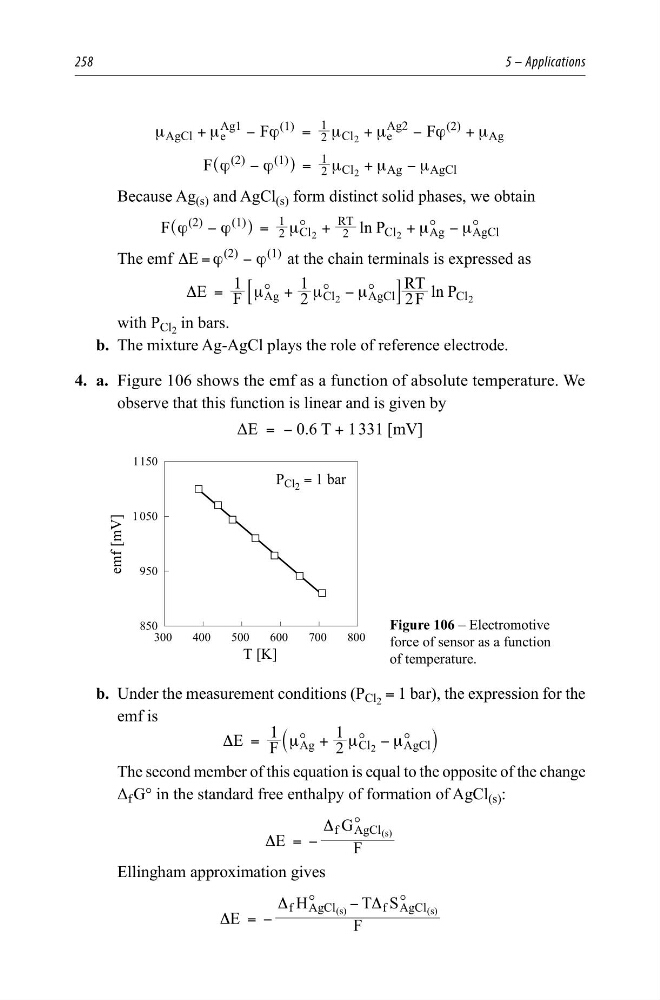
4. a. Figure 106 shows the emf as a function of absolute temperature. We
observe that this function is linear and is given by
ΔE = − 0.6 T + 1 331 [mV]
Figure 106 – Electromotive
force of sensor as a function
of temperature.
b. Under the measurement conditions (P Cl 2 = 1 bar), the expression for the
emf is
E
F
1
2
1
Ag
Cl
AgCl
2
μ
μ
μ
Δ =
+
−
°
°
°
`
j
The second member of this equation is equal to the opposite of the change
Δ f G° in the standard free enthalpy of formation of AgCl (s) :
E
F
G
f AgCl (s)
Δ
Δ
= −
°
Ellingham approximation gives
E
F
H
T S
f AgCl
f AgCl
(s)
( s)
Δ
Δ
Δ
= −
−
°
°
850
950
1 050
1 150
300
400
500
600
700
800
T [K]
emf [mV]
P Cl 2 = 1 bar
5 – Applications
F
F
AgCl
e
Ag1
(1)
2
1 Cl
e
Ag2
(2)
Ag
2
μ
μ
ϕ
μ
μ
ϕ
μ
+
−
=
+
−
+
F
(2)
(1)
2
1 Cl
Ag
AgCl
2
ϕ
ϕ
μ
μ
μ
−
=
+
−
^
h
Because Ag (s) and AgCl (s) form distinct solid phases, we obtain
F
l n P
(2)
(1)
2
1 Cl
2
RT
Cl
Ag
AgCl
2
2
ϕ
ϕ
μ
μ
μ
−
=
+
+
−
°
°
°
^
h
The emf E
(2)
(1)
ϕ
ϕ
Δ =
−
at the chain terminals is expressed as
E
F
1
2
1
2F
RT
ln P
Ag
Cl
AgCl
Cl
2
2
μ
μ
μ
Δ =
+
−
°
°
°
8
B
with P Cl 2 in bars.
b. The mixture Ag-AgCl plays the role of reference electrode.
4. a. Figure 106 shows the emf as a function of absolute temperature. We
observe that this function is linear and is given by
ΔE = − 0.6 T + 1 331 [mV]
Figure 106 – Electromotive
force of sensor as a function
of temperature.
b. Under the measurement conditions (P Cl 2 = 1 bar), the expression for the
emf is
E
F
1
2
1
Ag
Cl
AgCl
2
μ
μ
μ
Δ =
+
−
°
°
°
`
j
The second member of this equation is equal to the opposite of the change
Δ f G° in the standard free enthalpy of formation of AgCl (s) :
E
F
G
f AgCl (s)
Δ
Δ
= −
°
Ellingham approximation gives
E
F
H
T S
f AgCl
f AgCl
(s)
( s)
Δ
Δ
Δ
= −
−
°
°
850
950
1 050
1 150
300
400
500
600
700
800
T [K]
emf [mV]
P Cl 2 = 1 bar