

256
5 – Applications
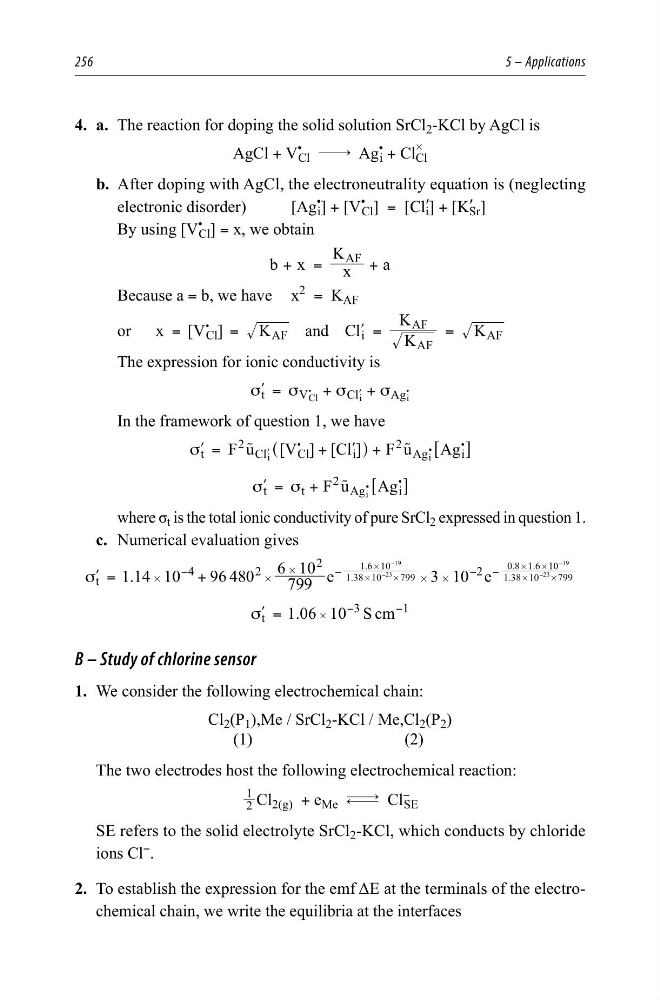
4. a. The reaction for doping the solid solution SrCl 2 -KCl by AgCl is
AgCl + V
•
Cl $ Ag
•
i + Cl
#
Cl
b. After doping with AgCl, the electroneutrality equation is (neglecting
electronic disorder)
[Ag
•
i ] + [V
•
Cl ] = [Cl ′
i ] + [K ′
Sr ]
By using [V
•
Cl ] = x, we obtain
b x
x
K
a
AF
+ =
+
Because a = b, we have x
2 = K AF
or
[ ]
x
V
K
and Cl
K
K
K
Cl
AF
i
AF
AF
AF
=
=
=
=
:
l
The expression for ionic conductivity is
t
V
Cl
Ag
Cl
i
i
σ
σ
σ
σ
=
+
+
:
:
l
l
In the framework of question 1, we have
F u
[V ] [Cl ] F u
Ag
t
2 Cl
Cl
i
2 Ag
i
i
i
•
σ =
+
+
:
:
l
l
l
u
u
^
h
6 @
F u
Ag
t
t
2 Ag
i
i
•
σ
σ
=
+
:
l
u 6 @
where σ t is the total ionic conductivity of pure SrCl 2 expressed in question 1.
c. Numerical evaluation gives
1.14 10
96 480
799
6 10
e
3 10 e
t
4
2
2
2
1.38 10
799
1.6 10
1.38 10
799
0.8 1.6 10
23
19
23
19
σ =
+
−
−
− −
#
#
#
#
#
#
#
#
#
#
#
#
−
−
−
−
l
1.06 10 S cm
t
3
1
σ =
−
−
#
l
B – Study of chlorine sensor
1. We consider the following electrochemical chain:
Cl 2 (P 1 ),Me / SrCl 2 -KCl / Me,Cl 2 (P 2 )
(1)
(2)
The two electrodes host the following electrochemical reaction:
2
1
Cl 2(g) + e Me m Cl
−
SE
SE refers to the solid electrolyte SrCl 2 -KCl, which conducts by chloride
ions Cl
−
.
2. To establish the expression for the emf ΔE at the terminals of the electrochemical chain, we write the equilibria at the interfaces
5 – Applications
4. a. The reaction for doping the solid solution SrCl 2 -KCl by AgCl is
AgCl + V
•
Cl $ Ag
•
i + Cl
#
Cl
b. After doping with AgCl, the electroneutrality equation is (neglecting
electronic disorder)
[Ag
•
i ] + [V
•
Cl ] = [Cl ′
i ] + [K ′
Sr ]
By using [V
•
Cl ] = x, we obtain
b x
x
K
a
AF
+ =
+
Because a = b, we have x
2 = K AF
or
[ ]
x
V
K
and Cl
K
K
K
Cl
AF
i
AF
AF
AF
=
=
=
=
:
l
The expression for ionic conductivity is
t
V
Cl
Ag
Cl
i
i
σ
σ
σ
σ
=
+
+
:
:
l
l
In the framework of question 1, we have
F u
[V ] [Cl ] F u
Ag
t
2 Cl
Cl
i
2 Ag
i
i
i
•
σ =
+
+
:
:
l
l
l
u
u
^
h
6 @
F u
Ag
t
t
2 Ag
i
i
•
σ
σ
=
+
:
l
u 6 @
where σ t is the total ionic conductivity of pure SrCl 2 expressed in question 1.
c. Numerical evaluation gives
1.14 10
96 480
799
6 10
e
3 10 e
t
4
2
2
2
1.38 10
799
1.6 10
1.38 10
799
0.8 1.6 10
23
19
23
19
σ =
+
−
−
− −
#
#
#
#
#
#
#
#
#
#
#
#
−
−
−
−
l
1.06 10 S cm
t
3
1
σ =
−
−
#
l
B – Study of chlorine sensor
1. We consider the following electrochemical chain:
Cl 2 (P 1 ),Me / SrCl 2 -KCl / Me,Cl 2 (P 2 )
(1)
(2)
The two electrodes host the following electrochemical reaction:
2
1
Cl 2(g) + e Me m Cl
−
SE
SE refers to the solid electrolyte SrCl 2 -KCl, which conducts by chloride
ions Cl
−
.
2. To establish the expression for the emf ΔE at the terminals of the electrochemical chain, we write the equilibria at the interfaces