

226
5 – Applications
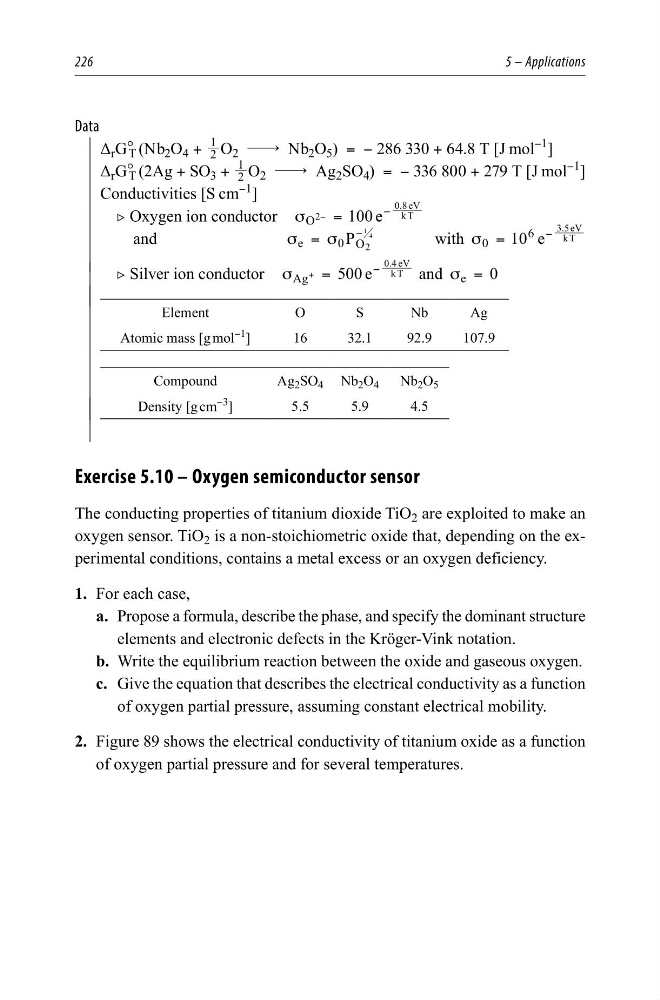
Data
Δ r G ° T (Nb 2 O 4 + 2
1
O 2 $ Nb 2 O 5 ) = − 286 330 + 64.8 T [J mol
−1
]
Δ r G ° T (2Ag + SO 3 + 2
1
O 2 $ Ag 2 SO 4 ) = − 336 800 + 279 T [J mol
−1
]
Conductivities [S cm
−1
]
2 Oxygen ion conductor
100 e
O 2
k T
0.8 eV
σ
=
−
−
and
P
e
0 O 2
1 4
σ
σ
=
−
with
10 e
0
6
k T
3.5 eV
σ =
−
2 Silver ion conductor
500 e
and
0
Ag
e
k T
0.4 eV
σ
σ
=
=
−
+
Element
O
S
Nb
Ag
Atomic mass [g mol
−1
]
16
32.1
92.9
107.9
Compound
Ag 2 SO 4 Nb 2 O 4 Nb 2 O 5
Density [g cm
−3
]
5.5
5.9
4.5
Exercise 5.10 – Oxygen semiconductor sensor
The conducting properties of titanium dioxide TiO 2 are exploited to make an
oxygen sensor. TiO 2 is a non-stoichiometric oxide that, depending on the experimental conditions, contains a metal excess or an oxygen deficiency.
1. For each case,
a. Propose a formula, describe the phase, and specify the dominant structure
elements and electronic defects in the Kröger-Vink notation.
b. Write the equilibrium reaction between the oxide and gaseous oxygen.
c. Give the equation that describes the electrical conductivity as a function
of oxygen partial pressure, assuming constant electrical mobility.
2. Figure 89 shows the electrical conductivity of titanium oxide as a function
of oxygen partial pressure and for several temperatures.
5 – Applications
Data
Δ r G ° T (Nb 2 O 4 + 2
1
O 2 $ Nb 2 O 5 ) = − 286 330 + 64.8 T [J mol
−1
]
Δ r G ° T (2Ag + SO 3 + 2
1
O 2 $ Ag 2 SO 4 ) = − 336 800 + 279 T [J mol
−1
]
Conductivities [S cm
−1
]
2 Oxygen ion conductor
100 e
O 2
k T
0.8 eV
σ
=
−
−
and
P
e
0 O 2
1 4
σ
σ
=
−
with
10 e
0
6
k T
3.5 eV
σ =
−
2 Silver ion conductor
500 e
and
0
Ag
e
k T
0.4 eV
σ
σ
=
=
−
+
Element
O
S
Nb
Ag
Atomic mass [g mol
−1
]
16
32.1
92.9
107.9
Compound
Ag 2 SO 4 Nb 2 O 4 Nb 2 O 5
Density [g cm
−3
]
5.5
5.9
4.5
Exercise 5.10 – Oxygen semiconductor sensor
The conducting properties of titanium dioxide TiO 2 are exploited to make an
oxygen sensor. TiO 2 is a non-stoichiometric oxide that, depending on the experimental conditions, contains a metal excess or an oxygen deficiency.
1. For each case,
a. Propose a formula, describe the phase, and specify the dominant structure
elements and electronic defects in the Kröger-Vink notation.
b. Write the equilibrium reaction between the oxide and gaseous oxygen.
c. Give the equation that describes the electrical conductivity as a function
of oxygen partial pressure, assuming constant electrical mobility.
2. Figure 89 shows the electrical conductivity of titanium oxide as a function
of oxygen partial pressure and for several temperatures.