

8
1 – Description of ionic crystals
in ionic crystals. Such defects are referred to as “intrinsic.” Foreign elements,
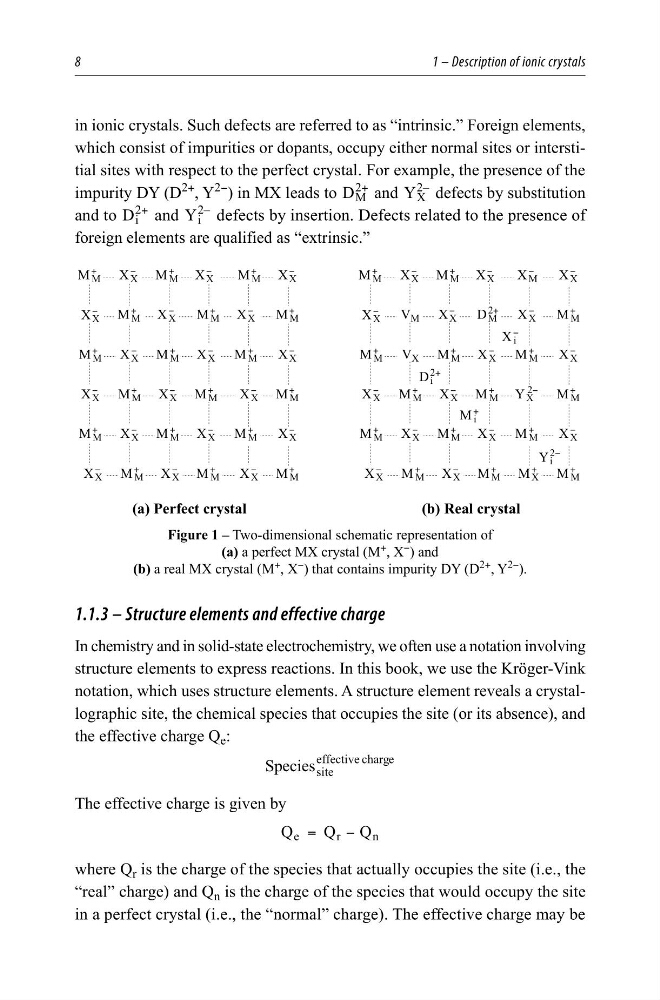
which consist of impurities or dopants, occupy either normal sites or interstitial sites with respect to the perfect crystal. For example, the presence of the
impurity DY (D
2+
, Y
2−
) in MX leads to D
2
M
+
and Y
2
X
–
defects by substitution
and to D
2
i
+
and Y
2
i
–
defects by insertion. Defects related to the presence of
foreign elements are qualified as “extrinsic.”
D3HUIHFWFU\VWDO
E5HDOFU\VWDO
' L
0
L
;
<
L
< L
<
0
0
;
<
;
0
0
;
<
;
;
<
0
;
<
;
9 0 ;
<
;
' 0
;
<
;
0
0
;
<
;
9 ; 0
0
;
<
;
0
0
;
<
;
0
0
0
0
;
<
;
0
0
< ;
<
0
0
;
<
;
;
<
;
0
0
;
<
;
0
0
;
<
;
0
0
0
0
;
<
;
0
0
0
;
0
0
;
<
;
0
0
;
<
;
0
0
0
0
;
<
;
;
<
;
;
<
;
;
<
;
0
0
0
0
0
0
;
<
;
0
0
;
<
;
;
<
;
0
0
;
<
;
0
0
0
0
;
<
;
;
<
;
0
0
0
0
;
<
;
;
<
;
0
0
;
<
;
0
0
;
<
;
0
0
0
0
;
<
;
;
<
;
0
0
0
0
;
<
;
Figure 1 – Two-dimensional schematic representation of
(a) a perfect MX crystal (M
+
, X
−
) and
(b) a real MX crystal (M
+
, X
−
) that contains impurity DY (D
2+
, Y
2−
).
1.1.3 – Structure elements and effective charge
In chemistry and in solid-state electrochemistry, we often use a notation involving
structure elements to express reactions. In this book, we use the Kröger-Vink
notation, which uses structure elements. A structure element reveals a crystallographic site, the chemical species that occupies the site (or its absence), and
the effective charge Q e :
Species
arg
site
effective ch e
The effective charge is given by
Q
Q Q
e
r
n
=
−
where Q r is the charge of the species that actually occupies the site (i.e., the
“real” charge) and Q n is the charge of the species that would occupy the site
in a perfect crystal (i.e., the “normal” charge). The effective charge may be
1 – Description of ionic crystals
in ionic crystals. Such defects are referred to as “intrinsic.” Foreign elements,
which consist of impurities or dopants, occupy either normal sites or interstitial sites with respect to the perfect crystal. For example, the presence of the
impurity DY (D
2+
, Y
2−
) in MX leads to D
2
M
+
and Y
2
X
–
defects by substitution
and to D
2
i
+
and Y
2
i
–
defects by insertion. Defects related to the presence of
foreign elements are qualified as “extrinsic.”
D3HUIHFWFU\VWDO
E5HDOFU\VWDO
' L
0
L
;
<
L
< L
<
0
0
;
<
;
0
0
;
<
;
;
<
0
;
<
;
9 0 ;
<
;
' 0
;
<
;
0
0
;
<
;
9 ; 0
0
;
<
;
0
0
;
<
;
0
0
0
0
;
<
;
0
0
< ;
<
0
0
;
<
;
;
<
;
0
0
;
<
;
0
0
;
<
;
0
0
0
0
;
<
;
0
0
0
;
0
0
;
<
;
0
0
;
<
;
0
0
0
0
;
<
;
;
<
;
;
<
;
;
<
;
0
0
0
0
0
0
;
<
;
0
0
;
<
;
;
<
;
0
0
;
<
;
0
0
0
0
;
<
;
;
<
;
0
0
0
0
;
<
;
;
<
;
0
0
;
<
;
0
0
;
<
;
0
0
0
0
;
<
;
;
<
;
0
0
0
0
;
<
;
Figure 1 – Two-dimensional schematic representation of
(a) a perfect MX crystal (M
+
, X
−
) and
(b) a real MX crystal (M
+
, X
−
) that contains impurity DY (D
2+
, Y
2−
).
1.1.3 – Structure elements and effective charge
In chemistry and in solid-state electrochemistry, we often use a notation involving
structure elements to express reactions. In this book, we use the Kröger-Vink
notation, which uses structure elements. A structure element reveals a crystallographic site, the chemical species that occupies the site (or its absence), and
the effective charge Q e :
Species
arg
site
effective ch e
The effective charge is given by
Q
Q Q
e
r
n
=
−
where Q r is the charge of the species that actually occupies the site (i.e., the
“real” charge) and Q n is the charge of the species that would occupy the site
in a perfect crystal (i.e., the “normal” charge). The effective charge may be