

Exercises
213
1. Give the reaction that involves anionic Frenkel disorder.
2. To increase the ionic conductivity of CaF 2 , we dope it by adding sodium
fluoride NaF or yttrium fluoride YF 3 . Given that the cationic species relative
to the dopant occupies a substitution site, write for each case the reaction
for introducing the dopant into CaF 2 .
3. CaF 2 reacts with water vapor to liberate gaseous hydrogen fluoride HF. State
the reaction given that the atomic species are introduced into substitution
sites.
4. Give two examples of complexes that may be formed in each type of solid
solution obtained in questions 2 and 3. Give the corresponding equilibrium
reactions and the effective charge of the complex obtained.
5. The solid solution (CaF 2 ) 0.99 (NaF) 0.01 is a solid that conducts via fluoride
ions F
−
. Use this to determine the free enthalpy of formation of a metal
fluoride with formula MF 2 at 1 000 K. To do this, consider the following
electrochemical chain:
Pt,Ni-NiF 2 / (CaF 2 ) 0.99 (NaF) 0.01 / M-MF 2 ,Pt
I
II
The fluorine pressure created by the Ni-NiF 2 mixture in compartment I is
7.4 # 10
−39
bar at 1 000 K. The electromotive force ΔE measured between
the terminals of the chain is 0.794 V, with the nickel electrode being positive.
a. Calculate the fluorine partial pressure imposed by the M-MF 2 pair.
b. Deduce the standard free enthalpy of formation of MF 2 at 1 000 K.
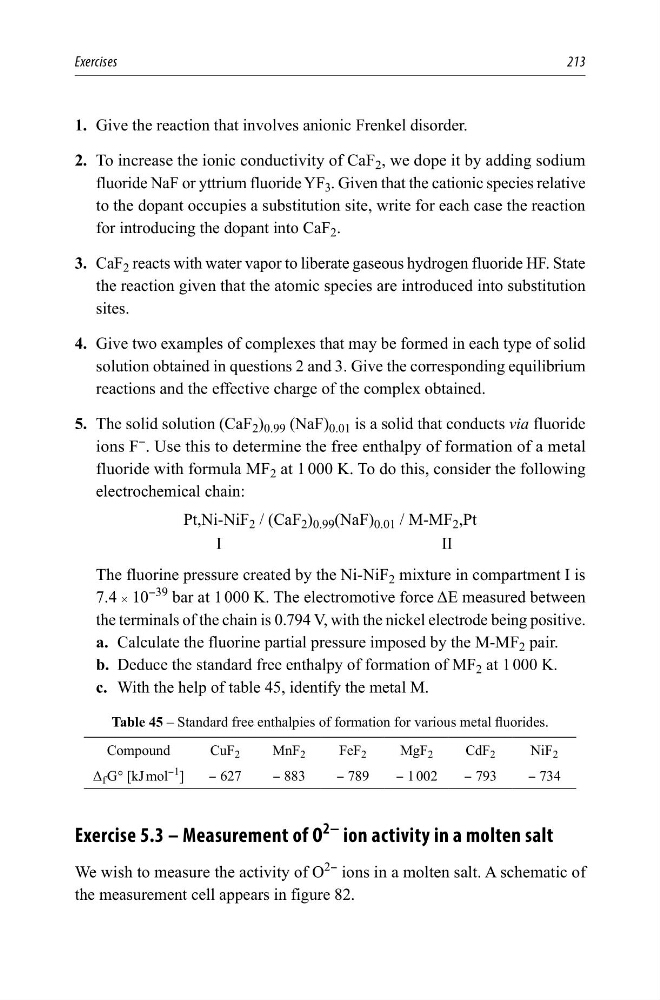
c. With the help of table 45, identify the metal M.
Table 45 – Standard free enthalpies of formation for various metal fluorides.
Compound
CuF 2
MnF 2
FeF 2
MgF 2
CdF 2
NiF 2
Δ f G° [kJ mol
−1
]
− 627
− 883
− 789
− 1 002
− 793
− 734
Exercise 5.3 – Measurement of O
2−
ion activity in a molten salt
We wish to measure the activity of O
2−
ions in a molten salt. A schematic of
the measurement cell appears in figure 82.
213
1. Give the reaction that involves anionic Frenkel disorder.
2. To increase the ionic conductivity of CaF 2 , we dope it by adding sodium
fluoride NaF or yttrium fluoride YF 3 . Given that the cationic species relative
to the dopant occupies a substitution site, write for each case the reaction
for introducing the dopant into CaF 2 .
3. CaF 2 reacts with water vapor to liberate gaseous hydrogen fluoride HF. State
the reaction given that the atomic species are introduced into substitution
sites.
4. Give two examples of complexes that may be formed in each type of solid
solution obtained in questions 2 and 3. Give the corresponding equilibrium
reactions and the effective charge of the complex obtained.
5. The solid solution (CaF 2 ) 0.99 (NaF) 0.01 is a solid that conducts via fluoride
ions F
−
. Use this to determine the free enthalpy of formation of a metal
fluoride with formula MF 2 at 1 000 K. To do this, consider the following
electrochemical chain:
Pt,Ni-NiF 2 / (CaF 2 ) 0.99 (NaF) 0.01 / M-MF 2 ,Pt
I
II
The fluorine pressure created by the Ni-NiF 2 mixture in compartment I is
7.4 # 10
−39
bar at 1 000 K. The electromotive force ΔE measured between
the terminals of the chain is 0.794 V, with the nickel electrode being positive.
a. Calculate the fluorine partial pressure imposed by the M-MF 2 pair.
b. Deduce the standard free enthalpy of formation of MF 2 at 1 000 K.
c. With the help of table 45, identify the metal M.
Table 45 – Standard free enthalpies of formation for various metal fluorides.
Compound
CuF 2
MnF 2
FeF 2
MgF 2
CdF 2
NiF 2
Δ f G° [kJ mol
−1
]
− 627
− 883
− 789
− 1 002
− 793
− 734
Exercise 5.3 – Measurement of O
2−
ion activity in a molten salt
We wish to measure the activity of O
2−
ions in a molten salt. A schematic of
the measurement cell appears in figure 82.