

Solutions to exercises
203
Solution 4.6 – Hydrogen oxidation at Ni / YSZ interface
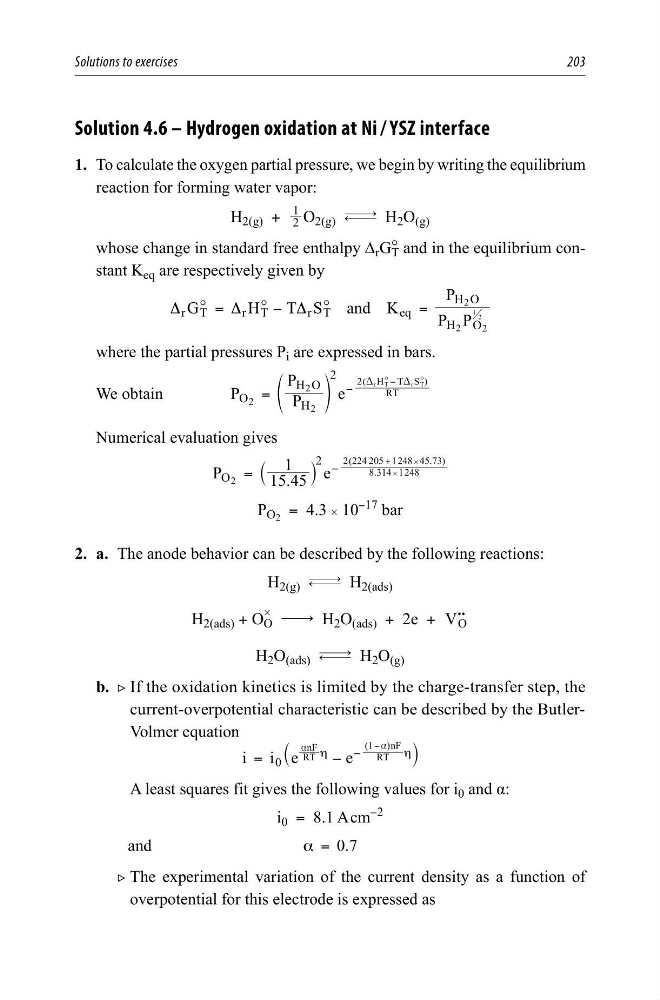
1. To calculate the oxygen partial pressure, we begin by writing the equilibrium
reaction for forming water vapor:
H 2(g) + 2
1
O 2(g) m H 2 O (g)
whose change in standard free enthalpy ∆ r G ° T and in the equilibrium constant K eq are respectively given by
G
H
T S and K
P P
P
r T
r T
r T
eq
H O
H O
2
2
2
1 2
Δ
Δ
Δ
=
−
=
°
°
°
where the partial pressures P i are expressed in bars.
We obtain
P
P
P
e
O
H
H O
2
2
2
2
RT
2( H T S )
r T
r T
=
−
D
D
−
°
°
e
o
Numerical evaluation gives
.
P
e
15 45
1
O
2
.
(
.)
2
8 314 1248
2 224 205 1248 45 73
=
−
#
#
+
`
j
P O 2 = 4.3 # 10
−17
bar
2. a. The anode behavior can be described by the following reactions:
H 2(g) m H 2(ads)
H 2(ads) + O
#
O $ H 2 O (ads) + 2e + V O
::
H 2 O (ads) m H 2 O (g)
b. 2 If the oxidation kinetics is limited by the charge-transfer step, the
current-overpotential characteristic can be described by the ButlerVolmer equation
i i e
e
0
RT
nF
RT
(1 )nF
=
−
η
η
−
a
a
−
`
j
A least squares fit gives the following values for i 0 and α:
i 0 = 8.1 A cm
−2
and
0.7
α =
2 The experimental variation of the current density as a function of
overpotential for this electrode is expressed as
203
Solution 4.6 – Hydrogen oxidation at Ni / YSZ interface
1. To calculate the oxygen partial pressure, we begin by writing the equilibrium
reaction for forming water vapor:
H 2(g) + 2
1
O 2(g) m H 2 O (g)
whose change in standard free enthalpy ∆ r G ° T and in the equilibrium constant K eq are respectively given by
G
H
T S and K
P P
P
r T
r T
r T
eq
H O
H O
2
2
2
1 2
Δ
Δ
Δ
=
−
=
°
°
°
where the partial pressures P i are expressed in bars.
We obtain
P
P
P
e
O
H
H O
2
2
2
2
RT
2( H T S )
r T
r T
=
−
D
D
−
°
°
e
o
Numerical evaluation gives
.
P
e
15 45
1
O
2
.
(
.)
2
8 314 1248
2 224 205 1248 45 73
=
−
#
#
+
`
j
P O 2 = 4.3 # 10
−17
bar
2. a. The anode behavior can be described by the following reactions:
H 2(g) m H 2(ads)
H 2(ads) + O
#
O $ H 2 O (ads) + 2e + V O
::
H 2 O (ads) m H 2 O (g)
b. 2 If the oxidation kinetics is limited by the charge-transfer step, the
current-overpotential characteristic can be described by the ButlerVolmer equation
i i e
e
0
RT
nF
RT
(1 )nF
=
−
η
η
−
a
a
−
`
j
A least squares fit gives the following values for i 0 and α:
i 0 = 8.1 A cm
−2
and
0.7
α =
2 The experimental variation of the current density as a function of
overpotential for this electrode is expressed as