

Solutions to exercises
199
v ads = Γ
2
[k ads P O 2 (1 − θ)
2 − k des θ
2
]
(2)
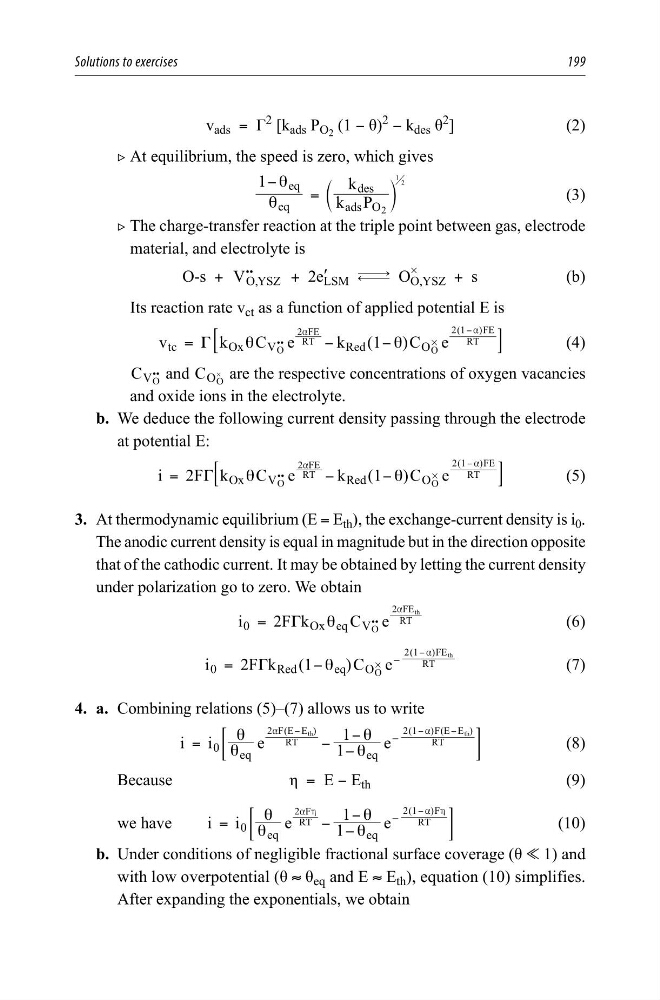
2 At equilibrium, the speed is zero, which gives
1
k P
k
eq
eq
ads O
des
2
1 2
θ
θ
−
= c
m
(3)
2 The charge-transfer reaction at the triple point between gas, electrode
material, and electrolyte is
O-s + V ,
O YSZ
::
+ 2e ′
LSM m O
#
O,YSZ + s
(b)
Its reaction rate v ct as a function of applied potential E is
v
k
C e
k (1 )C e
tc
Ox
V
R ed
O
O
••
RT
2 FE
O
RT
2(1 )FE
θ
θ
Γ
=
−
−
#
a
a
−
8
B
(4)
C V O
•• and C O O
# are the respective concentrations of oxygen vacancies
and oxide ions in the electrolyte.
b. We deduce the following current density passing through the electrode
at potential E:
i 2F k
C e
k (1 )C e
Ox
V
R ed
O
O
••
RT
2 FE
O
RT
2(1 )FE
θ
θ
Γ
=
−
−
#
a
a
−
8
B
(5)
3. At thermodynamic equilibrium (E = E th ), the exchange-current density is i 0 .
The anodic current density is equal in magnitude but in the direction opposite
that of the cathodic current. It may be obtained by letting the current density
under polarization go to zero. We obtain
i
2F k
C e
0
O x eq V O
••
RT
2 FE th
θ
Γ
=
a
(6)
i
2F k (1
)C e
0
R ed
eq
O O
RT
2(1 )FE th
θ
Γ
=
−
−
#
a
−
(7)
4. a. Combining relations (5)–(7) allows us to write
i i
e
1
1
e
0
eq
eq
RT
2 F(E E )
RT
2(1 )F(E E )
th
th
θ
θ
θ
θ
=
− −
−
−
a
a
−
−
−
;
E
(8)
Because
η = E − E th
(9)
we have
i i
e
1
1
e
0
eq
eq
RT
2 F
RT
2(1 )F
θ
θ
θ
θ
=
− −
−
−
a h
a h
−
;
E
(10)
b. Under conditions of negligible fractional surface coverage (θ % 1) and
with low overpotential (θ ≈ θ eq and E ≈ E th ), equation (10) simplifies.
After expanding the exponentials, we obtain
199
v ads = Γ
2
[k ads P O 2 (1 − θ)
2 − k des θ
2
]
(2)
2 At equilibrium, the speed is zero, which gives
1
k P
k
eq
eq
ads O
des
2
1 2
θ
θ
−
= c
m
(3)
2 The charge-transfer reaction at the triple point between gas, electrode
material, and electrolyte is
O-s + V ,
O YSZ
::
+ 2e ′
LSM m O
#
O,YSZ + s
(b)
Its reaction rate v ct as a function of applied potential E is
v
k
C e
k (1 )C e
tc
Ox
V
R ed
O
O
••
RT
2 FE
O
RT
2(1 )FE
θ
θ
Γ
=
−
−
#
a
a
−
8
B
(4)
C V O
•• and C O O
# are the respective concentrations of oxygen vacancies
and oxide ions in the electrolyte.
b. We deduce the following current density passing through the electrode
at potential E:
i 2F k
C e
k (1 )C e
Ox
V
R ed
O
O
••
RT
2 FE
O
RT
2(1 )FE
θ
θ
Γ
=
−
−
#
a
a
−
8
B
(5)
3. At thermodynamic equilibrium (E = E th ), the exchange-current density is i 0 .
The anodic current density is equal in magnitude but in the direction opposite
that of the cathodic current. It may be obtained by letting the current density
under polarization go to zero. We obtain
i
2F k
C e
0
O x eq V O
••
RT
2 FE th
θ
Γ
=
a
(6)
i
2F k (1
)C e
0
R ed
eq
O O
RT
2(1 )FE th
θ
Γ
=
−
−
#
a
−
(7)
4. a. Combining relations (5)–(7) allows us to write
i i
e
1
1
e
0
eq
eq
RT
2 F(E E )
RT
2(1 )F(E E )
th
th
θ
θ
θ
θ
=
− −
−
−
a
a
−
−
−
;
E
(8)
Because
η = E − E th
(9)
we have
i i
e
1
1
e
0
eq
eq
RT
2 F
RT
2(1 )F
θ
θ
θ
θ
=
− −
−
−
a h
a h
−
;
E
(10)
b. Under conditions of negligible fractional surface coverage (θ % 1) and
with low overpotential (θ ≈ θ eq and E ≈ E th ), equation (10) simplifies.
After expanding the exponentials, we obtain