

Solutions to exercises
193
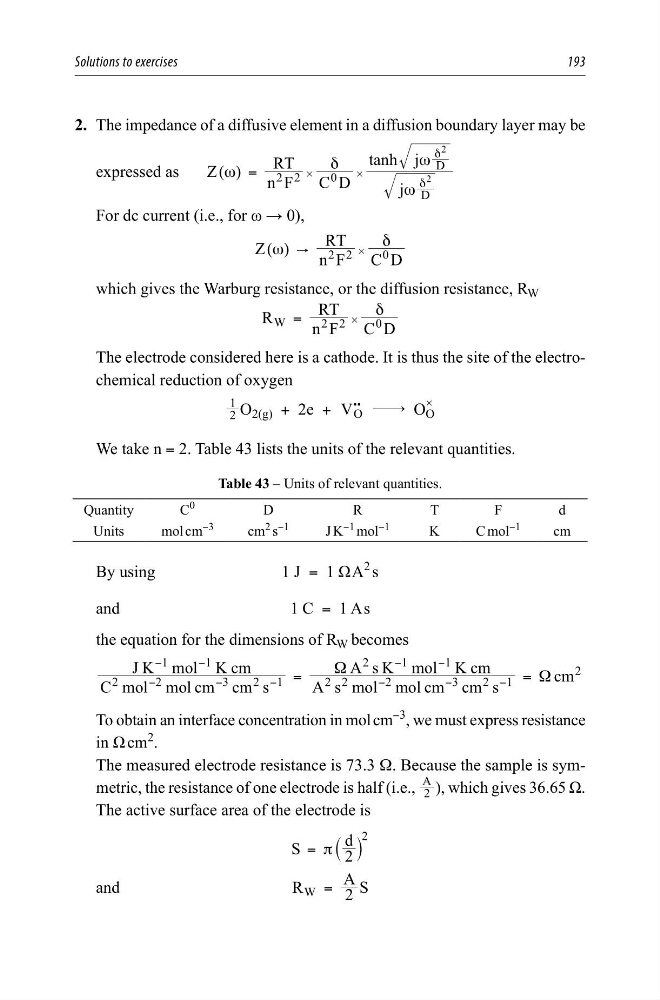
2. The impedance of a diffusive element in a diffusion boundary layer may be
expressed as
Z( )
n F
RT
C D
j
tanh j
2 2
0
D
D
2
2
ω
δ
ω
ω
=
δ
δ
#
#
For dc current (i.e., for ω → 0),
Z( )
n F
RT
C D
2 2
0
"
ω
δ
#
which gives the Warburg resistance, or the diffusion resistance, R W
R
n F
RT
C D
W
2 2
0
δ
=
#
The electrode considered here is a cathode. It is thus the site of the electrochemical reduction of oxygen
2
1
O 2(g) + 2e + V O
::
$ O
#
O
We take n = 2. Table 43 lists the units of the relevant quantities.
Table 43 – Units of relevant quantities.
Quantity
C
0
D
R
T
F
d
Units
mol cm
−3
cm
2
s
−1
J K
−1
mol
−1
K
C mol
−1
cm
By using
1 J = 1 Ω A
2
s
and
1 C = 1 A s
the equation for the dimensions of R W becomes
C mol mol cm cm s
J K mol K cm
A s mol mol cm cm s
A s K mol K cm
cm
2
2
3
2 1
1
1
2 2
2
3
2 1
2
1
1
2
Ω
Ω
=
=
−
−
−
−
−
−
−
−
−
−
To obtain an interface concentration in mol cm
−3
, we must express resistance
in Ω cm
2
.
The measured electrode resistance is 73.3 Ω. Because the sample is symmetric, the resistance of one electrode is half (i.e.,
A
2 ), which gives 36.65 Ω.
The active surface area of the electrode is
S
2
d 2
π
= ` j
and
R
A
S
2
W =
193
2. The impedance of a diffusive element in a diffusion boundary layer may be
expressed as
Z( )
n F
RT
C D
j
tanh j
2 2
0
D
D
2
2
ω
δ
ω
ω
=
δ
δ
#
#
For dc current (i.e., for ω → 0),
Z( )
n F
RT
C D
2 2
0
"
ω
δ
#
which gives the Warburg resistance, or the diffusion resistance, R W
R
n F
RT
C D
W
2 2
0
δ
=
#
The electrode considered here is a cathode. It is thus the site of the electrochemical reduction of oxygen
2
1
O 2(g) + 2e + V O
::
$ O
#
O
We take n = 2. Table 43 lists the units of the relevant quantities.
Table 43 – Units of relevant quantities.
Quantity
C
0
D
R
T
F
d
Units
mol cm
−3
cm
2
s
−1
J K
−1
mol
−1
K
C mol
−1
cm
By using
1 J = 1 Ω A
2
s
and
1 C = 1 A s
the equation for the dimensions of R W becomes
C mol mol cm cm s
J K mol K cm
A s mol mol cm cm s
A s K mol K cm
cm
2
2
3
2 1
1
1
2 2
2
3
2 1
2
1
1
2
Ω
Ω
=
=
−
−
−
−
−
−
−
−
−
−
To obtain an interface concentration in mol cm
−3
, we must express resistance
in Ω cm
2
.
The measured electrode resistance is 73.3 Ω. Because the sample is symmetric, the resistance of one electrode is half (i.e.,
A
2 ), which gives 36.65 Ω.
The active surface area of the electrode is
S
2
d 2
π
= ` j
and
R
A
S
2
W =