

Solutions to exercises
191
b. Given the expressions for the overpotential η and the activity X i , we can
write
2F
RT
ln 1 2FSX j D
I
0
η
ω
=
+
c
m
Near equilibrium (I = 0), the polynomial approximation of ln(1 + x) = x
allows us to write
2F
RT
2FSX j D
I
0
η
ω
=
#
4 2 F S
RT
X
1
D
1 j I
2
0
η
ω
=
−
#
#
#
4. a. The impedance Z of the electrode is expressed as
Z
4 2 F S
RT
X
1
D
1 j
2
0
ω
=
−
#
#
which we can write in the form
Z = σ W ω
−½
(1 −j )
This is a Warburg impedance that varies with ω
− ½
and with a Warburg
coefficient of
4 2 F S
RT
X
1
D
1
W
2
0
σ =
#
#
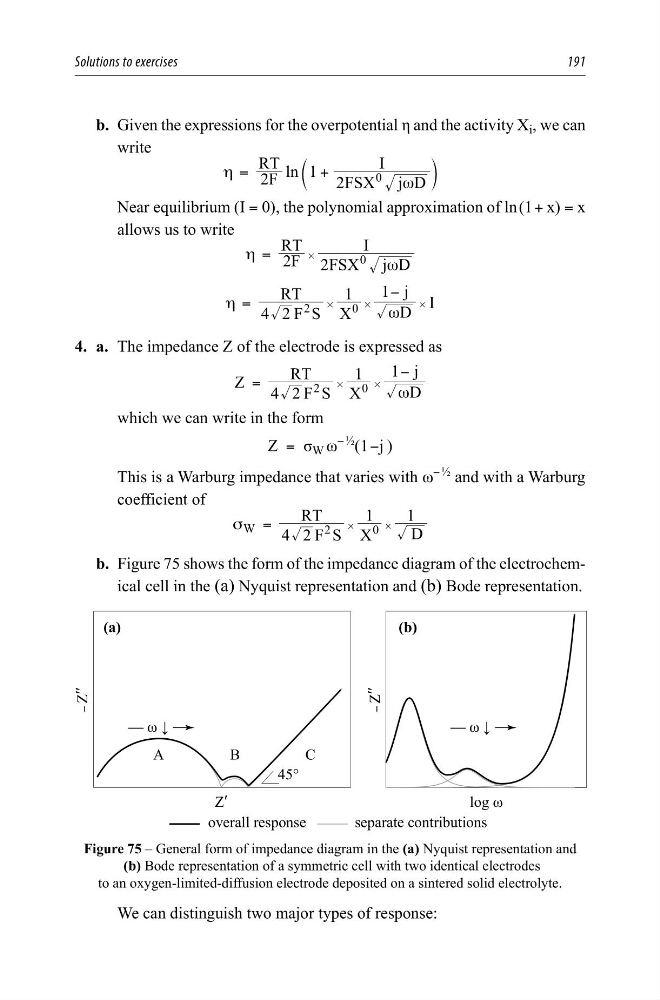
b. Figure 75 shows the form of the impedance diagram of the electrochemical cell in the (a) Nyquist representation and (b) Bode representation.
= ƍ
<= ƍƍ
<= ƍƍ
²ȦĻ
$
%
&
D
ORJȦ
E
RYHUDOOUHVSRQVHVHSDUDWHFRQWULEXWLRQV
²ȦĻ
Figure 75 – General form of impedance diagram in the (a) Nyquist representation and
(b) Bode representation of a symmetric cell with two identical electrodes
to an oxygen-limited-diffusion electrode deposited on a sintered solid electrolyte.
We can distinguish two major types of response:
191
b. Given the expressions for the overpotential η and the activity X i , we can
write
2F
RT
ln 1 2FSX j D
I
0
η
ω
=
+
c
m
Near equilibrium (I = 0), the polynomial approximation of ln(1 + x) = x
allows us to write
2F
RT
2FSX j D
I
0
η
ω
=
#
4 2 F S
RT
X
1
D
1 j I
2
0
η
ω
=
−
#
#
#
4. a. The impedance Z of the electrode is expressed as
Z
4 2 F S
RT
X
1
D
1 j
2
0
ω
=
−
#
#
which we can write in the form
Z = σ W ω
−½
(1 −j )
This is a Warburg impedance that varies with ω
− ½
and with a Warburg
coefficient of
4 2 F S
RT
X
1
D
1
W
2
0
σ =
#
#
b. Figure 75 shows the form of the impedance diagram of the electrochemical cell in the (a) Nyquist representation and (b) Bode representation.
= ƍ
<= ƍƍ
<= ƍƍ
²ȦĻ
$
%
&
D
ORJȦ
E
RYHUDOOUHVSRQVHVHSDUDWHFRQWULEXWLRQV
²ȦĻ
Figure 75 – General form of impedance diagram in the (a) Nyquist representation and
(b) Bode representation of a symmetric cell with two identical electrodes
to an oxygen-limited-diffusion electrode deposited on a sintered solid electrolyte.
We can distinguish two major types of response: