

Solutions to exercises
Solution 4.1 – Oxygen-diffusion-limited electrode
1. The reaction mechanisms to reduce oxygen lead to the following successive
steps:
2 diffusion in the gaseous phase and dissociative adsorption at the surface
of the electrode material
O 2(g) + 2s $ 2O-s
rapid
where s is an adsorption site.
2 a charge-transfer reaction at the surface of the electrode material
O-s + 2e + V O
::
$ O
#
O + s
rapid
2 diffusion of the species O
#
O (O
2−
) into the solid electrode
slow
2 exchange at the interface
O
#
O (electrode) $ O
#
O (electrolyte)
rapid
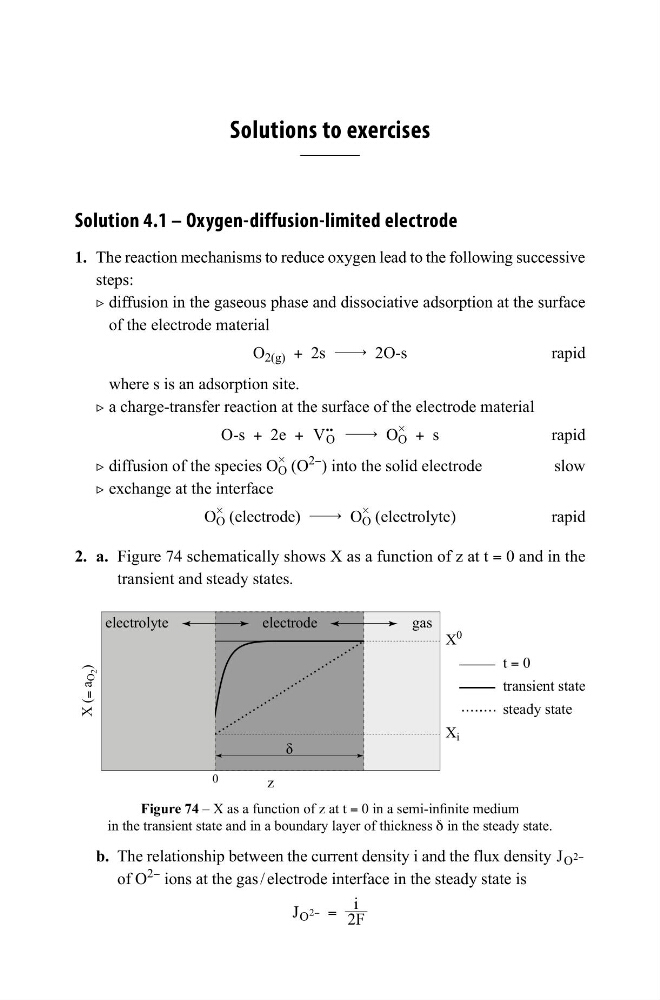
2. a. Figure 74 schematically shows X as a function of z at t = 0 and in the
transient and steady states.
HOHFWURO\WH
;D
2
;
; L
]
į
W
WUDQVLHQWVWDWH
VWHDG\VWDWH
HOHFWURGH
JDV
Figure 74 – X as a function of z at t = 0 in a semi-infinite medium
in the transient state and in a boundary layer of thickness d in the steady state.
b. The relationship between the current density i and the flux density J O 2−
of O
2−
ions at the gas / electrode interface in the steady state is
J
F
i
2
O 2 =
−
Solution 4.1 – Oxygen-diffusion-limited electrode
1. The reaction mechanisms to reduce oxygen lead to the following successive
steps:
2 diffusion in the gaseous phase and dissociative adsorption at the surface
of the electrode material
O 2(g) + 2s $ 2O-s
rapid
where s is an adsorption site.
2 a charge-transfer reaction at the surface of the electrode material
O-s + 2e + V O
::
$ O
#
O + s
rapid
2 diffusion of the species O
#
O (O
2−
) into the solid electrode
slow
2 exchange at the interface
O
#
O (electrode) $ O
#
O (electrolyte)
rapid
2. a. Figure 74 schematically shows X as a function of z at t = 0 and in the
transient and steady states.
HOHFWURO\WH
;D
2
;
; L
]
į
W
WUDQVLHQWVWDWH
VWHDG\VWDWH
HOHFWURGH
JDV
Figure 74 – X as a function of z at t = 0 in a semi-infinite medium
in the transient state and in a boundary layer of thickness d in the steady state.
b. The relationship between the current density i and the flux density J O 2−
of O
2−
ions at the gas / electrode interface in the steady state is
J
F
i
2
O 2 =
−