

Exercises
187
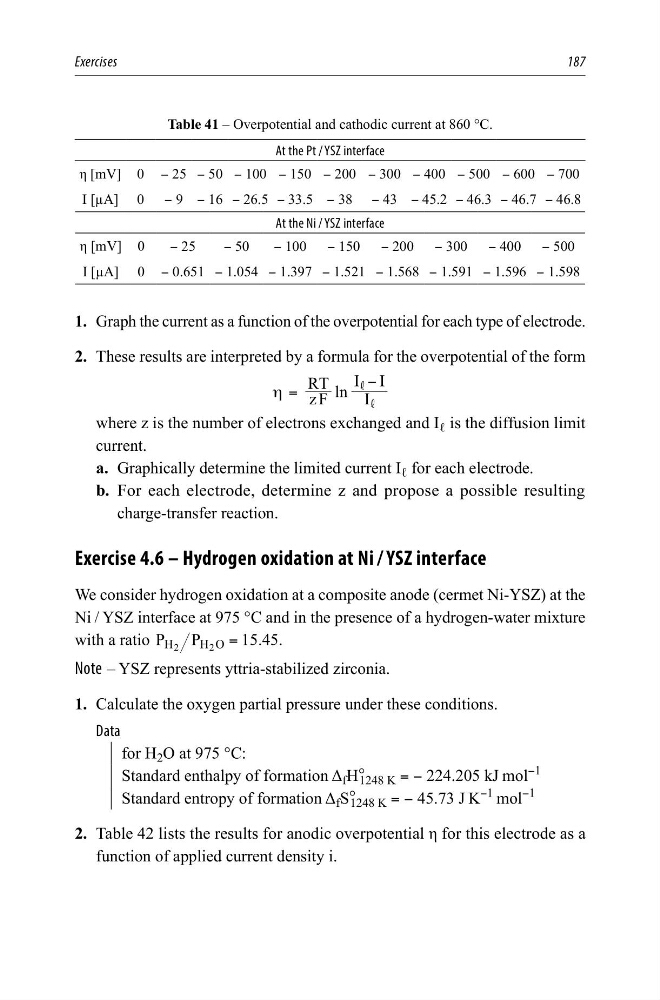
Table 41 – Overpotential and cathodic current at 860 °C.
At the Pt / YSZ interface
η [mV] 0 − 25 − 50 − 100 − 150 − 200 − 300 − 400 − 500 − 600 − 700
I [µA] 0 − 9 − 16 − 26.5 − 33.5 − 38 − 43 − 45.2 − 46.3 − 46.7 − 46.8
At the Ni / YSZ interface
η [mV] 0
− 25
− 50
− 100 − 150 − 200 − 300 − 400 − 500
I [µA] 0 − 0.651 − 1.054 − 1.397 − 1.521 − 1.568 − 1.591 − 1.596 − 1.598
1. Graph the current as a function of the overpotential for each type of electrode.
2. These results are interpreted by a formula for the overpotential of the form
z F
RT
ln I
I I
η =
−
,
,
where z is the number of electrons exchanged and I ℓ is the diffusion limit
current.
a. Graphically determine the limited current I ℓ for each electrode.
b. For each electrode, determine z and propose a possible resulting
charge-transfer reaction.
Exercise 4.6 – Hydrogen oxidation at Ni / YSZ interface
We consider hydrogen oxidation at a composite anode (cermet Ni-YSZ) at the
Ni / YSZ interface at 975 °C and in the presence of a hydrogen-water mixture
with a ratio
. .
P
P
15 45
H
H O
2
2
=
Note – YSZ represents yttria-stabilized zirconia.
1. Calculate the oxygen partial pressure under these conditions.
Data
for H 2 O at 975 °C:
Standard enthalpy of formation Δ f H ° 1248 K = − 224.205 kJ mol
−1
Standard entropy of formation Δ f S ° 1248 K = − 45.73 J K
−1
mol
−1
2. Table 42 lists the results for anodic overpotential η for this electrode as a
function of applied current density i.
187
Table 41 – Overpotential and cathodic current at 860 °C.
At the Pt / YSZ interface
η [mV] 0 − 25 − 50 − 100 − 150 − 200 − 300 − 400 − 500 − 600 − 700
I [µA] 0 − 9 − 16 − 26.5 − 33.5 − 38 − 43 − 45.2 − 46.3 − 46.7 − 46.8
At the Ni / YSZ interface
η [mV] 0
− 25
− 50
− 100 − 150 − 200 − 300 − 400 − 500
I [µA] 0 − 0.651 − 1.054 − 1.397 − 1.521 − 1.568 − 1.591 − 1.596 − 1.598
1. Graph the current as a function of the overpotential for each type of electrode.
2. These results are interpreted by a formula for the overpotential of the form
z F
RT
ln I
I I
η =
−
,
,
where z is the number of electrons exchanged and I ℓ is the diffusion limit
current.
a. Graphically determine the limited current I ℓ for each electrode.
b. For each electrode, determine z and propose a possible resulting
charge-transfer reaction.
Exercise 4.6 – Hydrogen oxidation at Ni / YSZ interface
We consider hydrogen oxidation at a composite anode (cermet Ni-YSZ) at the
Ni / YSZ interface at 975 °C and in the presence of a hydrogen-water mixture
with a ratio
. .
P
P
15 45
H
H O
2
2
=
Note – YSZ represents yttria-stabilized zirconia.
1. Calculate the oxygen partial pressure under these conditions.
Data
for H 2 O at 975 °C:
Standard enthalpy of formation Δ f H ° 1248 K = − 224.205 kJ mol
−1
Standard entropy of formation Δ f S ° 1248 K = − 45.73 J K
−1
mol
−1
2. Table 42 lists the results for anodic overpotential η for this electrode as a
function of applied current density i.