

154
3 – Transport in ionic solids
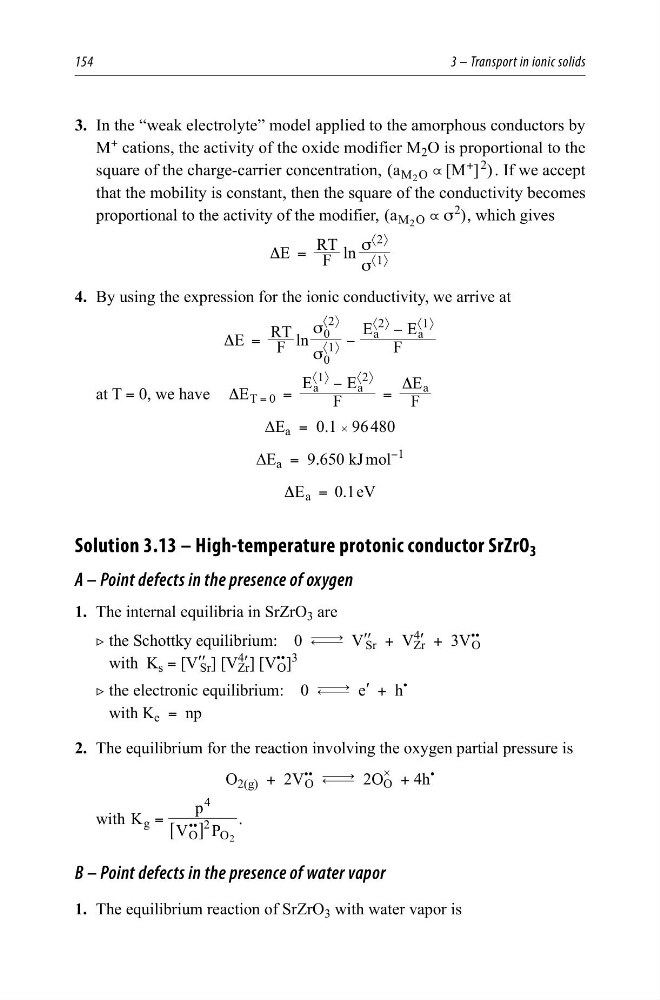
3. In the “weak electrolyte” model applied to the amorphous conductors by
M
+
cations, the activity of the oxide modifier M 2 O is proportional to the
square of the charge-carrier concentration, (a
[M ] )
M O
2
2
\
+
. If we accept
that the mobility is constant, then the square of the conductivity becomes
proportional to the activity of the modifier, (a
)
M O
2
2
\ σ , which gives
E
F
RT
ln 1
2
σ
σ
Δ =
4. By using the expression for the ionic conductivity, we arrive at
E
F
RT
ln
F
E
E
0
1
0
2
a
2
a
1
σ
σ
Δ =
−
−
at T = 0, we have
E
F
E
E
F
E
T 0
a
1
a
2
a
Δ
Δ
=
−
=
=
∆E a = 0.1 # 96 480
∆E a = 9.650 kJ mol
−1
E
0.1eV
a
Δ =
Solution 3.13 – High-temperature protonic conductor SrZrO 3
A – Point defects in the presence of oxygen
1. The internal equilibria in SrZrO 3 are
2 the Schottky equilibrium: 0 m V ′′ Sr + V
4 ′
Zr + 3V
••
O
with K s = [V ′′ Sr ] [V
4 ′
Zr ] [V
••
O ]
3
2 the electronic equilibrium: 0 m e ′ + h
•
with K e = np
2. The equilibrium for the reaction involving the oxygen partial pressure is
O 2(g) + 2V
••
O m 2O
#
O + 4h
•
with
.
K
V P
p
g
O
O
2
4
••
2
=
6 @
B – Point defects in the presence of water vapor
1. The equilibrium reaction of SrZrO 3 with water vapor is
3 – Transport in ionic solids
3. In the “weak electrolyte” model applied to the amorphous conductors by
M
+
cations, the activity of the oxide modifier M 2 O is proportional to the
square of the charge-carrier concentration, (a
[M ] )
M O
2
2
\
+
. If we accept
that the mobility is constant, then the square of the conductivity becomes
proportional to the activity of the modifier, (a
)
M O
2
2
\ σ , which gives
E
F
RT
ln 1
2
σ
σ
Δ =
4. By using the expression for the ionic conductivity, we arrive at
E
F
RT
ln
F
E
E
0
1
0
2
a
2
a
1
σ
σ
Δ =
−
−
at T = 0, we have
E
F
E
E
F
E
T 0
a
1
a
2
a
Δ
Δ
=
−
=
=
∆E a = 0.1 # 96 480
∆E a = 9.650 kJ mol
−1
E
0.1eV
a
Δ =
Solution 3.13 – High-temperature protonic conductor SrZrO 3
A – Point defects in the presence of oxygen
1. The internal equilibria in SrZrO 3 are
2 the Schottky equilibrium: 0 m V ′′ Sr + V
4 ′
Zr + 3V
••
O
with K s = [V ′′ Sr ] [V
4 ′
Zr ] [V
••
O ]
3
2 the electronic equilibrium: 0 m e ′ + h
•
with K e = np
2. The equilibrium for the reaction involving the oxygen partial pressure is
O 2(g) + 2V
••
O m 2O
#
O + 4h
•
with
.
K
V P
p
g
O
O
2
4
••
2
=
6 @
B – Point defects in the presence of water vapor
1. The equilibrium reaction of SrZrO 3 with water vapor is